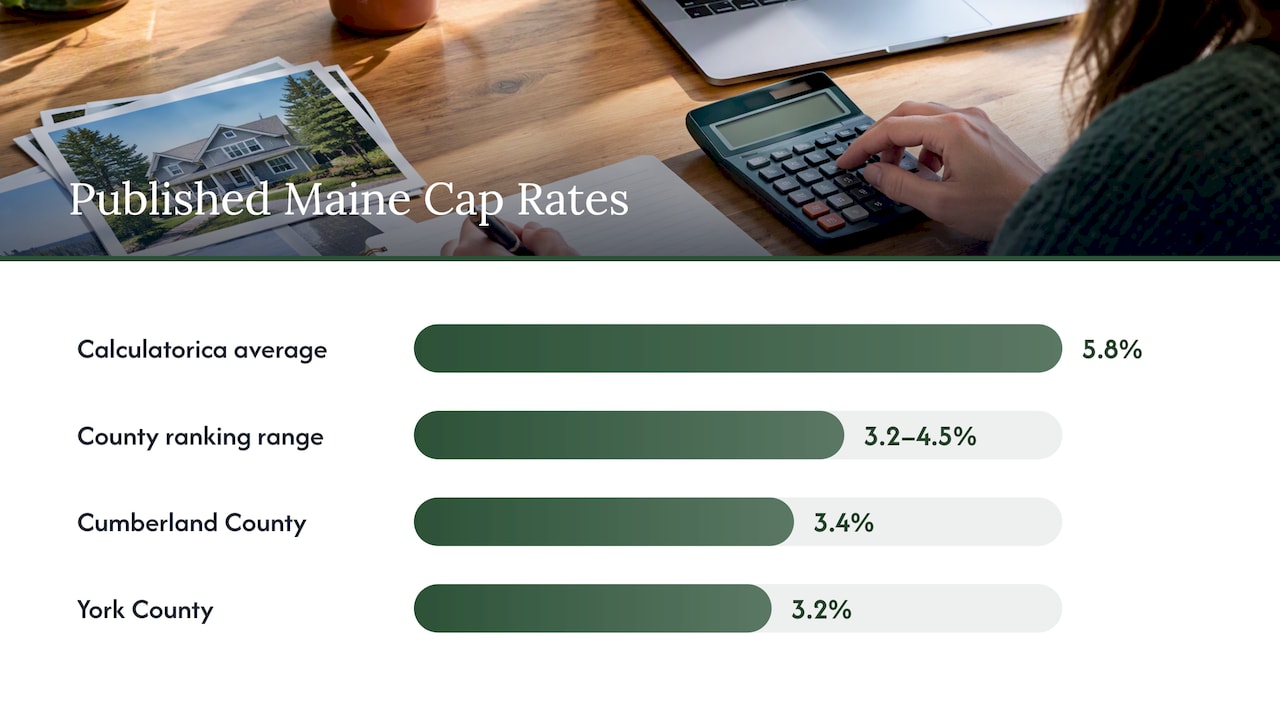
Maine cap rates for small residential rentals mostly land in the mid-single digits, and on paper they run lower in the pricey southern counties than in the northern and central ones. One published model puts the state average at 5.8%. A county-by-county ranking built from median prices and rents shows 3.2% to 4.5%. That gap is the point of this guide: a cap rate is only as good as the income and expense numbers behind it, and in Maine those numbers swing by town, by heating system and by tax bill.
Below you’ll find the formula, a worked duplex example, the figures published for Maine, and the Maine-specific costs that change your NOI before you make an offer.
TL;DR
- Cap rate is net operating income divided by the property’s current market value. Mortgage payments and income taxes stay out of NOI.
- Published Maine figures disagree: 5.8% statewide in one model, 3.2% to 4.5% by county in another. Treat any state average as a rough guide, not a target.
- Property taxes, heating, roofs, septic and wells decide whether a Maine rental really earns its cap rate.
- Run the numbers on the actual building, with real rents and real tax bills, before you rely on a headline percentage.
Table of Contents
- What a cap rate tells you (and what it doesn’t)
- How to calculate NOI and cap rate for a Maine rental
- What cap rates are published for Maine?
- Is 5% a good cap rate? Is 7.6%?
- Maine costs that move your NOI
- Local income sets the rent ceiling
- Our perspective: cap rate is the start of the conversation
- Working with a Maine Realtor on an investment purchase
- A short checklist before you trust a cap rate
- FAQ
- Sources
What a cap rate tells you (and what it doesn’t)
The capitalization rate is a snapshot of a property’s yearly return if you bought it with cash. The standard formula is Cap Rate = Net Operating Income ÷ Current Market Value.
Because it ignores financing, it lets you compare a duplex in Lewiston with a four-unit in Bangor without arguing about interest rates or down payments. It also means a cap rate does not tell you your cash-on-cash return, your monthly cash flow after a loan, or how much the building will appreciate.
It is also sensitive. The same source warns that a small error in NOI or value makes the result invalid, so treat it as a starting point for valuation, not a verdict. A cap rate does not replace an appraisal or a thorough inspection.
How to calculate NOI and cap rate for a Maine rental
Start with gross potential rent for a full year. Subtract a vacancy allowance. Then subtract every operating expense the owner pays: property taxes, insurance, maintenance, management, utilities the landlord covers, and a reserve for big repairs. The research behind the formula is explicit that debt service and income taxes are excluded.

A common first-time mistake is subtracting the mortgage payment. That distorts the cap rate because the metric is meant to be unleveraged.
A worked example: a hypothetical duplex
This is an illustration, not a listing. Say you are looking at a two-unit house priced at $400,000, with each unit renting for $2,000 a month. For the property tax line, we use Bangor’s 2026 mill rate of $17.70 per $1,000 as a stand-in. Your town’s rate will differ.
| Line | Annual amount |
|---|---|
| Gross potential rent (2 × $2,000 × 12) | $48,000 |
| Vacancy allowance (5%) | -$2,400 |
| Effective gross income | $45,600 |
| Property taxes ($400,000 × 17.70 ÷ 1,000) | -$7,080 |
| Insurance | -$1,800 |
| Repairs and maintenance | -$2,400 |
| Capital reserve (roof, boiler, paving) | -$2,400 |
| Management (8% of effective income) | -$3,648 |
| Landlord-paid water, sewer, common utilities | -$1,500 |
| Net operating income | $26,772 |
Cap rate: $26,772 ÷ $400,000 = 6.7%.
Now change one assumption. If the seller’s listing shows taxes at last year’s lower assessment and you correct for a reassessment, or if you add a realistic $4,000 for heating oil in a unit where the landlord pays heat, NOI drops to $22,772 and the cap rate to 5.7%. One line moved the answer by a full point. That is why the expense side deserves more of your time than the rent side.
If you are building an expense line for turnover costs, a landlord turnover checklist helps you see what each re-lease actually involves, so your vacancy and repair allowances come from a list rather than a guess.
What cap rates are published for Maine?
No single number is correct, because each source builds it differently. Here is what two public tools show.
| Source | Figure | How it is built |
|---|---|---|
| Calculatorica, updated March 1, 2026 | 5.8% average | Median value of $370,000, one-bedroom rent of $14,400 a year, estimated NOI of $8,640 |
| RentalCalcs county ranking | 3.2% (York, Hancock) to 4.5% (Aroostook, Somerset) | Median price and median rent per county, with operating costs set at 35% of rent |
Two things stand out. First, the inputs are medians, so they describe a typical house, not the building you are bidding on. Second, the county ranking assumes a median home is rented as a single-family unit. Small multifamily buildings often price better against their rent than a single-family house does, which is part of why investors look at duplexes and triplexes.
The county data does show a consistent pattern: the higher the median price, the lower the modeled cap rate. In that ranking, Cumberland County at 3.4% and York County at 3.2% sit near the bottom, while Aroostook, Somerset and Penobscot sit near the top. Buyers in southern Maine are often paying for appreciation, demand and a deep tenant pool, not for yield.
Is 5% a good cap rate? Is 7.6%?
It depends on the asset and your tolerance for risk. A 5% cap rate can be strong for a high-quality asset in a stable, low-risk market, while an investor who needs immediate cash flow in a tertiary market might want closer to 8% to 10%.
In Maine terms, a few rules of thumb we use when talking with investors:
- Below 5% on a typical rental: you are betting on appreciation or on a below-market rent you can raise. Check the rent roll and lease terms closely.
- 5% to 7%: a workable range for well-kept small multifamily in a town with steady demand, as long as your expense lines are honest.
- 7.6% and above: look for the reason. It may be a bargain, or it may be deferred maintenance, a failing septic system, underreported expenses or weak rental demand.
A high cap rate with a 40-year-old roof and a tired boiler is not a high cap rate. It is a deferred bill.
Maine costs that move your NOI
National formulas do not know how Maine houses work. These are the lines we tell buyers to pressure-test.
Property taxes and reassessment
Maine taxes are set town by town through a mill rate, and a sale can lead to a reassessment. Use the current tax bill as a floor, then ask the town assessor how recent sales are affecting values. Our guide to Maine property taxes and the homestead exemption explains how the rules work. The homestead exemption applies to an owner’s primary residence, so do not assume it will reduce the taxes on a rental.
Heat, roofs and mechanicals
In a cold-climate state, who pays for heat changes everything. Oil, propane, heat pumps and wood all price differently. Add a capital reserve line for roofs, heating systems, septic systems, wells, decks and appliances, which is also the approach one Maine investment property guide does not need to tell you twice: those items fail, and they are expensive. A professional inspection is the best way to size the reserve, and our checklist on vetting Maine home inspectors shows what to ask before you hire one.
Septic, wells and shoreline
Lakefront and camp properties can have attractive rents or seasonal income but unusual compliance costs. Before you count on that income, read our checks for Maine lakefront property and for buying a camp, including septic, permits and access.
Short-term rental rules
A nightly-rental income projection can inflate a cap rate fast. Local rules differ by municipality, and Portland has its own registration and tax regime. We cover them in our piece on Portland, Maine rental rules and due diligence. Confirm the permitted use with the municipality before you underwrite any short-term income.
Tenants already in place
Buying an occupied building means inheriting leases and deposit obligations. Review how deposits and tenant-occupied sales work at closing before you accept a seller’s rent roll at face value.
Local income sets the rent ceiling
Rent has to be paid out of local paychecks. Maine’s per capita personal income was $71,662 in 2025, up 4.2% from 2024, which remains below the U.S. average of $76,393. That does not cap rents everywhere, but it explains why rent growth in Aroostook or Somerset County tends to have less room than in Portland, where demand is deeper. When you project rent increases, tie them to what tenants in that town can afford, not to a state or national average.
In the larger markets, commercial brokers have written about renter demand. A Colliers midyear review of Maine multifamily, dated August 2023, described Portland as a long-term hold even as renter demand showed signs of cooling. That report is older, so use it for context, not for current pricing.
Our perspective: cap rate is the start of the conversation
We have spent 20 years helping buyers and sellers across central and southern Maine, and the pattern with investors is consistent. People fall in love with a percentage and skip the building. A 7% cap rate on a spreadsheet feels like a win. Then the inspection turns up a failing roof, the town reassesses after the sale, or the seller’s “actual” rents turn out to be one tenant’s best month.
Our approach is to be transparent and unhurried. We pull comparable sales, check the tax record, ask for twelve months of rent deposits and utility bills, and run the cap rate three ways: the seller’s version, a conservative version and a realistic one. If the three numbers are close, the deal is easy to trust. If they are far apart, that spread is your negotiation.
We also remind buyers that appraisals matter when you finance. If the number comes in under your price, our guide to requesting a reconsideration of value explains your options before you cover any gap out of pocket. And in a competitive market, our notes on multiple offers in Maine help you decide how much room you really have.
The best cap rate is the one you can defend line by line.
— David
Working with a Maine Realtor on an investment purchase
If you are weighing a rental, a small multifamily or a seasonal property, we can help you screen listings, build a cap rate on the real numbers and negotiate from them. Our services cover buying, selling, investment property and vacation or seasonal property across central and southern Maine, with data-driven pricing and availability beyond standard hours. Tell us your budget and your target return, and we will tell you honestly whether the market can deliver it.
A short checklist before you trust a cap rate
- Get 12 months of actual rent collected, not asking rents.
- Replace the seller’s tax figure with a projection that accounts for possible reassessment.
- List who pays heat, water, sewer, trash and snow removal.
- Add a capital reserve based on the age of the roof, boiler, septic and well.
- Confirm permitted use and any short-term rental rules with the town.
- Leave out mortgage payments and income taxes, then check the result against your target.
- Compare with recent sales of similar buildings in the same town.
FAQ
How do I calculate cap rates?
Divide net operating income by the property’s current market value. NOI is rental income minus operating expenses such as taxes, insurance, maintenance, management and vacancy, and it excludes mortgage payments and income taxes. For a $400,000 building with $26,772 of NOI, the cap rate is 6.7%.
What is a good cap rate in Maine?
There is no single number. Published Maine figures range from about 3.2% to 4.5% by county for median single-family rentals to a 5.8% state average in another model. A good rate is one that holds up after you verify taxes, repairs and actual rents for the specific building.
Is 5% a good cap rate?
It can be, in a stable market with a high-quality asset, according to industry guidance. Buyers who need strong immediate cash flow in smaller markets often look for more. Compare it with local comparable sales and with your financing costs.
Should I include my mortgage in NOI?
No. Cap rate is an unleveraged measure, so debt service stays out. Use cash-on-cash return to see how financing affects what you actually earn.
Sources
- Cap Rate and Net Operating Income (NOI) in Real Estate Investment
- Cap Rate for Maine (2026), Calculatorica
- Best Places to Buy Rental Property in Maine (2026), RentalCalcs
- Cost of Being a Landlord Maine: 9 Real Costs for 2026
- Maine’s Economic Year in Review: 2025
- Maine Multifamily Midyear Review, Colliers