Appraisal gap coverage is a promise in your offer to pay cash, up to a stated amount, if the home appraises below the contract price. Your lender will only lend against the appraised value, so the clause tells the seller you will make up the difference yourself instead of walking away or asking for a lower price. In Maine’s competitive towns it can make an offer stronger. It can also cost you real money, so it needs a cap you chose on purpose.
Below is how the gap works, what it can cost, how to protect yourself, and how we advise buyers across central and southern Maine to decide.
TL;DR
- An appraisal gap is the difference between the contract price and the appraised value. The lender typically reduces the loan to match the appraisal, so you cover the shortfall in cash or renegotiate.
- Gap coverage is a capped promise written into your offer. Cap it at an amount you could lose without regret, and keep it separate from your down payment and closing cash.
- If you think the appraisal is wrong, ask your lender for a Reconsideration of Value before you pay anything.
- Gap coverage makes most sense when the home is priced fairly and you have cash beyond your minimums. It makes little sense when the list price already sits above what comparable sales support.
Table of Contents
- What an appraisal gap is, in plain numbers
- What gap coverage looks like in an offer
- When a gap clause makes sense in Maine
- When to skip it
- If the appraisal comes in low: your steps
- Who is most exposed to a gap
- Our perspective: price first, clause second
- Working with a Realtor on a competitive offer
- Frequently asked questions
- Sources
What an appraisal gap is, in plain numbers
When you finance a home, the lender orders an appraisal from a licensed appraiser. Maine’s licensing board describes an appraisal as an opinion of value prepared by a state licensed or certified appraiser following national standards. It is an opinion built from comparable sales, not a fact like a tax bill.
Here is a made-up example to show the arithmetic. It is not a real Maine sale.
| Item | Amount |
|---|---|
| Contract price | $400,000 |
| Appraised value | $385,000 |
| Appraisal gap | $15,000 |
| Down payment you planned (5%) | $20,000 |
The lender bases the loan on the appraised value, not the contract price. If you planned a 5% down payment, the lender now calculates it on $385,000, so the loan is smaller than you expected. To close at $400,000 you need your planned down payment plus the whole $15,000 gap, in cash, on top of closing costs. That is why the gap lands so hard on first-time buyers who budgeted close to their limit.
What gap coverage looks like in an offer
There are three common ways the gap can be handled once a low appraisal comes back:
- The seller lowers the price. The contract is amended to the appraised value, or to a number between the two.
- You split it. The seller drops part of the gap and you bring cash for the rest.
- You pay the gap. You keep the original price and cover the difference in cash.
Gap coverage simply decides option three in advance. A typical clause says the buyer will pay up to a stated dollar amount above the appraised value, and only if the appraisal falls short. Anything beyond that cap reopens negotiation, and your other contingencies still decide whether you can leave.
Two details matter in how the clause is worded:
- A fixed cap, not a percentage you have not calculated. Write a dollar figure you have already tested against your savings.
- Whether the clause replaces your appraisal contingency. Covering a gap is not the same as waiving the contingency. Waiving it means you may lose your deposit if the deal fails over value. Your agent and a Maine real estate attorney should review the exact language before you sign, because it changes your legal position.
When a gap clause makes sense in Maine
We do not recommend gap coverage as a reflex. We recommend it when four things are true.
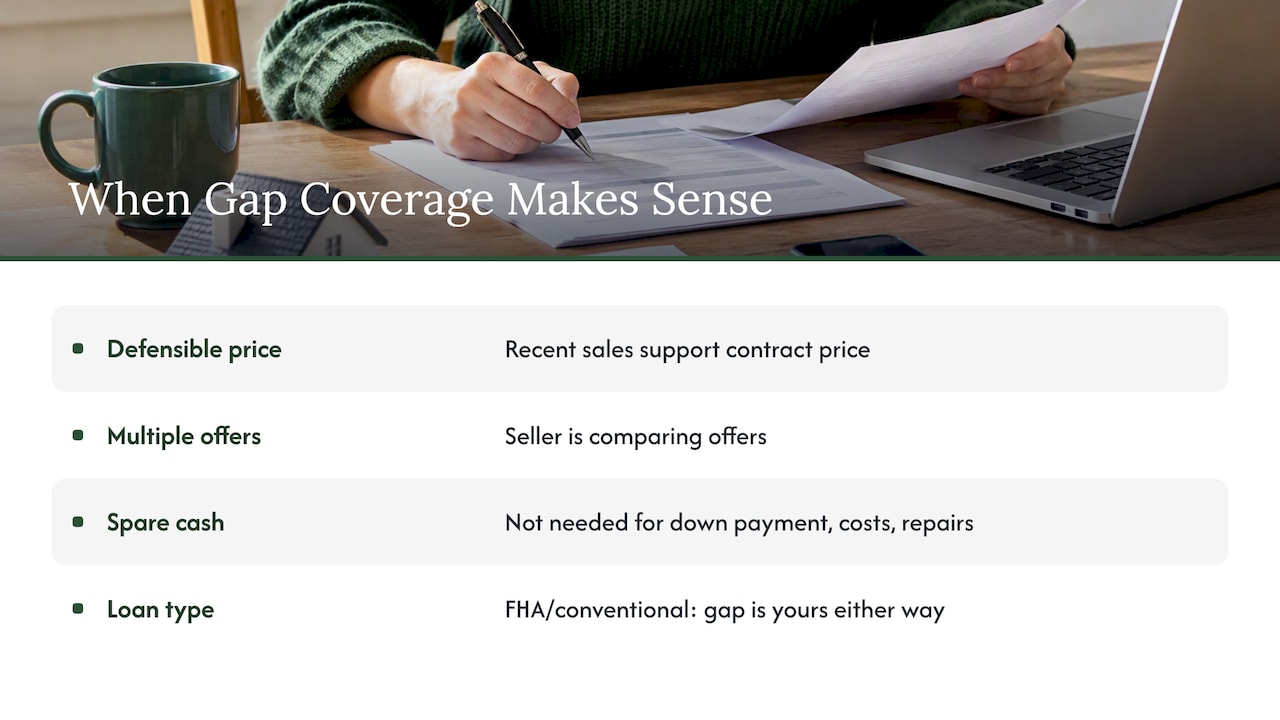
The price is defensible. Before we write a gap clause we pull comparable sales and run a comparative market analysis. If the recent sold prices support the contract price, the chance of a gap is small and the clause costs you little. If the home is listed well above recent sales, the clause is a bet against the appraiser. Our piece on why a number like $424,550 is only a starting point in Maine explains how a list price and a supportable value come apart.
You are in a real multiple-offer situation. A gap clause only helps when the seller is comparing offers. Our look at multiple offers in Maine covers how sellers weigh price, financing strength, and contingencies, because a clean financing profile can sometimes beat a higher number.
You have cash that is truly spare. Money you promise for a gap must not be the money you need for the down payment, closing costs, or a repair reserve. Our guide to Maine closing costs for buyers and sellers is a good place to total those costs first.
Your loan type tolerates it. FHA and conventional loans both lend against the lesser of price or value, so the gap is yours either way. The difference is how much cash you have left after the minimum down payment. We walk buyers through both before they write an offer.
When to skip it
Skip or shrink the clause if:
- Your savings would be wiped out by the cap.
- The home has features that are hard to compare, such as a waterfront lot, an unusual layout, or a major addition. Appraisers have fewer matching sales to lean on, and the risk of a miss grows.
- You are using a down payment assistance program. Check the rules of your program and lender before promising extra cash. MaineHousing publishes its First Home Program FAQs, and its guidelines include appraisal and property standards, so confirm how a gap would interact with your loan before you offer.
- You would rather walk away than overpay. A fair price is a perfectly good reason to leave a deal.
If the appraisal comes in low: your steps
A low number is not final. Work through it in this order.
1. Read the report
Ask for the full appraisal. Maine law says a financial institution that charges you for an appraisal must give you one copy at no cost on request, under the conditions in the statute. Read the comparable sales, square footage, bedroom and bath count, condition notes, and any listed upgrades.
2. Look for factual errors
Common examples include the wrong square footage, a missing finished basement or bathroom, a comparable sale from a very different neighborhood, or an overlooked recent sale of a similar house nearby. Freddie Mac advises that if you find errors, you can request a new appraisal. Your agent can pull better comparable sales to support the request.
3. Ask your lender for a Reconsideration of Value
Federal guidance lets borrowers ask their lender for a Reconsideration of Value, known as an ROV. The Consumer Financial Protection Bureau explains that borrowers can challenge inaccurate appraisals this way, pointing to factual errors, missing comparable sales, or mischaracterized features. The final decision belongs to the lender, who may adjust the value or order a new appraisal. The interagency guidance on reconsiderations of value sets out how lenders are expected to handle these requests.
Two cautions. An ROV is not a complaint, and it is not a way to force a higher number: bring evidence, not frustration. And the licensing board is not a shortcut either. Complaints against an appraiser can lead to licensing discipline, but they do not change the value on your report. Our own walkthrough, request an ROV before covering the gap, lists what to bring and how to time it against your contract deadlines.
4. Renegotiate
If the number stands, go back to the seller with the report in hand. Sellers often accept a reduction when the next buyer will face the same appraisal. A new buyer’s lender will order its own appraisal, and a sale that falls through over value has a cost for the seller too, in time on the market.
5. Decide what you can pay
If you do cover part of the gap, do it with your eyes open. Cash you put in above appraised value is cash you may not recover at resale unless the market rises. That is acceptable for a home you plan to keep for years, and a poor deal for a short hold.
6. Know your exit
Check your contract for the appraisal and financing deadlines. Deadlines in the purchase agreement are real, and a missed date can change your rights. Our article on Maine inspection contingencies shows how tight those windows run, and the appraisal timeline works the same way. Ask your agent and attorney exactly what you can do and by when.
Who is most exposed to a gap
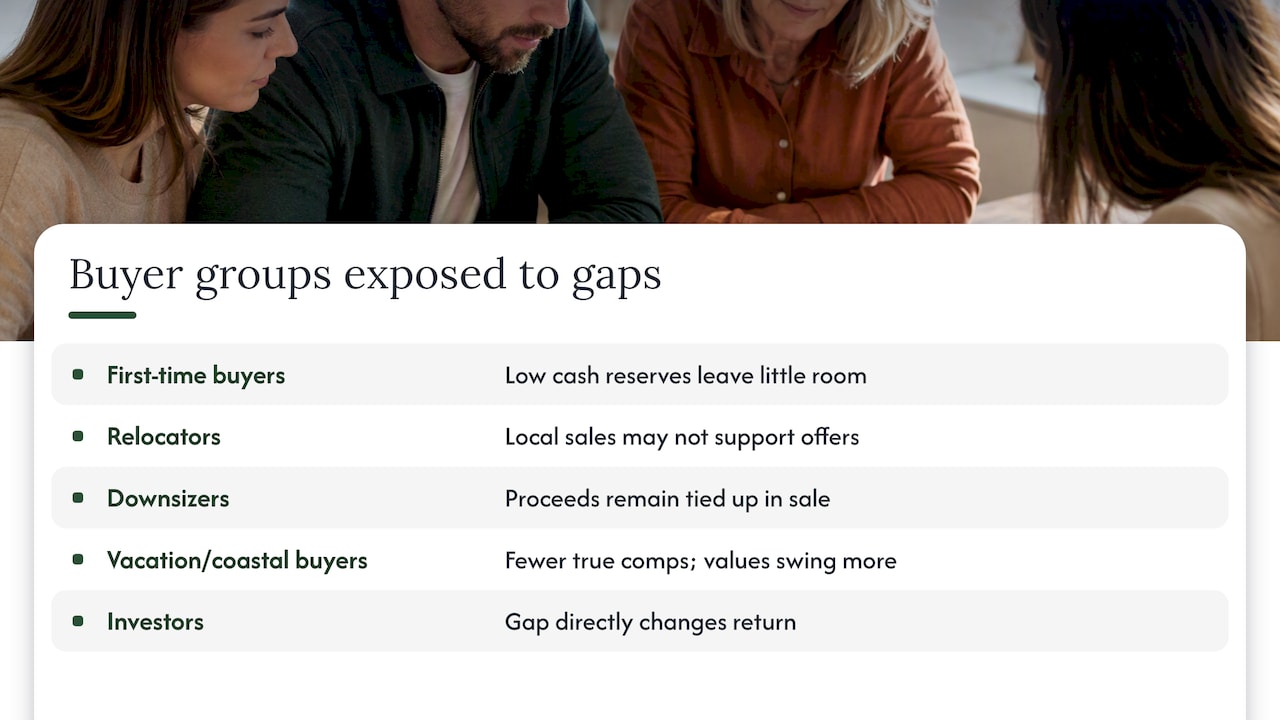
First-time buyers. Low cash reserves leave little room. If you are still working out your budget, start with how to qualify as a first-time homebuyer in Maine before you write a gap clause.
Relocators. Buyers moving from higher-priced areas often see Maine prices as modest and offer well over list. Local comparable sales may not support that figure, and the appraiser works from local sales, not from what your old market would have paid.
Downsizers. If you are selling a larger home and buying a smaller one, the gap on the purchase side competes with proceeds still tied up in your sale. Timing matters. Owners 62 and older who are weighing a purchase with a reverse mortgage should read how reverse mortgage appraisals are handled, since the valuation drives how much a borrower can access. Rules and lenders vary by state, so talk to a licensed lender before relying on any one source.
Vacation and coastal buyers. Shoreline and seasonal homes have fewer true comparables and values that swing more from house to house. We suggest smaller caps and a firmer line on price here.
Investors. A gap changes your return directly. Run the numbers on the appraised value, not the contract price, and walk away if the deal only works at the higher figure.
Our perspective: price first, clause second
We have worked the Maine market for 20 years, and the pattern is consistent. Most gap problems start before the offer, with a price that was never tested against sold homes. A gap clause can paper over a mismatch for a moment, but the appraiser still works from the same data we do.
So we start with the comparables. We look at what actually closed nearby, what condition those homes were in, and how long they sat. Then we talk to you about cash: not what you could scrape together, but what you would be comfortable having spent a year from now. If that number supports a cap, we write one. If it does not, we say so, even when it means a weaker offer on a house you love.
We also stay reachable beyond standard hours, because appraisals and deadlines do not wait for the weekend. When a low value arrives, you will get a call from us with the report already read and a plan for the ROV, the seller conversation, and your numbers.
— David
Working with a Realtor on a competitive offer
If you are buying in central or southern Maine and expect to compete, we can run the comparables, pressure-test your budget, and draft an offer where any gap promise is capped and sensible. We also represent sellers, investors, and vacation property buyers. See what we offer at RealtorMaine, then reach out before your next showing.
Frequently asked questions
Does appraisal gap coverage mean I will pay the gap?
No. It is a conditional promise that applies only if the appraisal comes in below the contract price, and only up to the cap you set. If the home appraises at or above the price, you owe nothing extra. A well-priced home often appraises close to the contract price, which is why the price check comes first.
Can I back out if the appraisal is low?
It depends on your contract. If you kept an appraisal or financing contingency and act within its deadline, you can usually end the deal under its terms. If you waived the contingency or promised to cover the gap, your options narrow. Have your agent and a Maine real estate attorney read your exact language.
Who pays for the appraisal in Maine?
The buyer typically pays the lender’s appraisal fee, either upfront or at closing. If you pay for an appraisal on a loan, Maine law lets you request a free copy from the financial institution, subject to the statute’s conditions. A second appraisal ordered after an ROV may carry its own fee, so ask your lender first.
Will the Maine appraisal board fix a low value?
No. The board handles licensing complaints and can discipline appraisers through warnings, fines, or licensing action, but it does not change property values or award money. For a disputed value, your route is a Reconsideration of Value through the lender.
Sources
- What Homebuyers Can Expect with an Appraisal, Freddie Mac
- What Consumers Should Know About the Appraisal Process, Maine Professional Licensing
- Mortgage borrowers can challenge inaccurate appraisals, CFPB
- Interagency Guidance on Reconsiderations of Value, Federal Reserve
- Maine Title 9-B, §447: Real estate appraisals; copies
- First Home Program FAQs, MaineHousing