If an appraisal in Maine comes in below the contract price, your immediate options are: renegotiate the price, split the appraisal gap, bring extra cash to close, request a lender Reconsideration of Value (ROV), or use your appraisal contingency to exit. The appraisal caps how much the lender will loan, which creates a gap between contract price and loan size. Maine appraisal rules and your specific lender’s policies shape which of these paths is realistic.
TL;DR:
- Because lenders generally calculate the maximum loan from the lower of the purchase price or appraised value, buyers must renegotiate or fund the difference themselves.
- Borrowers generally get one Reconsideration of Value request per appraisal; submit corrected facts and overlooked comparable sales promptly, because lenders do not pause closing deadlines.
- For a rebuttal, agents should check errors and assemble three to five recent comparable sales, especially in rural or coastal markets with few transactions.
- A low valuation can change mortgage insurance requirements or loan program eligibility, and preapproval does not guarantee the property will support the agreed price.
Table of Contents
- What a low appraisal actually means and why it happens
- Realistic options for buyers and sellers after a low appraisal
- How Reconsideration of Value and appraisal challenges work
- Agent playbook: fighting or mitigating a low appraisal
- Step-by-step checklist to keep the sale moving
- How low appraisals impact mortgage approval and buyer financing options
- Strategies for buyers and sellers to avoid low appraisals
- Effects of low appraisal on investment and vacation properties
- Maine market context in brief
- How David Haydym and RealtorMaine can help when an appraisal is low
- FAQ
- Sources
What a low appraisal actually means and why it happens
A low appraisal creates what’s called an appraisal gap: the difference between the contract price you agreed to and the value a licensed appraiser assigns to the property. That gap matters because a low appraisal directly limits the loan amount your lender is willing to provide, regardless of what you and the seller agreed to pay.
Not every valuation method produces the same number. Different valuation types can produce different results because automated valuation models, desktop reviews, and full inspection appraisals rely on different comps and different levels of detail, and the lender decides which one it uses for underwriting.
A few things commonly drag a Maine appraisal below contract price:
- A shortage of recent, truly comparable sales in rural or coastal towns with low transaction volume
- Fast-moving local price increases that outpace the sales data an appraiser can legally use
- Condition issues, deferred maintenance, or renovations that weren’t documented or permitted
- Timing: an appraisal ordered weeks after the offer may reflect an older set of closed sales
An appraiser’s number is an opinion of value, not a fact, reached under the Uniform Standards of Professional Appraisal Practice. Lenders also run their own quality control steps on appraisals before they fund a loan, which is part of why the process can feel slow even after a value comes in as expected.
Realistic options for buyers and sellers after a low appraisal
Once the appraisal comes back low, both sides have workable paths forward. Buyers can negotiate a lower price, split the gap, bring extra cash, or exercise an appraisal contingency to walk away cleanly if none of those work.
- Renegotiate the price. Ask the seller to come down to the appraised value, supported by the appraisal report itself and any comps your agent can add. Sellers facing a motivated buyer and a documented value gap often agree rather than restart the marketing process.
- Split the gap. If the contract price was above the appraisal value, buyer and seller might agree to a new price splitting the gap, each absorbing part of the shortfall rather than one side covering it all.
- Bring additional cash to closing. Buyers can cover the gap out of pocket, which raises their effective down payment and lowers the loan-to-value ratio, sometimes improving the loan terms in the process.
- Use the appraisal contingency. Most Maine purchase agreements include an appraisal contingency with a stated deadline; invoking it lets a buyer renegotiate or cancel the contract and recover earnest money if the seller won’t budge.
- Seller alternatives. Sellers who believe the appraisal undervalued the home can request the buyer’s lender pursue a Reconsideration of Value, or in some cases suggest the buyer switch lenders for a fresh appraisal, though this adds time.
Learn more about closing cost ranges for Maine buyers and sellers if bringing extra cash to the table is on the table, since that figure stacks on top of whatever gap money you contribute.
How Reconsideration of Value and appraisal challenges work
A Reconsideration of Value, or ROV, is a borrower-initiated request asking the lender to review an appraisal that seems inaccurate or incomplete. Fannie Mae’s guidance formalizes this process and generally allows borrowers one ROV request per appraisal, with lenders required to let borrowers submit supporting evidence.
Evidence that actually moves the needle includes:
- Corrected factual errors, such as wrong square footage, bedroom count, or lot size
- Comparable sales the appraiser missed or dismissed without explanation
- Condition or feature discrepancies, like an unlisted renovation or finished basement
- Documentation showing the property type was misclassified (condo versus single-family, for example)
When a lender receives an ROV request, it has a few options: ask the original appraiser to correct the issue, order a desk or field review, or commission a new appraisal entirely. Any replacement appraisal has to be documented with a reason for ordering it. The lender, not the Maine licensing board, controls whether a value actually changes. Maine’s appraisal board can investigate licensing or ethics complaints but it cannot order a new value, so an ROV through the lender is the practical route.
Pro Tip: Submit your ROV evidence as soon as you get the appraisal report. Most lenders won’t pause your closing timeline to wait for a slow rebuttal.
Agent playbook: fighting or mitigating a low appraisal
A good agent treats a low appraisal as a project with a deadline, not a dead end. The first move is assembling a rebuttal package built around 3 to 5 recent comparable sales that match the subject property on square footage, lot size, age, and condition, ideally sales the appraiser didn’t already consider.
From there, the checklist typically includes:
- Reviewing the report line by line for factual errors in square footage, room count, or property classification
- Gathering photos, permits, and inspection notes that support renovations or condition the appraiser may have undervalued
- Coordinating directly with the lender’s ROV desk, tracking submission deadlines, and preparing for a possible desk review or second appraisal
- Drafting contract amendments, seller credits, or short-term holdbacks that keep the deal alive while the valuation question gets resolved
Pro Tip: Ask your agent to request the comps the appraiser actually used. If none of them closed in the last 90 days, that’s a reasonable basis for a rebuttal.
A solid pre-appraisal preparation checklist can also help sellers head off some of these issues before the appraiser ever walks through the door.
Step-by-step checklist to keep the sale moving
Once the low appraisal lands, speed matters more than perfection. Work through these steps roughly in order:
- Read the full appraisal report and confirm your lender’s specific contingency and ROV deadlines that day.
- Notify your agent and the other side’s agent immediately so everyone is working from the same numbers.
- Build a rebuttal or ROV package with corrected facts and comparable sales, and confirm who needs to sign and submit it to the lender.
- Negotiate a revised price or concessions with the other side, then confirm the new financing math with your lender before signing anything.
- If the gap can’t be closed, withdraw cleanly under your appraisal contingency, or proceed with out-of-pocket funds if that’s the better outcome for you.
- Document every communication and keep your earnest money protected until the contingency is formally resolved or waived in writing.
| Step | Who handles it | Typical timing |
|---|---|---|
| Review appraisal for errors | Buyer’s agent | Same day report arrives |
| Submit ROV package | Lender, with borrower’s evidence | Within days of the report |
| Renegotiate price or concessions | Both agents | Within contingency window |
| Exit or proceed decision | Buyer, with agent and lender input | Before contingency deadline |
How low appraisals impact mortgage approval and buyer financing options
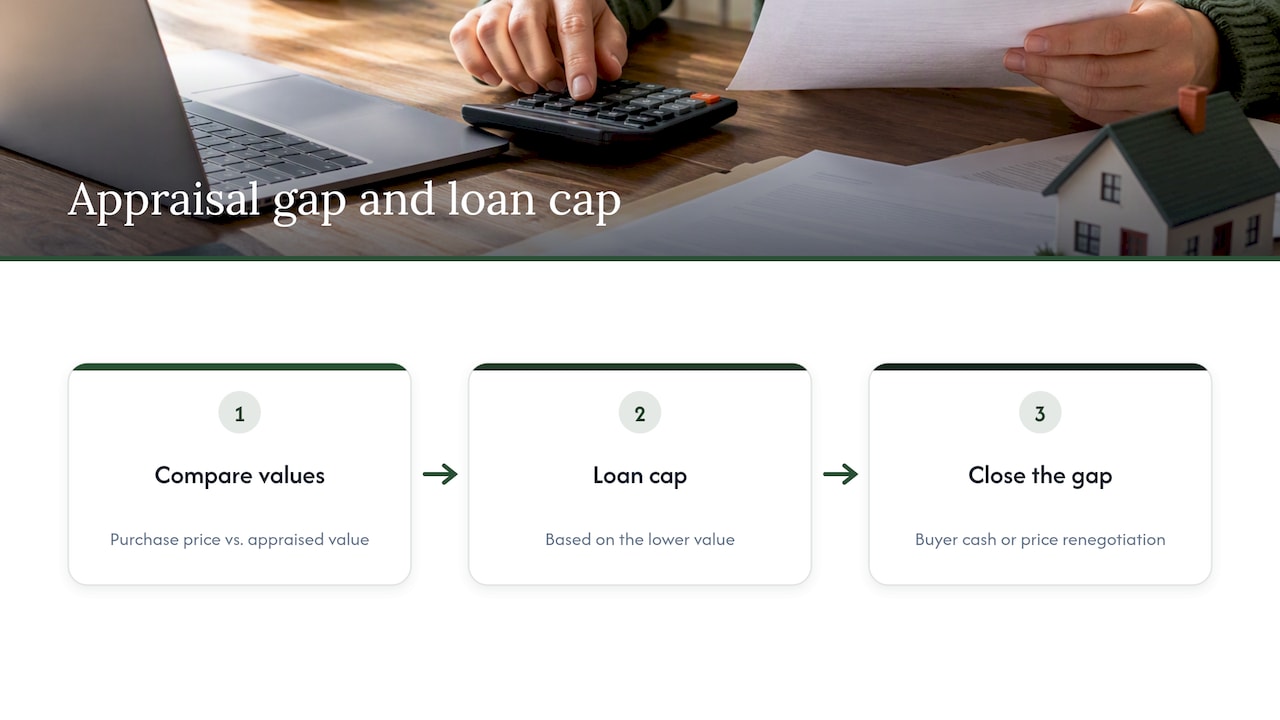
A low appraisal doesn’t kill your mortgage approval outright, but it does cap what the lender will fund. Most loan programs base the maximum loan amount on the lower of the purchase price or appraised value, so a gap between the two means the buyer either covers the difference in cash or the price gets renegotiated.
The effect on loan-to-value ratio matters beyond just the immediate math. If you were putting down a smaller amount and the appraisal comes in low, your loan-to-value ratio can shift enough to trigger different mortgage insurance requirements or, in some cases, push you into a different loan program entirely. Buyers using FHA or VA financing face additional wrinkles, since those appraisals carry their own rules that follow the property for a period of time regardless of which lender is used. If you’re exploring VA loan options with no down payment in Maine, it’s worth understanding how a VA appraisal’s value determination can affect a future transaction on the same property.
A preapproval letter doesn’t guarantee appraisal parity, since preapproval is based on your income, credit, and assets, not the specific property’s value. That’s why a low appraisal can surface even when a buyer is otherwise fully qualified.
Strategies for buyers and sellers to avoid low appraisals
Prevention beats negotiation every time. Sellers can get ahead of valuation problems by pulling together documentation on recent renovations, permits, and upgrades before the appraiser ever arrives, since an appraiser working from incomplete information defaults to conservative assumptions.
Buyers and their agents can help by providing the appraiser with a packet of supporting comps at the time of the appraisal appointment rather than waiting to dispute a low number after the fact. Pricing the home realistically from the start also reduces risk: an offer that significantly outbids recent comparable sales is more likely to trigger a gap, especially in competitive multiple-offer situations where buyers waive contingencies to compete.
Clear, organized communication between agent and appraiser also helps. A short cover sheet noting unique features, upgrades, or comparable sales the appraiser might not find through standard databases can prevent a low number before it happens rather than fixing it afterward. If you’re weighing how an online estimate compares to what an appraiser might find, our breakdown of reconciling Zestimate figures with formal appraisals is a useful starting point.
Effects of low appraisal on investment and vacation properties
Investment and seasonal properties in Maine carry extra appraisal risk because comparable sales can be thinner and harder to match. A camp on a remote lake or a condo in a coastal vacation town may have only a handful of truly similar sales within a reasonable distance and timeframe, which gives the appraiser less to work with and more room for a conservative number.

Seasonal demand swings add another layer. A property that sells in July for a premium because of lake access or proximity to the coast may appraise lower in the off season if the appraiser leans on sales from quieter months. Investors financing a purchase with a rental income component also need the appraisal to support both the sale price and the projected rent roll, so a low value can affect financing eligibility beyond the purchase price itself. Buyers pursuing vacation or investment property in Maine should expect to budget time for a possible ROV or second opinion given these thinner comp pools.
Maine market context in brief
Appraisals in Maine sometimes lag real market prices because municipal revaluations don’t happen every year, and local reporting has documented how revaluation timing and tax pressure vary widely by town. Seasonal demand in coastal and lake towns can push prices up faster than the comps an appraiser is allowed to use. County-level differences are real too: a comp that works in York County may be irrelevant in Aroostook. This is where a local agent’s knowledge of town-by-town patterns becomes the difference between a frustrating appraisal fight and a quick resolution.
— David
How David Haydym and RealtorMaine can help when an appraisal is low
A low appraisal is stressful, but it’s rarely the end of a transaction when you have someone who knows the local comps assembling your case. We put together rebuttal packages built on recent, matched sales, negotiate directly with lenders and the other side’s agent to find a workable price or concession, and advise on contract strategy so you’re not guessing what to sign next.

What we bring to a low appraisal situation:
- Local market knowledge across Maine, town by town, not just county-wide averages
- Negotiation experience with lenders and counterparty agents to resolve gaps without losing the deal
- Availability beyond standard business hours when a contingency deadline is approaching
If you’re facing a low appraisal on a home you’re buying or selling, reach out through our Maine real estate services to talk through your specific numbers and next steps.
FAQ
Is it common for appraisals to come in low?
Low appraisals happen regularly enough that lenders and federal guidance have built formal processes to address them, including the Reconsideration of Value request. An appraisal gap occurs whenever the appraised value falls below the agreed purchase price, and it doesn’t necessarily mean the home was overpriced, just that the appraisal relied on a limited set of comps.
How much does an appraisal typically cost in Maine?
Appraisal costs aren’t published by any of the sources behind this article, so a specific statewide figure isn’t available here. Buyers can confirm the exact cost through their lender’s loan estimate, since it’s typically included as part of total closing costs.
Why is property so cheap in Maine?
This question depends heavily on location, and there’s no single statewide answer supported by the sources used here. Property values vary significantly by county and by proximity to coastal or urban areas, which is part of why local comps matter so much in any individual appraisal.
Why is my appraised value so low?
A low value usually traces back to limited comparable sales, a property condition issue the appraiser noted, or timing, since an appraisal based on older closed sales may miss a fast-rising local market. Different valuation methods, like automated models versus full inspections, can also produce different numbers depending on which one your lender used.
Sources
- My appraisal is less than the sale price—what does that mean for me? | Consumer Financial Protection Bureau
- Reconsideration of Value (ROV) | Fannie Mae
- Maine