
Your municipality sets your property tax bill by multiplying its assessed value for your home by the local mill rate. There’s no statewide rate. Check your town’s assessed value against comparable sales, confirm you’ve filed for the Homestead Exemption if you qualify, and mark April 1 on your calendar. That single date drives most exemption and assessment deadlines in Maine.
TL;DR:
- The assessed value of your property is often based on recent sales, replacement cost, and income approach, which can cause sharp changes after revaluations.
- Local mill rates vary significantly, with coastal towns typically having lower rates but higher property assessments, influencing your yearly tax bill.
- Filing a written abatement request within 185 days of the tax commitment, supported by comparable sales or an appraisal, is crucial to challenge inaccurate assessments.
- Exemptions like the Homestead or veteran benefits can reduce your taxable value but require timely application and proper documentation.
- Many towns split bills into two installments, and mortgage escrows simplify payments, but verify proration and exemption transfer details before closing.
Table of Contents
- How Property Taxes in Maine Actually Get Calculated
- What You’ll Actually Pay: Rates, Variation, and a Real Example
- What to Do When Your Assessment Feels Wrong
- Exemptions That Can Lower Your Bill
- Billing, Escrow, and What Happens if You Fall Behind
- What Buyers Should Check Before Closing
- What I Watch for on Behalf of Buyers and Sellers
- A Realtor’s View on Why Tax Homework Pays Off
- Get Local Help Before Your Next Closing
- Sources
How Property Taxes in Maine Actually Get Calculated
Each of Maine’s municipalities runs its own assessment. A local assessor (sometimes an elected official, sometimes a contracted firm) sets what’s called the “just value” of your property, essentially its fair market value as of April 1 each year. The Property Tax Division of Maine Revenue Services separately calculates a State Valuation, which equalizes property values across towns for the purpose of distributing state aid to schools and revenue sharing. It has nothing to do with your individual bill.
Your bill comes from one formula:
- Tax owed = assessed value × mill rate ÷ 1,000
- A mill rate of 18 means $18 in tax for every $1,000 of assessed value.
Assessors use three approaches to reach that value: market comparison (recent sales of similar homes), cost (replacement cost minus depreciation), and income (for rental or commercial property). Towns periodically run full revaluations, and when they do, assessed values can jump sharply even if the mill rate stays flat.
What You’ll Actually Pay: Rates, Variation, and a Real Example
Maine’s statewide effective property tax rate runs close to 1% of home value, based on Tax Foundation figures, with a separate calculator from SmartAsset putting the effective rate around 0.91%. Neither number tells you what you’ll pay, because Maine has no state property tax rate. Every mill rate is local.
- Coastal towns with strong tourism and vacation-home demand, like those on Mount Desert Island, often carry lower mill rates but higher assessed values.
- Inland and rural towns frequently run higher mill rates on lower assessed values.
- You can find your town’s current mill rate and certified assessment ratio through its assessor’s office or the MRS assessor resources page.
Here’s the math in action: a home assessed at $300,000 in a town with an 18 mill rate owes $5,400 a year ($300,000 × 18 ÷ 1,000). Drop that same home into a town with a 12 mill rate and the bill falls to $3,600, even though the house hasn’t changed at all.
What to Do When Your Assessment Feels Wrong
If your assessed value looks out of line with what similar homes are actually selling for, you have a formal path to challenge it, and it starts with paperwork, not a phone call.
- File a written abatement request with your local assessor. Bulletin No. 10 requires the request in writing, and most towns set a deadline within 185 days of the tax commitment date. Verbal complaints at the counter don’t count.
- Build your evidence before you file. Recent comparable sales, a professional appraisal, or documentation of a factual error (wrong square footage, wrong lot size) carry far more weight than a general complaint that “taxes are too high.” The burden of proof sits with you, the taxpayer, not the town.
- Wait for the assessor’s decision. If denied, or if you get no response within the statutory window, you can escalate to your municipality’s board of assessment review.
- For qualifying cases, appeal to the State Board. The Maine State Board of Property Tax Review notes that residential appeals typically start and end at the municipal level. The State Board mostly handles larger commercial and industrial disputes, though its FAQ confirms parties can represent themselves at any hearing, and complex valuation fights often benefit from an appraiser or attorney.
Pro Tip: Don’t wait for your bill to feel painful before you check your assessment. Pull your town’s property card (most are online now) the year after any town-wide revaluation and compare it to three recent sales on your street. That’s the fastest way to catch an error before the abatement clock starts running.
Exemptions That Can Lower Your Bill
Maine offers several exemptions that reduce your property’s taxable value before the mill rate ever gets applied, and most require you to ask for them.
- Homestead Exemption: up to $25,000 off your just value for permanent Maine residents who’ve owned property in the state for at least 12 months, per Maine Revenue Services.
- Veteran exemption: reduces just value for qualifying veterans, with a larger amount available for veterans with specially adapted housing.
- Blind exemption: a fixed reduction in just value for legally blind residents.
- Renewable energy investment exemption: covers qualifying solar and wind installations.
- Business equipment exemption: applies to qualifying business personal property.
- Current-use programs (Tree Growth, Farmland, Open Space): lower assessed value in exchange for keeping land undeveloped or in active use.
Partial exemptions get adjusted by your municipality’s certified assessment ratio, per the Property Tax Relief program page, so the dollar reduction on your bill won’t always match the stated exemption amount exactly. Apply at your local town office, generally by April 1, with proof of residency, ownership, or veteran/disability status on hand.
Billing, Escrow, and What Happens if You Fall Behind
Towns set a commitment date each year, the point at which the assessor formally certifies the tax roll and the treasurer issues bills. Due dates and interest rates on late payments vary by municipality, so check your specific town’s schedule rather than assuming a statewide standard.
- Many towns split bills into two installments, often due in the fall and following spring.
- If your mortgage escrows for taxes, your lender pays the bill directly from that account.
- At closing, taxes get prorated between buyer and seller based on the closing date, a figure you should verify line by line on your closing statement.
- Owners facing genuine financial hardship can request a poverty/hardship abatement directly through their town office, separate from a standard value-based abatement.
Pro Tip: If you’re buying a home mid-year, ask your closing agent to show you the exact proration math, not just the final credit or debit. Towns calculate this differently, and a rushed closing is where errors slip through.
What Buyers Should Check Before Closing
Tax history tells you things a listing sheet won’t, and skipping this step is one of the more common regrets buyers report after closing.
- Pull the last three years of tax bills for the property to spot trends, not just the current number.
- Ask whether the town has a revaluation scheduled or recently completed. A post-sale reassessment can push your bill up significantly if the prior assessment was outdated.
- Confirm whether the seller’s exemptions transfer. Homestead and current-use enrollments generally don’t carry over automatically. You’ll need to reapply.
- Check for special assessments tied to the property (sewer, road improvements) that might carry forward.
- Verify the proration method and your lender’s escrow setup before signing anything, so there are no surprises in your first mortgage statement.
- Loop in local expertise when a tax figure looks inconsistent with comparable homes. A Realtor familiar with the town can often explain an anomaly faster than a call to the assessor’s office.
What I Watch for on Behalf of Buyers and Sellers
Every offer I write factors in the tax picture, not just the sale price. I check assessed value against recent comparable sales, flag whether the town has a revaluation coming, and confirm exemption status before we ever get to negotiation. An unexpected tax jump is leverage. I’ve used a pending revaluation or a lapsed homestead exemption to renegotiate price or request a closing credit more than once.
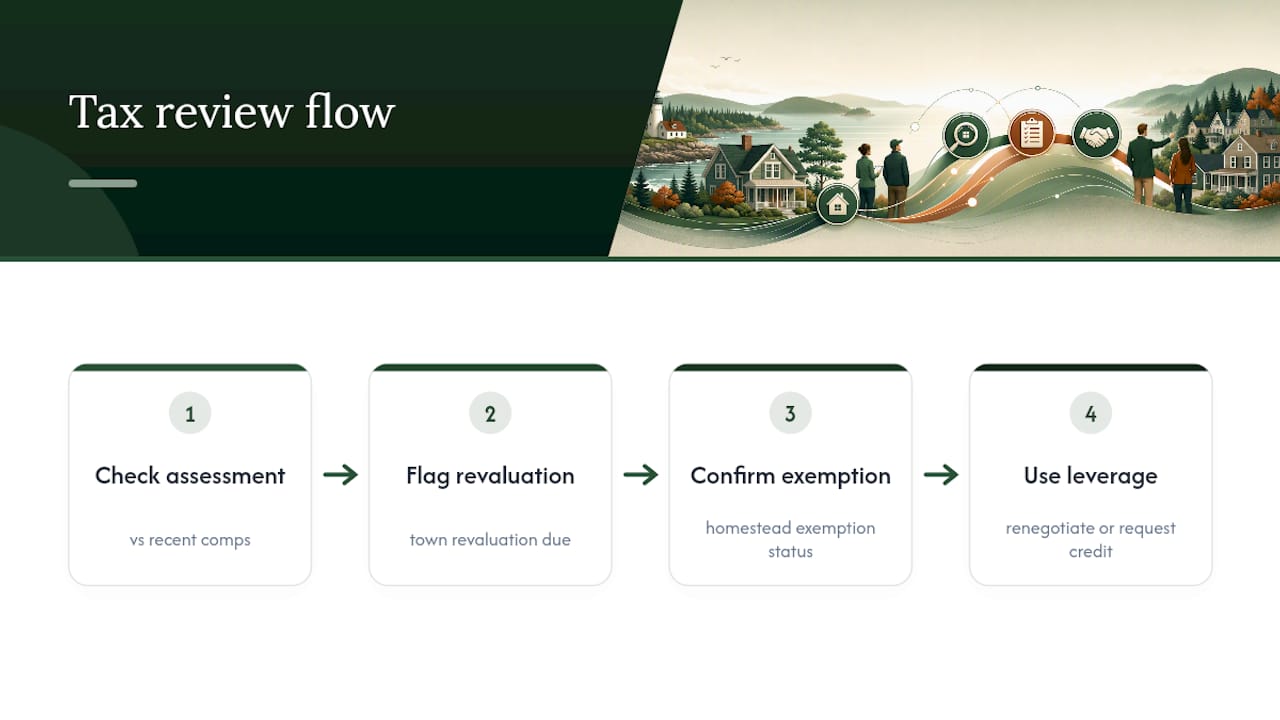
When a valuation dispute looks real, not just a hunch, I bring in an appraiser or, for complicated cases, an attorney, and I coordinate that work so my clients aren’t chasing three professionals on their own.
A Realtor’s View on Why Tax Homework Pays Off
Property taxes fund the schools and roads that make a town worth buying into, and that revenue stability is exactly why assessments rarely go down without a fight. In twenty years of closings across central and southern Maine, I’ve seen tax knowledge save deals and save money more often than any negotiating trick. The owners who read their assessment before they call me are always in a stronger position than the ones who wait for a surprise bill.
— David
Get Local Help Before Your Next Closing
You can get a local read on whether an assessment is fair, whether a revaluation is coming, and how to turn either into leverage at the negotiating table. A real estate professional can review tax history on comparable properties, coordinate appraisals when a valuation dispute looks worth pursuing, and work tax-related terms directly into offers and counteroffers, so you’re not untangling any of it alone after closing.

If you’re buying or selling in central or southern Maine and want someone to walk through the tax picture with you before you sign anything, reach out to David directly and get a straight read on what the numbers actually mean for your deal.
Sources
- MAINE REVENUE SERVICES PROPERTY TAX DIVISION BULLETIN NO. 10 — Property tax abatement and appeals procedures
- Homestead Exemption program | Maine Revenue Services
- Frequently Asked Questions > Maine State Board of Property Tax Review
- 2026 Maine Tax Rates, Collections, and Burdens | Tax Foundation