An escalation clause is a line in your offer that says you will beat any higher competing offer by a set amount, up to a maximum you choose. In Maine it is legal and used, but it comes with a specific wrinkle: the Maine Real Estate Commission has addressed how the seller’s side may share the competing offer that triggered it. This guide explains how the clause works, what a Maine buyer should put in writing, and when it helps or hurts.
TL;DR
- An escalation clause raises your price automatically, by a fixed increment above a competing offer, until it reaches a cap you set.
- Maine’s Real Estate Commission has ruled that the clause can work as long as the buyer receives a copy of the offer that was used to escalate.
- It can reveal your ceiling, push you above what you needed to pay, and does nothing for weak financing or heavy contingencies.
- Many sellers prefer a “best and final” round, so a clause is a tool for specific situations, not a default.
- Have your agent and, ideally, an attorney review the wording before you sign.
Table of Contents
- What an escalation clause does
- What Maine says about escalation clauses
- What a well-drafted clause includes
- What happens when two offers have escalation clauses
- How sellers see escalation clauses
- Can an escalation clause backfire?
- When a clause makes sense, and when to skip it
- Our perspective
- Working with a Maine agent on your offer
- FAQ
- Sources
What an escalation clause does
You offer a base price. The clause adds that if the seller receives a bona fide offer above it, your price rises to beat that offer by a stated amount, but never past a maximum. According to Realtor.com’s explanation, the clause typically names the original offer price, the maximum price and the escalation amount.
The point is to stay competitive in a multiple-offer situation without guessing the winning number and without bidding your top dollar when nobody else bid high.
A simple example
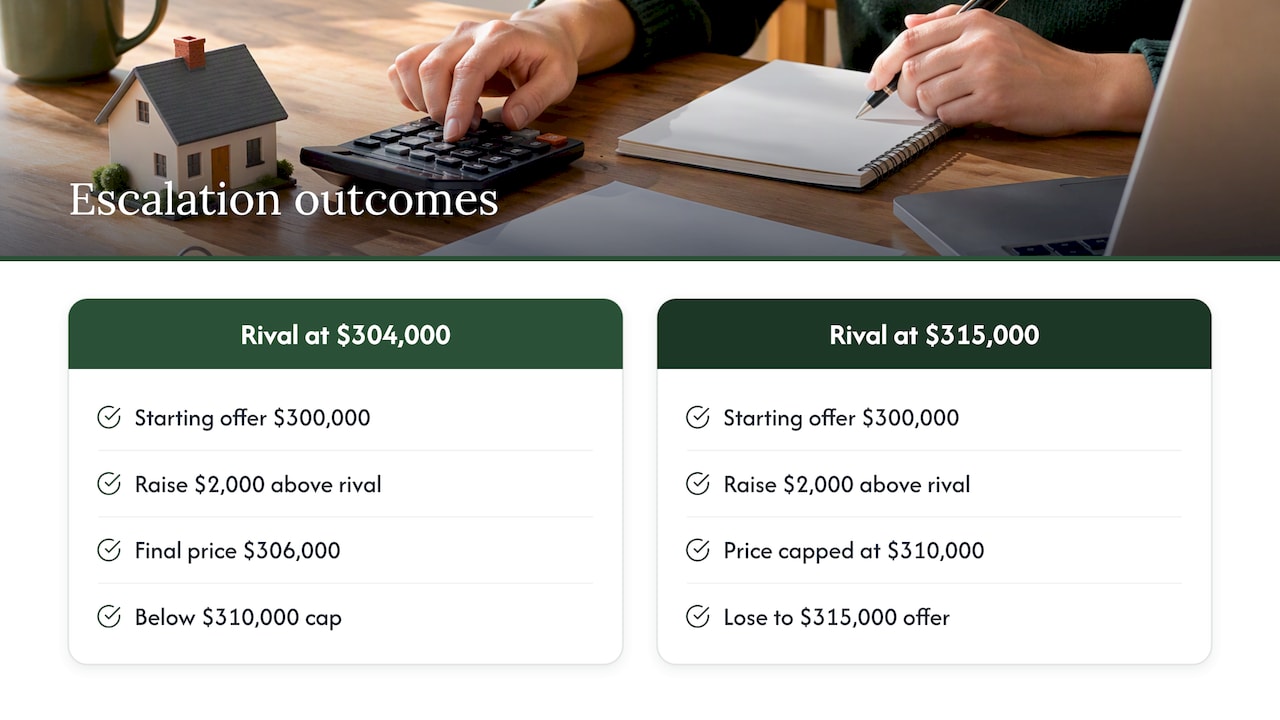
Realtor.com’s example starts at $300,000, escalates in $2,000 steps above a competing offer and caps the price at $310,000. If the best rival offer is $304,000, your price becomes $306,000. If the rival goes to $315,000, you stop at $310,000 and lose, because the cap protects you from going further.
Virginia REALTORS® uses a similar illustration: a $300,000 offer that escalates $5,000 above another bona fide offer, up to $350,000. A $325,000 competing offer would produce a $330,000 price.
What Maine says about escalation clauses
Maine has an official position, which many national guides lack. In a 2017 advisory ruling, the Maine Real Estate Commission addressed an escalation clause that raises the buyer’s price to a specified amount above the highest offer received, up to a cap, and tied it to the buyer receiving a copy of the offer used to escalate.
Why the offer copy matters
Maine’s Commission Rule, 02-039 C.M.R. ch. 410, § 12, generally bars a brokerage and its licensees from disclosing the terms of an offer, counteroffer or purchase and sale contract to anyone other than the buyer and seller while the transaction is pending, unless there is prior written permission. That is a problem for escalation: the buyer who wrote the clause wants proof of the competing number.
The same advisory ruling concluded that when an escalation clause is used, the seller’s written rejection of a competing offer and acceptance of the escalation offer relieves the listing agent of that general prohibition, so the agent can provide the competing offer to the escalating buyer. In plain terms, the seller’s written decision is the key that lets the proof move.
The Commission’s offers and counteroffers guidelines add two related points. Offer and counteroffer terms may not be disclosed without prior written consent before withdrawal, expiration or written rejection. And all offers must be communicated to the client, with the agent keeping the client informed of stated interest in the property. So a Maine listing agent cannot quietly shop your number to other bidders, and a seller will see your escalation offer alongside the rest.
This is general information, not legal advice. For your own contract, ask your agent how the offer will be handled and have a Maine real estate attorney read the clause.
What a well-drafted clause includes
Vague clauses create disputes. A well-structured clause covers the base offer price, the increment above a competing offer, the maximum purchase price and documentation of a bona fide offer.
Use this checklist when you and your agent draft:
- Base price. The number you will pay if no one else bids higher.
- Increment. The amount you will go over the best competing offer. Smaller increments cost you less; larger ones look stronger.
- Cap. The most you will pay, and ideally a number you have already tested against comparable sales.
- Proof. A requirement that the seller provide a copy of the competing offer, consistent with the Maine process above.
- Definition of a competing offer. Is it any offer, or a signed, arm’s-length one from an unrelated buyer?
- Financing and appraisal. What happens if the appraisal comes in below your escalated price.
For item 5, the Oklahoma Real Estate Commission’s official 2026 escalation addendum is a useful illustration of what a form can define: an arm’s-length bona fide offer, closing timing and limits on certain sale contingencies. It is an Oklahoma form, not a Maine rule, but it shows the kind of detail that prevents arguments.
Plan for the appraisal
The higher your escalated price climbs, the more likely it is to outrun the appraisal. Freddie Mac notes a clause may include an appraisal contingency, meaning the purchase proceeds only if the price is not above the lender’s appraised value. If you waive that protection, you need cash for the gap. Our guide to what to do about a low appraisal in Maine explains the reconsideration-of-value route before you cover a shortfall.
What happens when two offers have escalation clauses
It happens in hot markets. Per Freddie Mac, when two offers both carry clauses, the prices step up against each other according to each clause’s terms until one buyer’s cap is passed by the other buyer’s bid.
The practical result: the buyer with the higher cap usually wins, and the loser’s cap is effectively exposed. Both clauses also have to be readable by the seller without a calculator. If they are not, expect the seller’s agent to call for best and final offers instead. For a broader view of how competing bids play out, see how multiple offers strategy changes with market conditions, and our own page on multiple offers in Maine.
How sellers see escalation clauses
Sellers are not obliged to welcome them. The Maryland REALTORS® guidance says sellers may find escalation addenda complicated to compare, may ask for best and final offers instead, and do not have to entertain them.
If a seller does consider several, the sensible move is to compare net proceeds rather than sticker prices. DocJacket advises building a net sheet for each offer, because the real price depends on the base, increment and cap. A buyer’s offer with a $5,000 lower escalated price but a clean inspection window and a firm lender letter may net the seller more certainty.
If you are selling, that is a good reason to price carefully at the start. See why $424,550 is only a starting point in Maine home pricing.
Can an escalation clause backfire?
Yes, in several ways. The North Carolina Real Estate Commission, in its bulletin on the pitfalls, lists these risks:
- It can reveal your maximum price to the seller.
- It can lead you to pay more than you needed to.
- Enforceability can be uncertain until a specific price is entered.
- It can invite fraud through a fictitious competing offer.
The Commission recommends attorney review. That is a North Carolina view and it discourages their use, so treat it as a caution, not a Maine rule. Maine’s offer-copy requirement answers the fraud concern directly, which is a good reason to insist on proof.
There are also non-price problems. A seller may choose an offer with stronger financing or fewer contingencies rather than the highest number, leaving you to pay more than necessary for an offer that might have lost anyway. Real Estate News contributor J. Philip Faranda makes the same point: an escalation clause is not a magic bullet, and price cannot offset weak financing, unfavorable contingencies, a low down payment or appraisal risk.
Cutting contingencies is its own risk
Buyers who try to compensate by shortening or dropping inspection rights take on real exposure in older Maine housing stock. Before you do, read about inspection contingencies in Maine, and run through a home inspection checklist for Maine buyers. Homes built before 1978 also bring lead paint rules, covered in our page on 10-day inspection rights.
When a clause makes sense, and when to skip it
| Situation | Escalation clause | Often better |
|---|---|---|
| Several bids expected, you have room above list price | Reasonable, with a firm cap | Strong base price plus a short, specific escalation |
| Seller has announced a best and final round | Usually unnecessary | Put your top price in the final offer |
| Your offer is financing-heavy or low down payment | Weak on its own | Strengthen the lender letter first |
| Home likely to appraise below your cap | Risky | Appraisal plan or cash for the gap |
| Only one offer expected | Rarely needed | Make a fair offer, negotiate directly |
The cap is the whole decision. Choose it before you see the house in a bidding frenzy, from comparable sales and your own budget.
Our perspective
We have spent 20 years in Maine real estate, and our view is simple: an escalation clause is a sharp tool, not a strategy. It works when you already know your ceiling, your financing is strong and the seller’s agent is willing to handle it cleanly. It disappoints when a buyer hopes it will make up for a thin offer.
We start with the data. Before any buyer writes a clause, we look at recent comparable sales and ask what the home is worth to you, not just what the market might bid. If the cap is above what the numbers support, we say so, even when it would be easier to let the clause run. That is the transparent, no-pressure process we promise.
We also tell buyers the other side of the coin: in some towns, a clean offer with a clear closing timeline and sensible contingencies beats a higher number with tricks. And since multiple offers do not wait for business hours, we make ourselves available beyond them, so you can decide quickly and calmly.
— David
Working with a Maine agent on your offer
If you are buying in central or southern Maine and want help deciding whether to escalate, where to set your cap and how to keep your offer clean, we can walk you through it. We also represent sellers who want to handle multiple offers fairly. Start at RealtorMaine to reach us about buying, selling, investment or vacation property.
FAQ
What does an escalation clause look like?
It is a short addendum or paragraph stating your base price, the amount you will add above a higher competing offer and your maximum price. For example, $300,000 base, $2,000 above any better offer, capped at $310,000. In Maine it should also ask for a copy of the offer used to escalate.
Why would a seller not want an escalation clause?
Comparing escalating offers is harder than comparing flat numbers, and some sellers would rather call for best and final offers. They are not required to entertain clauses at all. A seller may also value stronger financing or fewer contingencies over the biggest possible price.
Can an escalation clause backfire?
Yes. It can disclose your ceiling, cause you to pay more than the next-best bid required, and fail to help if your financing or contingencies are weak. Fraud through a made-up competing offer is another risk, which is why proof of the competing offer matters.
What happens if two offers have escalation clauses?
The prices step up against each other under each clause’s terms until one buyer’s cap is surpassed. The buyer with the higher cap generally wins. A seller may skip that process and ask for best and final offers.
Is an escalation clause allowed in Maine?
Yes. The Maine Real Estate Commission’s 2017 advisory ruling addressed one directly and explained how the offer copy can be provided after the seller’s written decision. Have your agent and an attorney review the exact wording for your purchase.
Sources
- Maine Real Estate Commission Advisory Ruling 2017-01
- Maine Offers and Counteroffers Guidelines
- Realtor.com: What Is an Escalation Clause in Real Estate?
- Virginia REALTORS®: Escalation Clauses
- Prevu: How Escalation Clauses Help Homebuyers Win
- Oklahoma Real Estate Commission 2026 Escalation Addendum
- Freddie Mac: Should My Offer Include an Escalation Clause?
- Maryland REALTORS®: What is an Escalation Clause?
- DocJacket: Multiple Offers on a House
- NCREC: The Pitfalls of Using Escalation Clauses
- Business Insider: Escalation Clause in a Real Estate Contract
- Real Estate News: Escalation clauses are not a magic bullet
- Multiple offers strategy