

Most Maine renovations return less than they cost, and the gap depends on the project, the town and the timing. Small, visible upgrades such as a garage door, an entry door or a minor kitchen refresh tend to recoup the most. Big interior overhauls recoup the least. Before you spend anything, compare the cost with what buyers in your specific neighborhood will pay for the finished home. A local REALTOR® can run that comparison with sold-home data in an afternoon.
This guide is for people deciding whether to renovate before selling, buy a home that needs work, or fix up a downsized, rental or coastal property.
TL;DR
- Maine sits below the national average: a large study found Maine homeowners recoup about 62.5% of renovation costs, against 69% nationally.
- Entry doors, garage doors, minor kitchen updates and decks usually pay back best. Major kitchens and full gut jobs pay back worst.
- Never spend beyond what your neighborhood’s buyers will pay. A finish level the area does not support is money you will not see again.
- Budget a 15 to 20% contingency, and more for older Maine homes.
- Calculate ROI on a specific project with local sold prices before you sign a contract.
Table of Contents
- What “ROI” means for a Maine renovation
- Which projects pay back most
- Kitchens and bathrooms: where the money goes
- Central Maine versus the coast
- Do not out-renovate your neighborhood
- Budgeting: the 30% rule, contingency and the deposit
- How to calculate ROI on your own project
- Renovate, sell as-is or buy differently?
- Our perspective
- Get a local number before you spend
- FAQ
- Sources
What “ROI” means for a Maine renovation
Renovation ROI (return on investment) is the share of a project’s cost that comes back as added sale value. If you spend $20,000 and a buyer will pay $14,000 more because of it, the return is 70%, and the project cost you $6,000 net.
A return below 100% is normal and is not automatically a bad decision. A new roof or furnace may be needed to sell at all. A kitchen that is dated enough to scare off buyers can make the home sit on the market. What matters is that you know the number before you spend.
The Maine figure to keep in mind is the statewide average. The Today’s Homeowner study of 70,000 homes in nearly 1,300 cities put Maine among the lowest-return states at 62.5% recouped, versus 69% nationally. That study covers 2023. Treat it as a reality check, since returns move with the market.
Which projects pay back most
No single source settles this, and the reports define projects differently, so read the numbers as a ranking, not a promise. Two sets of figures are useful together.
A Maine builder’s 2026 guide gives these Maine-specific ROI ranges:
| Project | Typical return (Maine) |
|---|---|
| Garage door replacement ($3,000 to $5,000) | Over 90% |
| Manufactured stone veneer | 85 to 90% |
| Minor kitchen remodel | 75 to 85% |
| Wood deck | 65 to 75% |
| Basement finishing | 50 to 70% |
| Major kitchen renovation | 50 to 60% |
The 2025 Cost vs. Value data for New England, as summarized by a Maine remodeler, shows the same pattern. A garage door at $4,317 was credited with $15,081 in resale value, and a steel entry door recouped 182.9%. The same data puts a midrange minor kitchen remodel at $28,936 with 134.3% recouped, while a major midrange kitchen at $102,857 recouped 47.2%.
The Appraisal Institute, whose members are professional appraisers, reviewed that same New England report in May 2026. It found midrange kitchens at 43.3% and midrange bathrooms at 59.8%, with upscale versions lower at 33.2% and 27.3%. Backup generators (97.5%), composite decking (82%) and basement remodels (75%) did well.
The lesson across all of these is the same. Cheap, visible, first-impression projects outperform expensive interior ones, and the more you spend on finish level, the lower the percentage you get back.
Kitchens and bathrooms: where the money goes
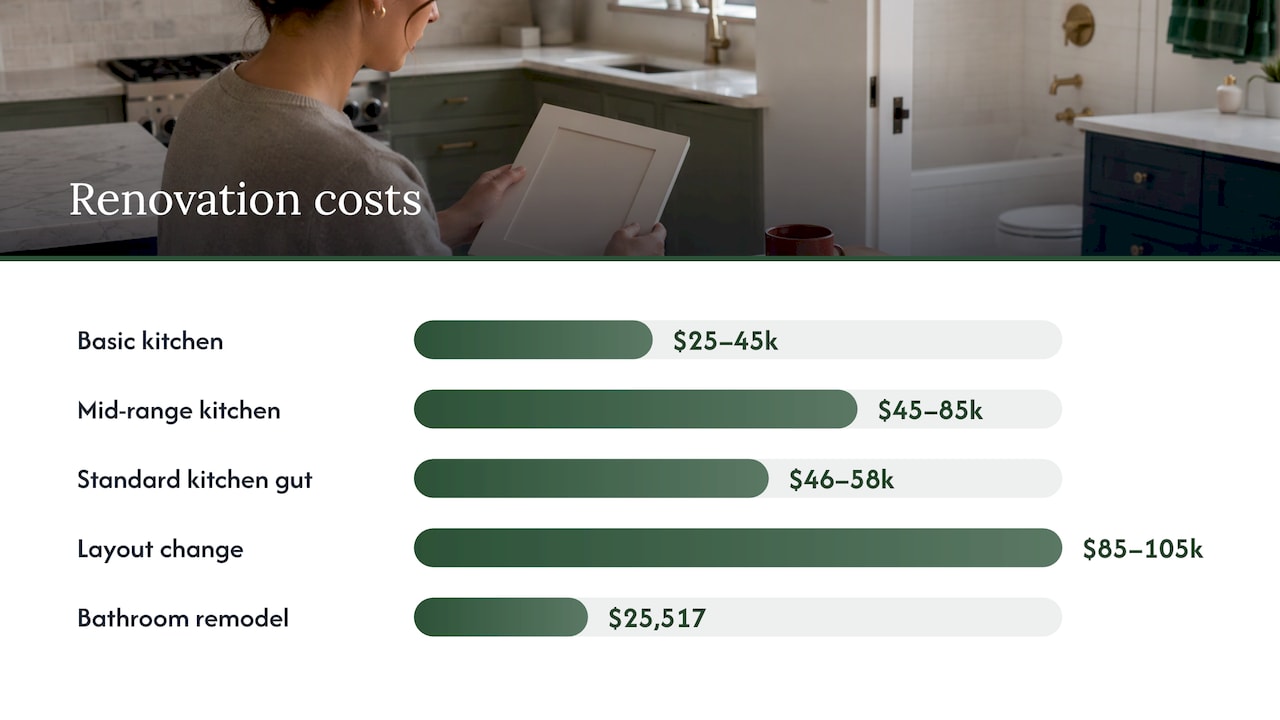
Kitchens draw the most spending and the most disappointment. Maine kitchen pricing varies widely by contractor and scope. Southern Maine guidance puts a basic kitchen remodel at $25,000 to $45,000 and a mid-range project at $45,000 to $85,000, with custom layouts passing $100,000. An Augusta-area builder prices a standard kitchen gut at $46,000 to $58,000 and a wall-removal layout change at $85,000 to $105,000.
Compare that with the return ranges above. The refresh route, meaning cabinet refacing, new counters and hardware, keeps the spend low and the percentage high. For a look at how kitchen upgrades are valued at resale in another market, see this kitchen remodel resale returns breakdown; the logic of spending to the local buyer’s level carries over.
Bathrooms can be a pleasant surprise in Maine. A 2022 New York Times report on the Cost vs. Value study said Maine ranked first for bathroom remodel return at 89%, at an average cost of $25,517. That is one year’s ranking, and the newer New England figure above is lower, so plan on a solid return but not a guaranteed one.
Some other numbers you will see online, such as a 167.20% kitchen ROI for Maine, come from content sites and use their own methods. Use them to see which direction value runs, and rely on sold prices near you for the decision.
Central Maine versus the coast
Maine is not one market. Costs and buyer expectations shift a lot between Augusta, Lewiston-Auburn, Portland and the coast.
Costs. One 2026 cost guide lists a labor multiplier of 0.95 for Augusta and Central Maine, 1.00 for Lewiston-Auburn and 1.20 for the Midcoast, with an average kitchen from $40,000 in Central Maine to $52,000 on the Midcoast. Treat these as planning estimates and get local bids.
Home values. Median values in Bangor, Waterville, Lewiston and Augusta run roughly $200,000 to $290,000, against about $695,000 in Portland. A $100,000 kitchen in a $250,000 home is a very different bet than in a $700,000 one. Our market notes on the Augusta market and the Portland housing market show what buyers in those places are paying.
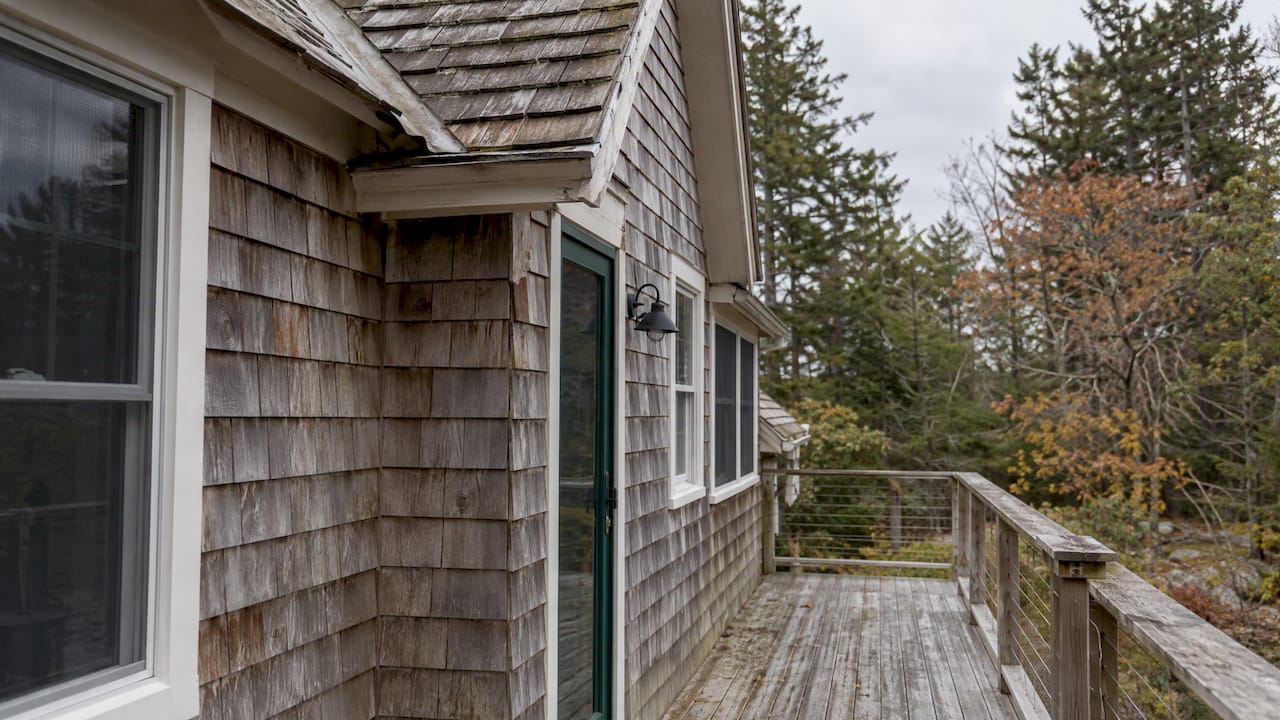
Coastal exteriors. For vacation and coastal properties, one 2026 analysis argues that exterior work such as cedar shake roofing, cedar siding and decks outperforms interior remodels, because weather and views drive buyer decisions. It also finds the strongest gains on a structurally sound but dated home, and best results when work finishes shortly before listing. Roofing is a good example of a project where buyers care about condition; this piece on roof replacement resale value explains why the headline percentage is only part of the picture.
Do not out-renovate your neighborhood
The fastest way to lose money is to finish a home beyond what its street supports. The Appraisal Institute warns that a $100,000 kitchen where buyers do not support that finish level creates a mismatch between cost and the value it adds.
Maine builders point to the same limits: neighborhood standards, different buyer expectations in Portland and rural towns, workmanship, and permits. Unpermitted work can create problems at sale, so pull permits on anything that needs them.
A practical test: look at the three or four most recent sales of comparable homes within a mile. If the best of them sold with laminate counters and a 15-year-old furnace, a quartz and professional-range kitchen will not move the price by what it cost.
Budgeting: the 30% rule, contingency and the deposit
A common guideline is to spend no more than 30% of your home’s value on renovations. Read it as a ceiling. On a $250,000 Central Maine home that means $75,000 at the very most, and much less if you plan to sell soon.
Other budget points for Maine:
- Contingency. Builders recommend 15 to 20% extra, and a personal finance guide suggests 20 to 30% for homes 50 or more years old, because old wiring, plumbing and hidden damage show up once walls open.
- Sales tax. Maine charges 5.50% on building materials. On a $20,000 materials order that is about $1,100.
- Deposit. Maine law limits the first payment on a home construction contract over $3,000 to one third of the price. Treat that as a maximum.
Full-house numbers vary enormously. Southern Maine builders describe $65,000 to $140,000 for a cosmetic whole-home refresh and $150,000 to $325,000 for mid-range work. Coastal and island homes can add 15 to 40%. Whatever the figure, remember that the guide itself cautions that no project guarantees a dollar-for-dollar return.
How to calculate ROI on your own project
- Get a written cost. Use a contractor bid, plus tax, permits and the contingency.
- Find the value gain. Compare recent sold prices of renovated and unrenovated homes like yours in your town. A comparative market analysis (CMA), which is a report on those sales, does this.
- Divide. Value gain divided by total cost gives the return.
- Add the sale-ready factor. Ask whether the work lets you sell faster or avoids a price discount for condition.
- Decide. Do it if the return is strong, or if the home will not sell well without it. Otherwise price the home as-is.
Example: a $12,000 exterior refresh with new front door, paint and landscaping. If similar updated homes sell $10,000 higher, the return is 83%, and the net cost is $2,000. A $60,000 kitchen that lifts value by $30,000 returns 50%, with $30,000 net out of your pocket.
Renovate, sell as-is or buy differently?
Sellers and downsizers. Often the best spend is light: repairs, paint, and staging. Our guide to Maine home staging with $200 to $500 fixes covers it, and our piece on pricing a Maine home shows how condition feeds the number.
First-time buyers. A fixer-upper can be affordable, but cost the work first and include the contingency in your total budget. Compare a home that needs work with new construction before deciding.
Investors. Buy in a neighborhood where the finished home still sits at or below the area’s norm. Older Maine homes frequently uncover hidden conditions once work begins, and your numbers must survive that. Aging systems matter too; this guide to older home HVAC upgrades shows what to prioritize. In Maine, heating choices carry rebates up to $9,000 that change the math.
Vacation buyers. Prioritize roof, siding, deck and windows, since weather punishes them, before any interior finish.
Our perspective
Renovation advice online usually starts with a project list. We start with the street. After 20 years in the Maine market, the question I ask first is what buyers in this specific town will pay for this specific home, because a Camden cottage and a Lewiston two-family do not reward the same work.
That is why we build a comparative market analysis before you hire a contractor, not after. It shows where the price ceiling is, which updates buyers in your area reward, and which ones you would be paying for on your own.
We also keep our process pressure-free and our hours flexible, because renovation decisions usually surface in the evening, when you are looking at quotes. If you are buying, I will tell you early when a house needs more work than the price suggests. If you are selling, I will tell you which fixes help and which can wait.
David
Get a local number before you spend
If you are weighing a renovation before selling, or a home that needs work, David Haydym is a licensed REALTOR® who has sold over 50 homes in central and southern Maine and handles pricing strategy, comparative market analyses and negotiation for buyers, sellers, investors and vacation property seekers.

See how we can help with buying a home, selling, investment property or seasonal property.
FAQ
How much should I spend on a home renovation in Maine?
Stay under the 30% guideline, and well under it if you will sell within a few years. Set the budget from what comparable renovated homes sold for, add a 15 to 20% contingency, and plan more for older homes.
What renovation adds the most value in Maine?
Small exterior and entry projects lead. Maine builders report garage doors returning over 90% and minor kitchen remodels returning 75 to 85%. Major kitchens and full gut renovations return the least per dollar.
Can a renovation add $100,000 to my home’s value?
It can on a high-priced home, but it usually costs more than that to do. Because most projects return well under 100% of their cost, adding $100,000 in value generally means spending far more, unless the home is badly dated and priced at a discount for it.
Is it better to renovate before selling or sell as-is?
It depends on the gap between your price as-is and the price of comparable updated homes. A CMA answers this. Light repairs, paint and staging are usually the first things to price.
Sources
- Today’s Homeowner renovation study via Business Wire
- Home Renovation ROI in Maine, Bennett Builders
- Cost vs Value 2025, New England
- What the Value!, Appraisal Institute
- Home Remodeling in Maine: Room-by-Room Cost Guide
- Cost to Remodel a House in Augusta, ME
- Is That Bathroom Remodel Worth It?, The New York Times
- Kitchen Remodel ROI by State, Fixr
- Home Renovation Cost in Maine 2026
- Moving to Maine: Cost of Living, Jobs and Best Towns
- Coastal Real Estate as an Investment
- Budgeting for home renovations, Fidelity
- Renovate or Build New in Maine?
- How to Build a Home Improvement Budget in 6 Steps
- Maine Home Renovation Cost Calculator
- Contractor Deposit Limits by State
- Construction & Renovation Costs in Maine
- Kitchen remodel resale returns
- Roof replacement resale value
- Older home HVAC upgrades