
If you need to move within 60 days or want mature trees and an established block, resale usually wins. If you want warranty coverage, current building codes, and the ability to pick your own finishes, new construction usually wins. The honest answer depends less on price and more on your timeline, your tolerance for uncertainty, and how much you value a finished, negotiable product versus a blank slate you can shape. The sections below cover costs, timelines, and a checklist to help you decide.
TL;DR:
- Buying new construction offers longer builder warranties that cover major structural and system defects, reducing immediate maintenance costs.
- Resale homes typically close faster within 30 to 60 days, making them better suited for buyers with tight schedules or tenancy expiration dates.
- New builds often require a construction loan and overlapping payments during long build timelines, whereas resale purchases usually need a standard mortgage.
- Established neighborhoods provide mature trees, character, and predictable appreciation, while new developments depend heavily on timely infrastructure completion.
- Property taxes and insurance may be higher for resale homes due to aging systems, but new homes can face reassessment increases and stricter HOA rules in early years.
Table of Contents
- Why Buy New Construction? The Real Advantages
- What Are the Downsides of Buying New Construction?
- Why Buy Resale? The Case for an Existing Home
- What Are the Risks of Buying a Resale Home?
- How Do Financing and Costs Actually Compare?
- How Long Does Each Option Actually Take?
- How Do You Choose? A Simple Buyer Checklist
- What Does 20 Years in the Maine Market Teach You About This Decision?
- Does Location Affect Value Retention Differently for New vs. Resale?
- How Do Property Taxes and Insurance Compare?
- How Do HOA Rules and Amenities Differ Between New and Established Communities?
- When I Recommend New Construction vs. Resale
- How Realtormaine Helps You Navigate This Decision
- Sources
Why Buy New Construction? The Real Advantages
Builder warranties are the single biggest financial cushion new construction offers. Most builders cover structural defects for years and systems (HVAC, plumbing, electrical) for a shorter window, which means the roof, furnace, or foundation problems that blindside resale buyers usually aren’t your problem in year one or two. Realtor confirms this lower near-term maintenance burden is one of the clearest financial arguments for buying new.
Energy efficiency is the second big one. Current building codes and Energy Star-rated appliances and smart-home features mean new homes typically run leaner on utility bills than a house built even 15 years ago, with better insulation, tighter envelopes, and modern HVAC systems doing the heavy lifting.
Buyer demand backs this up. Preference for new homes recently hit its highest point since 2007, and it’s not just about shiny countertops.
New construction also gives you:
- Customization control, though the window closes fast. Structural choices (layout, square footage) lock in early; finish choices (cabinets, flooring, fixtures) come later and are your last real chance to personalize.
- Builder incentives that offset higher list prices, including rate buydowns, closing-cost credits, and free upgrade packages.
- Planned infrastructure, like new schools, sidewalks, and community amenities designed for how people live now, not decades ago.
Pro Tip: Ask the builder for the exact date structural changes lock in versus finish selections. Miss the structural deadline and you’re stuck with the floor plan, no matter how much you love that extra window.
What Are the Downsides of Buying New Construction?
The trade-off for a brand-new home is time and cash flow, and both can catch buyers off guard. A quick-move-in spec home might close in a few months, but a custom build can stretch past a year once permits, weather, and supply chain snags stack up.
That timeline creates a real financial squeeze: carrying rent or a mortgage while also funding a construction loan is one of the most underestimated costs of going new. Budget for months of overlapping housing payments, not weeks.
Other realities worth planning around:
- Immature landscaping. No mature trees, thin topsoil, and a neighborhood that’s still half construction site for a year or two.
- HOA fees are common in new developments, often funding amenities you may or may not use.
- Limited price negotiation. Builders rarely cut the base price; they’d rather throw in upgrades or buy down your rate than move off list price.
- Warranty fine print matters. Read exactly what’s covered, for how long, and what voids coverage before you sign anything.
Get every promised upgrade and finish allowance in writing, because verbal promises from a sales rep have a way of disappearing by closing day.
Why Buy Resale? The Case for an Existing Home
Speed is resale’s biggest selling point. Existing homes typically close within 30 to 60 days of an accepted offer, compared to the months-long wait for new construction. If your lease is ending or you’re relocating for a job, that difference alone can decide the question.
Resale also gets you a neighborhood that already exists. Mature trees, established schools, walkable services, and a sense of what the community actually feels like day to day. Buyers who prioritize that character tend to lean resale almost every time, because no builder can replicate decades of tree growth on a two-year-old lot.

There’s more room to negotiate, too. Sellers of existing homes are often more flexible on price, repair credits, and closing timelines than a builder working off a fixed pricing sheet.
Resale gives you a few other practical wins:
- You can walk through the actual home before buying it, not a model unit or a set of blueprints, which removes a lot of guesswork.
- Inspection findings translate directly into negotiating leverage, something builders rarely offer.
- Investors get immediate rental income potential, since there’s no build timeline eating into cash flow before the property starts earning.
Pro Tip: If mature landscaping and an established feel matter to you, resale almost always beats new construction. No amount of budget fixes a tree that hasn’t had 30 years to grow.
What Are the Risks of Buying a Resale Home?
The flip side of “move-in ready” is that you’re inheriting someone else’s maintenance history, whether you know it or not. Roofs, water heaters, and HVAC systems all have expiration dates, and older homes are more likely to be closer to that line than a house built last year.
Utility costs tend to run higher, too. Older insulation, single-pane windows, and outdated HVAC systems mean resale homes often cost more to heat and cool than a comparably sized new build, even before you factor in the layout: a lot of older floor plans (small kitchens, chopped-up living spaces) need expensive remodeling to feel modern.
A few more things to budget for:
- No builder warranty. Whatever the inspection finds is on you to fix or negotiate, so lean hard on that report.
- Maintenance history matters. Ask for receipts, permits, and service records before you assume anything works as advertised.
- Property taxes can vary widely depending on how long the current owner has held the home and when it was last reassessed.
How Do Financing and Costs Actually Compare?
New construction sometimes requires a short-term construction loan that converts to a standard mortgage at completion, while resale buyers typically go straight into a conventional or FHA mortgage. That difference alone changes your closing costs and your monthly cash-flow math during the build.
Builder deposits also work differently than resale earnest money. Expect a larger upfront commitment tied to milestones, offset in many cases by incentives. NAHB data shows the price gap between new and existing homes has narrowed in recent years, and much of that narrowing comes from builders leaning on rate buydowns and closing-cost assistance rather than lowering the sticker price itself.
To compare the two paths fairly, run this math:
- Start with purchase price for each option.
- Add estimated repairs or system replacements over the next 5 to 10 years (higher for resale, lower for new).
- Add projected utility costs over the same period (typically higher for resale).
- Add HOA fees if applicable, for either option.
- Subtract any builder incentives, rate buydowns, or seller concessions.
Down payment ranges vary by loan type. FHA programs allow as little as 3.5% down, while conventional loans often range from 5% to 20%. A side-by-side FHA versus conventional breakdown can clarify which fits your situation.
In some markets, a builder’s rate buydown can make the effective monthly cost of new construction lower than a similarly priced resale home, even with a higher sticker price.
How Long Does Each Option Actually Take?
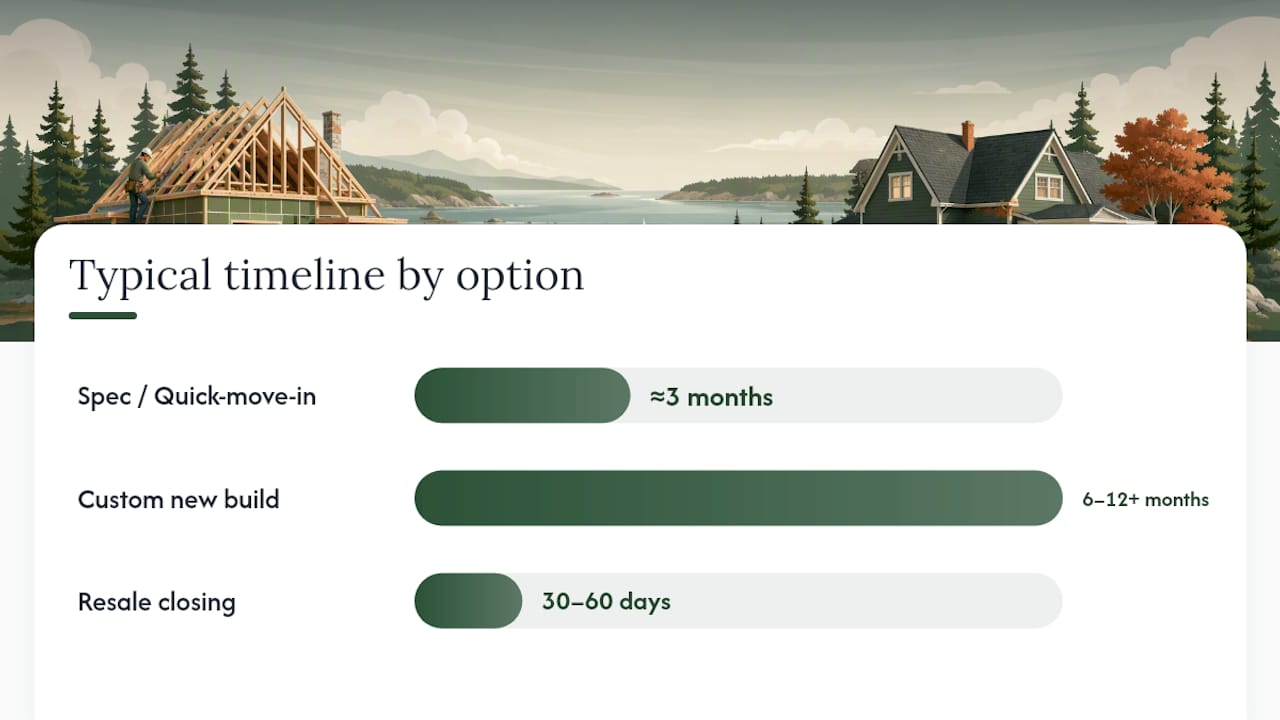
Spec or quick-move-in new builds can close in a few months; fully custom builds often take six months to a year or more, with permits, weather, and material delays as the usual culprits. Resale closings, by contrast, typically wrap up in 30 to 60 days once an offer is accepted.
The financial ripple effect matters as much as the calendar. Overlapping rent and mortgage payments, or a construction loan running alongside your current housing cost, adds up fast over several months.
Before signing anything on a new build, check for:
- A firm estimated completion date in the contract, not a vague range.
- Liquidated damages language if the builder misses that date.
- A written finish schedule so you know when selections lock in.
How Do You Choose? A Simple Buyer Checklist
Start by scoring your own priorities honestly, because the right answer is rarely about which home is “better.” It’s about which trade-offs you can live with.
Walk through these questions first:
- How soon do you need to move, and can you absorb a delay?
- What are your cash reserves for either a down payment plus incentives, or unexpected resale repairs?
- How much construction uncertainty can you tolerate without losing sleep?
- Do you want to choose your own finishes, or would you rather see exactly what you’re getting?
- Is a specific neighborhood or school district more important than a specific home?
Ask builders directly about warranty terms, finish allowances, and what happens if the final walkthrough turns up discrepancies. Ask sellers or their agents about HOA rules, recent repairs, and why they’re moving. Red flags on either side include vague completion dates, undocumented upgrade promises, or an inspection report the seller won’t discuss.
Score each option 1 to 10 on every factor, multiply by the weight, and total it.
Pro Tip: Run the scoring exercise separately for your top two properties, not just the two categories. A specific resale home might outscore a specific new build even if resale “usually” wins on paper.
What Does 20 Years in the Maine Market Teach You About This Decision?
David Haydym has spent 20 years and more than 50 closed transactions helping buyers across central and southern Maine work through exactly this choice. Patterns emerge fast: relocating families who need to move in under 90 days almost always land on resale, while buyers with flexible timelines and a strong preference for efficiency tend to gravitate toward new builds despite the wait.
The most common mistake on either side is negotiating alone: builders respond differently to an agent who knows which incentives are actually flexible, and resale sellers move faster when a knowledgeable agent frames the inspection report correctly.
Does Location Affect Value Retention Differently for New vs. Resale?
Location tends to outweigh the age of the structure when it comes to long-term value retention, but new construction and resale play by slightly different rules within that truth. A new development in a growing corridor with planned infrastructure can appreciate quickly as the surrounding area builds out, but that appreciation depends heavily on the developer finishing phases on schedule and the broader area filling in as promised. If a builder stalls out or a planned school or retail corridor never materializes, early buyers in that development can find themselves boxed in by unfinished lots for years.
Resale homes in established neighborhoods tend to have more predictable appreciation patterns simply because the neighborhood’s character, school ratings, and walkability are already known quantities. There’s less speculation involved.
The practical takeaway: if you’re buying new construction primarily as an investment, look hard at the developer’s track record and the phase of the build-out you’re entering. Early-phase buyers take on more risk and more reward. If you’re buying resale for value retention, an established location with strong fundamentals will almost always outperform a newer home in a weaker location, regardless of how updated the finishes are.
How Do Property Taxes and Insurance Compare?
Property taxes on new construction are often assessed at the completed value once the home is finished, which can mean a noticeable jump from the pre-construction estimate a buyer budgeted for. Resale homes, by contrast, usually carry a known tax history, though that number can shift significantly after a sale if the local assessor reassesses based on the new purchase price rather than the previous owner’s long-held valuation.
Insurance tends to favor new construction on the cost side. Modern electrical systems, updated plumbing, newer roofing materials, and current fire-safety codes typically translate into lower premiums, since insurers price risk based partly on the age and condition of major systems. A resale home with an aging roof or outdated wiring can see higher premiums, or in some cases, a requirement to upgrade those systems before a policy is even issued.
Neither factor should be treated as a footnote. Run both numbers, projected tax reassessment and insurance quotes, before you finalize a budget for either option, since either can shift your real monthly cost by a meaningful margin without ever showing up on the sale price.
How Do HOA Rules and Amenities Differ Between New and Established Communities?
New developments come with HOAs far more often than established neighborhoods do, and those associations tend to govern more aggressively in the early years while the developer or an appointed board is still shaping the community’s identity. Expect stricter rules on exterior paint colors, landscaping, fencing, and even holiday decorations, paired with amenities like clubhouses, pools, or walking trails that justify the fee but also add to your fixed monthly costs.
Established neighborhoods may or may not have an HOA at all, and where one exists, it’s often less restrictive simply because the community’s character is already set. Rules tend to be more predictable, and dues are more likely to reflect actual, known maintenance costs rather than ambitious plans for future amenities still under construction.
Before you commit to either, request the HOA’s governing documents, current fee schedule, and reserve fund status. A new development’s HOA might look inexpensive on paper simply because the reserve fund hasn’t had time to build up, which can mean a special assessment down the road once the community ages and major repairs come due.
When I Recommend New Construction vs. Resale
A young family relocating for work with a 60-day deadline gets a clear answer from me: resale, every time, because the timeline doesn’t leave room for build delays. A couple with a flexible move date and strong opinions about finishes usually leans new, and I tell them to nail down the structural lock-in date before anything else.
The honest trade-off is this: new construction trades speed and negotiation room for warranty coverage and control. Resale trades certainty about the finished product for faster occupancy. I help buyers weigh both against their actual timeline, not the theoretical ideal. If you want a plan specific to your situation, that’s a conversation worth having before you start touring anything.
— David
How Realtormaine Helps You Navigate This Decision
Choosing between new construction and resale gets easier with someone who negotiates both sides regularly. Realtormaine reviews builder contracts line by line, flags finish allowances that tend to cause disputes at closing, and coordinates inspections on resale properties so nothing gets missed before you sign.

David Haydym brings 20 years of experience and more than 50 closed transactions across central and southern Maine to this exact decision. That means comparative market analysis to tell you whether a builder’s price is competitive, hands-on negotiation with sellers on repair credits and closing terms, and direct experience spotting the contract language that protects you when a builder’s finish schedule slips. Whether you’re leaning new or resale, reach out to David Haydym to schedule a consultation and get a plan built around your actual timeline and budget.
Sources
- NAHB: Gap between new and existing home prices narrows (May 2025)
- Realtor
- LendingTree: New construction vs existing home