

Yes, you can buy a house while you still owe student loans. Lenders don’t ask whether you have the debt. They ask how big the monthly payment is next to your income, and which payment each loan program makes them use. That second part is where buyers get surprised, because a loan showing a $0 payment on your credit report is rarely counted as $0 in underwriting. If you plan for the number the lender will actually use, student loans become a budgeting question rather than a dead end. A local agent who knows the loan programs can help you shop with that number from day one.
TL;DR
- Lenders measure your debt-to-income ratio (DTI): total monthly debt payments divided by gross monthly income. Student loans go into the debt side.
- A $0, deferred or income-driven payment usually isn’t counted as zero. Most programs substitute a percentage of your balance, often 0.5%.
- Each program (FHA, Fannie Mae, Freddie Mac, VA, USDA) has its own rule, so the same loans can look different on different files.
- Get your real payment documented before you shop, and don’t defer or refinance loans without checking how it changes your mortgage math.
Table of Contents
- How student loans enter a mortgage application
- The payment the lender uses is not always the payment you make
- Income-driven plans, recertification and rule changes
- Who else’s payments can be excluded
- What helps before you apply
- Matching the loan program to your student debt
- Perspective: how we plan a purchase around student loans
- Start your search with your real numbers
- FAQ
- Sources
How student loans enter a mortgage application
The measure that matters is your debt-to-income ratio. Freddie Mac’s homebuyer guidance defines it as your total recurring monthly debt divided by your gross monthly income, which is your income before taxes. The more of that income that already goes to student loans, car payments and credit cards, the less room a lender sees for a mortgage payment.
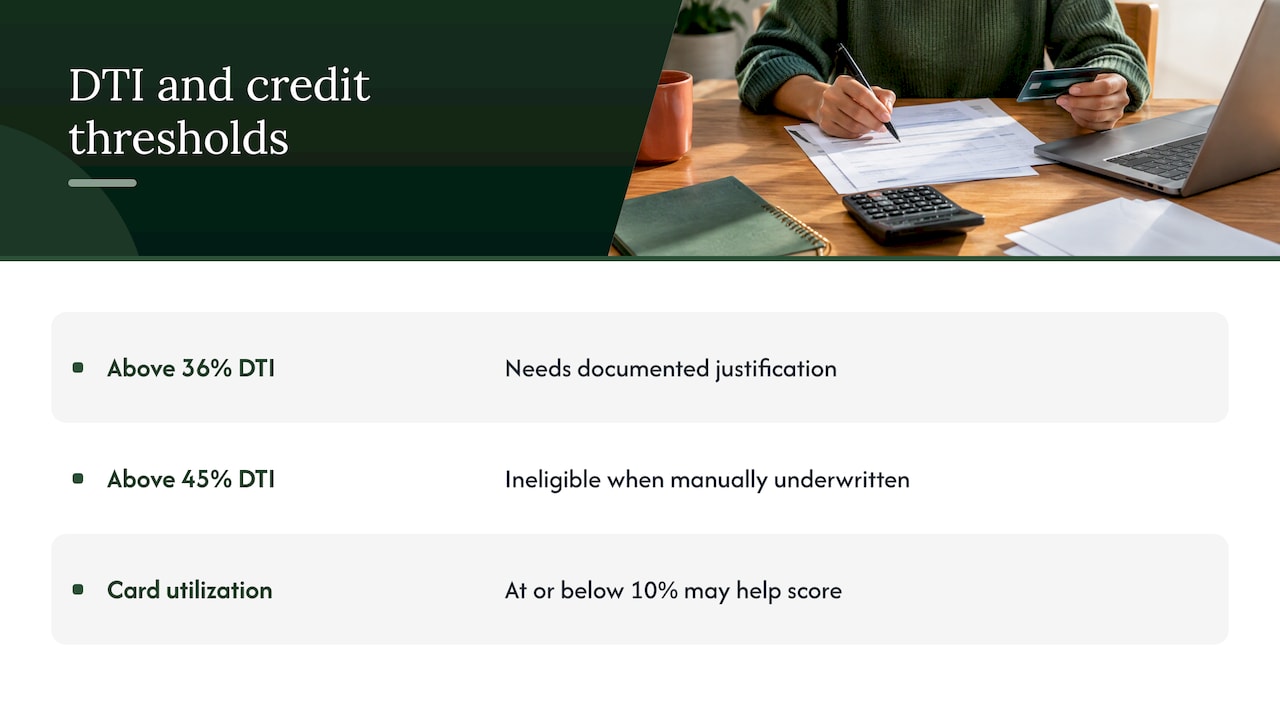
The limits are program-specific. For manually underwritten loans sold to Freddie Mac, the Seller/Servicer Guide makes a ratio above 45% ineligible, and ratios above 36% need documented justification. Automated underwriting systems can sometimes approve different ratios, so the honest answer to “what’s my limit?” comes from a lender running your actual file.
Student loans don’t automatically hurt your credit either. Freddie Mac notes that carrying the debt isn’t an automatic score drag, and that keeping credit card utilization at or below 10% can help your score. Researchers who studied Fannie Mae’s approach found underwriters put less weight on student debt than on other debt, because it is associated with on-time mortgage payment.
The payment the lender uses is not always the payment you make
This is the part most guides skip. If your loans are in deferment, forbearance or an income-driven plan with a $0 bill, the underwriter still has to put something in the DTI. What that something is depends on the loan type.
| Program | What counts when the payment is $0, deferred or lower than the standard payment |
|---|---|
| FHA | The credit report or documented payment if above zero, or 0.5% of the outstanding balance if reported as zero. A lower payment needs written documentation from the servicer (HUD Mortgagee Letter 2021-13). |
| Fannie Mae | A documented $0 income-driven payment can be used. Deferred or forbearing loans use 1% of the balance or a fully amortizing payment (Selling Guide B3-6-05). |
| Freddie Mac | Must be greater than zero. If the report shows $0, the lender uses 0.5% of the balance unless the file documents a different current payment above zero (Seller/Servicer Guide). |
| VA | No payment counted if the loan stays deferred at least 12 months past closing. Otherwise 5% of the balance divided by 12, or the credit report payment if higher (summary of the VA handbook rule). |
| USDA | The reported or documented payment if above zero, or 0.5% of the balance if zero (summary of HB-1-3555). |
Two details are worth knowing. Under the FHA rule, a student loan comes out of the calculation only with written proof from the servicer that the balance was forgiven, canceled, discharged or paid in full. And on a loan in your name alone, USDA still counts it even if someone else is paying it.
Individual lenders can also apply stricter methods than the program minimums, so ask any lender which method they use before you fall in love with a house.
A worked example
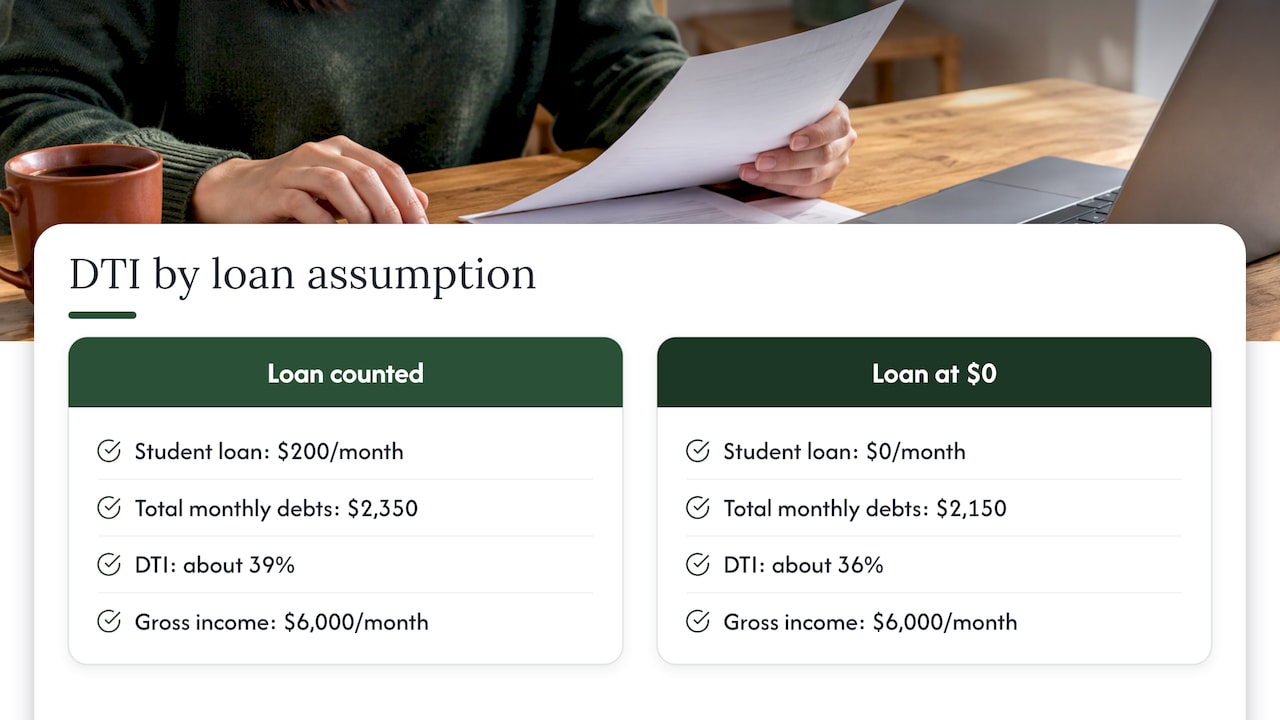
Say your household earns $6,000 a month before taxes. You have a $350 car payment, $100 in minimum card payments, and $40,000 in federal student loans on an income-driven plan that shows a $0 payment. You are eyeing a home with a projected $1,700 monthly housing payment. These figures are illustrative.
Under a 0.5% rule, the student loan counts as $200 ($40,000 × 0.005). Your total monthly debts are $1,700 + $350 + $100 + $200 = $2,350. Divided by $6,000, your DTI is about 39%.
If you had assumed the loan counted as $0, you would have calculated $2,150 divided by $6,000, about 36%. Three points of difference can move a file from comfortable to needing justification, which is why the lender’s method matters more than your bill.
Experian’s own published example makes the same point: a $300 student loan payment on $5,000 of gross monthly income pushed a borrower to about 44%, versus roughly 38% without it.
Income-driven plans, recertification and rule changes
If you are on an income-driven repayment (IDR) plan, your payment may be low because your income was low when you last certified. Freddie Mac’s guide says that if your payment will rise on or before your first mortgage payment due date, because you must recertify income, the underwriter uses the documented future payment when it is higher. A raise or new job that lifts your income can therefore also lift the student loan payment the lender uses.
The landscape has also been moving. Freddie Mac clarified in September 2023 that an amount above $0 must be used for all student loans, including IDR plans, and added IDR recertification guidance in January 2024. On the borrower side, the National Consumer Law Center’s September 2026 brief says legacy IDR plans allowing $0 payments remain available to Direct Loan borrowers who did not take on new loans or consolidate after July 1, 2026. Because your plan, your servicer’s paperwork and the lender’s guidelines all update, bring a current servicer statement to your first lender conversation.
Who else’s payments can be excluded
Sometimes a parent or relative pays a student loan that is in your name. Fannie Mae and Freddie Mac allow a non-mortgage debt to be excluded from your DTI when someone else has made the payments for the most recent 12 months without delinquencies. Fannie Mae wants canceled checks or bank statements from the payer. The exclusion isn’t allowed when the payer is an interested party in the sale, such as the seller or a real estate agent. If this fits your family, start keeping the paper trail now.
What helps before you apply
You can improve the file in the months before a preapproval. The practical steps, drawn from Contour Mortgage’s 2026 guide and Freddie Mac’s advice:
- Raise the income side. Raises, bonuses, or side work with a one- to two-year history all help the ratio.
- Lower other monthly debt. Paying off a small balance removes its whole monthly payment from the ratio, which can do more than a small cut to a large loan.
- Keep card balances low. Utilization below 30% is the baseline, and under 10% is better.
- Set up autopay and dispute errors. A wrong payment on your credit report can be corrected with your latest servicer statement, a route Fannie Mae’s guide allows.
- Hold off on new credit. Don’t open a car loan or cards right before you apply.
Two moves deserve caution. Many lenders calculate a higher payment for deferred loans, so deferring doesn’t necessarily help. And refinancing federal loans into private loans means losing income-driven repayment, forbearance and forgiveness protections, and some lenders want 12 months of on-time payments on refinanced loans. Talk to your lender before you change anything on the loans.
If your DTI is still too high, Freddie Mac points buyers to its CreditSmart education tools or a HUD-certified housing counselor. Our mortgage calculator can show you what a given price does to your monthly housing payment, and if you are also checking old lender disputes, see how mortgage overcharge settlements work.
Matching the loan program to your student debt
Because each program counts student loans differently, the best fit for your file is a real choice, not a default. A few Maine-specific reads:
- FHA with a low down payment is often the first thing buyers with student debt look at. Our piece on when 3.5% down FHA beats conventional walks through the comparison.
- VA buyers who can document a deferment lasting at least 12 months past closing may have no student payment counted. See buying in Maine with $0 down on a VA loan.
- USDA depends on the address and household income, covered in two checks that decide USDA loans in Maine.
- First-time buyers can read how to qualify for Maine help of up to $10,000.
When you are ready, a preapproval built for Maine sellers and state programs shows you what the lender will actually look at, and our look at Maine mortgage rate trends puts monthly payments in context.
Perspective: how we plan a purchase around student loans
Most buyers who tell us about student loans are worried the answer is no. In our experience of 20 years in the Maine market, the more useful question is which payment the lender will use and which program counts it most favorably.
That is why we start with the numbers, not the house. We look at your income, your loan statements and the programs side by side, so your price range reflects what underwriting will say. Our approach is built on data-driven pricing and a process without pressure, and we stay reachable beyond standard hours because preapproval questions don’t wait for business hours.
Whether you are a first-time buyer in Augusta, a family relocating to Central Maine, a senior downsizing, or an investor, the same discipline applies: know your real debt-to-income ratio, choose the program that fits it, then negotiate from a position of certainty.
David
Start your search with your real numbers
If student loans are part of your picture, we can help you turn your statements into a realistic Maine price range, match it to FHA, conventional, VA or USDA financing, and search homes that fit. David Haydym is a licensed REALTOR® with over 50 homes sold across central and southern Maine, working with first-time buyers, relocating families, investors, seniors and vacation property seekers.

See how we work with buyers on our Buying a Home in Maine page.
FAQ
Do student loans count against you when buying a house?
They count as monthly debt in your debt-to-income ratio, the same way a car loan does. They don’t disqualify you by themselves. What matters is the payment the lender must use and your income. Lenders may assess loans in deferment or forbearance differently than loans in active repayment.
Can I buy a house if my student loans are in deferment?
Yes, but most programs won’t treat the payment as zero. FHA, Freddie Mac and USDA generally use 0.5% of the balance, Fannie Mae uses 1% or a fully amortizing payment, and VA can count nothing if the deferment lasts at least 12 months beyond closing, with documentation.
What if my income-driven plan payment is $0?
Fannie Mae allows a documented $0 income-driven payment. Freddie Mac and FHA require an amount above zero, typically 0.5% of the balance. If your plan requires recertification before your first mortgage payment, the lender may use the higher future payment.
Should I pay off student loans before buying?
Not necessarily. Paying off a small loan can remove its monthly payment from your ratio, but draining savings you need for a down payment and closing costs can hurt more than it helps. Run your numbers with a lender before deciding.
Can a parent’s payments keep my student loan out of my DTI?
Fannie Mae and Freddie Mac allow it when someone else has paid the loan for the most recent 12 months without delinquencies, backed by canceled checks or bank statements. FHA and USDA rules are stricter: a loan in your name generally counts.
Sources
- Freddie Mac: Qualifying for a Mortgage with Student Loan Debt
- Freddie Mac Seller/Servicer Guide, section 5401.2
- Fannie Mae Selling Guide B3-6-05, Monthly Debt Obligations
- HUD Mortgagee Letter 2021-13
- Student Loan Debt and Access to Homeownership (ERIC)
- Experian: How Student Loans Affect Your Debt-to-Income Ratio
- Student loan payment in DTI when it shows $0 (VA rule summary)
- Student Loans in the Payment (USDA rule summary)
- Buying a House With Student Loan Debt: What Lenders Count
- Buying a Home With Student Loans in 2026
- Agency Guideline Update Summary, 2023–2024
- National Consumer Law Center issue brief, September 2026