

You can buy a house after a divorce, and there is no legal waiting period. What decides whether you are approved is your paperwork: a finished decree, a clear answer on who owns the old home and its mortgage, and income a lender can document on your own. Get those three settled first and the purchase itself is the easy part. We help buyers in central and southern Maine work through exactly that sequence, from the budget to the offer.
TL;DR
- Lenders do not require you to wait after a divorce, but they do require the decree or separation agreement, so a finalized divorce makes approval simpler.
- Support you receive can count as income only with a documented history, and support you pay counts against you as a monthly debt.
- A joint mortgage on the old home stays your obligation until it is refinanced or paid off, unless a lender excludes it under specific rules.
- Your state’s property laws and your decree decide what money you actually have for a down payment.
- Start with a realistic budget and a short list of documents, then search for homes.
Table of Contents
- When to buy: during the divorce or after
- How divorce changes mortgage qualification
- The old home and the old mortgage
- Your decree and your state’s property rules
- Documents to gather before you apply
- Build a budget for one income
- Buying in Maine after a divorce
- Our perspective
- Talk with a Realtor about your next home
- FAQ
- Sources
When to buy: during the divorce or after
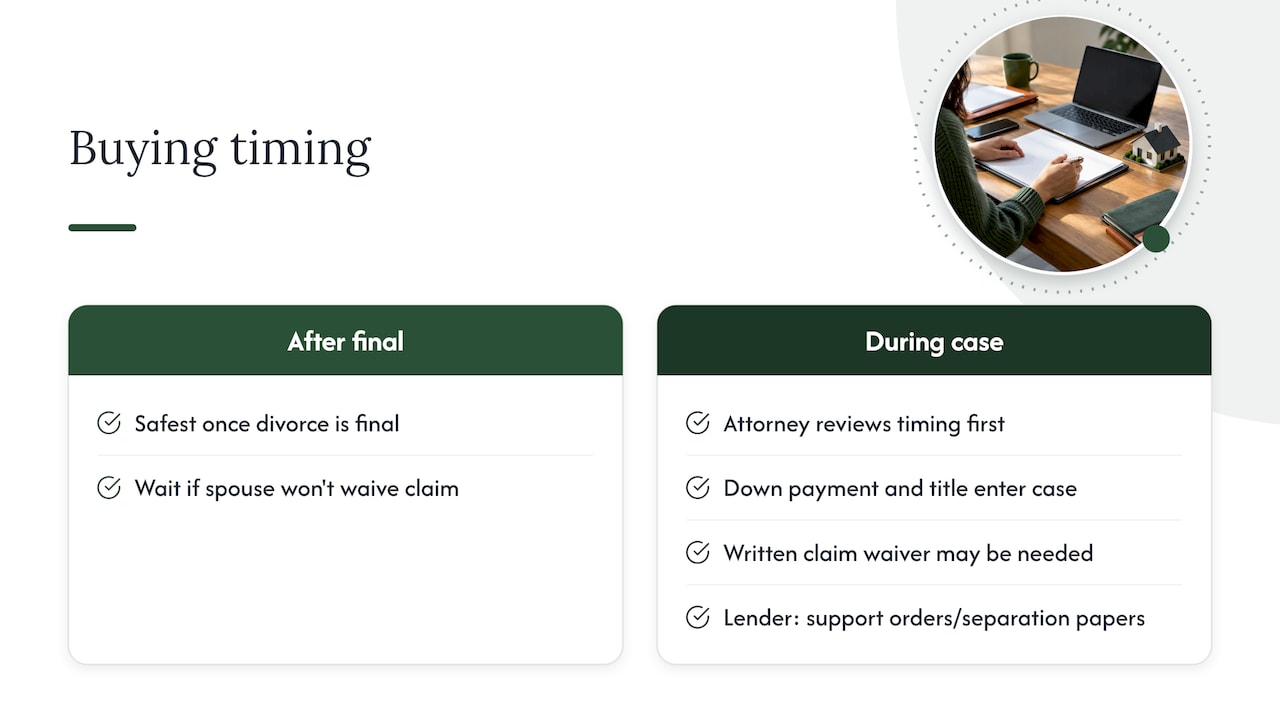
The safest time to buy is after the divorce is final. Until then, the home you buy may be pulled into the property division, and a spouse may claim an interest in it. One attorney writing for a legal services company advises that if a spouse will not sign a written agreement waiving any claim to a home you buy mid-divorce, you should wait until the divorce is finalized.
That does not mean waiting years. Buying during a divorce is sometimes possible, but you need your divorce attorney to review the timing first, because the money for the down payment and the new title can both become part of the case. If your attorney clears it, the lender will still ask for the temporary support orders or separation papers that exist at that point.
There is also a personal side. Many people choose to rent for several months after the decree while income, custody schedules and housing needs settle. That is a reasonable plan, not a setback. If you rent in the meantime, use the time to build the file a lender will want: steady pay stubs, a clean payment record on every account, and, if you receive support, the months of deposits that make it usable income.
How divorce changes mortgage qualification
A lender looks at your income, your debts and your credit, as it would for any buyer. Divorce changes each of those three, usually in ways you can plan for.
Support you receive
Alimony, child support and similar payments can count as income, but only with proof. Fannie Mae’s Selling Guide says these payments must be documented by a decree or separation agreement, with a minimum six-month history of full, regular, timely payments, and they must be expected to continue for at least three years from the application date.
That three-year rule catches many parents. If child support ends within three years, for example because a child turns 18, a lender cannot use it. A Florida family-law attorney points out that by the time six months of receipts are on record, the remaining term may already be too short. Requirements differ somewhat by loan type, so ask your lender how the specific program treats your support.
Support you pay
Support you owe is treated as a debt. Under Fannie Mae’s rules, payments ordered by a decree or written legal agreement that must continue for more than 10 months count in your recurring monthly debt. For alimony and similar payments, the lender may instead reduce your qualifying income by the payment amount. Either way, it shrinks the loan you can get.
Here is a worked example with made-up numbers. You earn $6,500 a month and owe $900 a month in support under the decree. A lender may treat you as earning $5,600 for qualifying purposes, or add $900 to your monthly debts. In both cases your price range drops, so plan your search around the lower number, not your gross pay.
Credit
A divorce does not itself lower your credit score. What does is a missed payment on a joint card or loan that the decree assigned to someone else. Both of you are still on the account until the creditor releases you. Pull your credit reports before you house hunt, close or separate joint accounts where you can, and keep every remaining payment on time.
The old home and the old mortgage
This is the part that surprises people most. A divorce decree is an agreement between you and your ex-spouse. It does not bind the lender. According to Experian, with a joint mortgage both parties remain responsible for repaying the debt whether or not they are still married. A quitclaim deed, which transfers ownership of the title, does not remove a spouse from mortgage liability either, as that same Florida attorney explains.
In practice there are three ways the old home gets resolved:
- One spouse keeps it and refinances. The mortgage moves into that person’s name alone, which means that person must qualify by themselves. The other spouse is then free of the loan.
- The home is sold. The loan is paid from the proceeds and the remaining equity is divided as the decree says. This gives the departing spouse the cleanest start, and the sale proceeds often become the down payment on the next home.
- One spouse leaves while the loan stays joint. It is allowed, but it is the hardest on the person buying again, because the payment can still count against them.
If you are the one who moved out, ask your lender about contingent liabilities. Fannie Mae’s guide says a debt assigned to another party by court order, but not released by the creditor, is not required to be counted in your monthly debt, although the lender cannot ignore payment history from before the assignment. A mortgage lender in California told National Mortgage News that some lenders exclude this kind of debt when the decree clearly says the departing spouse bears no responsibility. That is lender-specific, so raise it early, and make sure your attorney words the decree clearly on this point.
Your decree and your state’s property rules
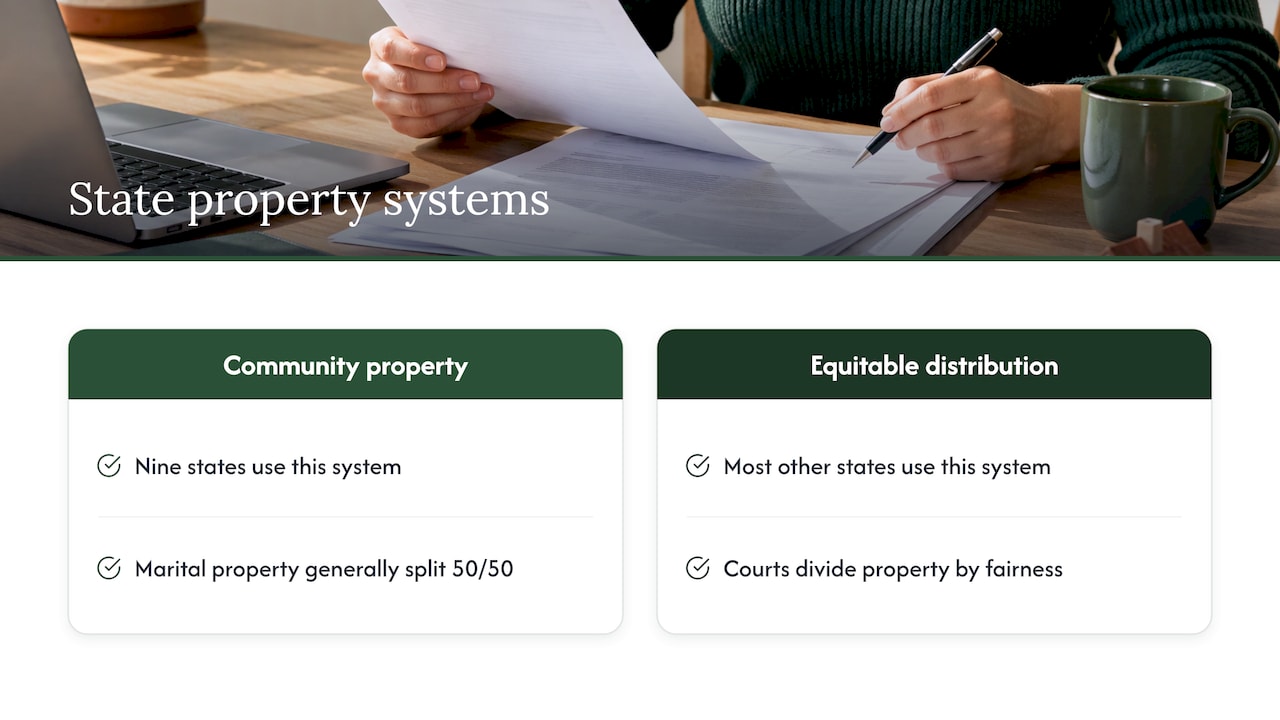
What you walk away with depends on where you divorced. Nine states, including Arizona, California, Texas and Washington, are community property states, where property acquired during marriage is generally split 50/50. Most others use equitable distribution, where courts divide property by fairness. The American Bar Association’s Family Law Section describes both systems and notes that some states let a party, often the custodial parent, stay in the home temporarily after the divorce or during the case.
Why this matters for a buyer: your down payment may come from a share of home equity, a retirement account split or a cash settlement. Know exactly what the decree gives you and when it is paid. A lender will want to see where every dollar of your down payment came from, so move settlement money into your own account early and keep the transfer records.
Questions about what your decree means for property, or how to change it, belong with your divorce attorney. A Realtor and a lender work from the decree as written.
Documents to gather before you apply
Having these ready shortens the process and avoids the delays that cost buyers their offers:
- The final divorce decree, separation agreement or property settlement, with every page and any amendments.
- Proof of support received or paid, such as court orders and bank deposits showing the history.
- Recent pay stubs, two years of tax returns and recent bank statements for every account the funds will come from.
- The statement for any mortgage you still hold, and proof of how the old home was resolved: a closing statement, a refinance or a recorded deed.
- A letter explaining large deposits, such as a settlement payment, with the paperwork behind them.
Fannie Mae’s guidance explicitly calls for a copy of the decree or equivalent to be kept in the loan file when support is counted. Expect the underwriter to read it closely.
Build a budget for one income
Most people buying after divorce are buying on a single income for the first time in years. Build the budget from the bottom up:
- Start with your take-home pay plus any support that qualifies under the lender’s history rule.
- Subtract support you pay, child care, health insurance and any debts the decree assigned to you.
- Decide what monthly housing cost leaves room for savings. The number a lender approves is a ceiling, not a target.
- Add property taxes, homeowner’s insurance and maintenance to the mortgage payment. Maine buyers should also factor in winter heating costs and, for condos or planned communities, monthly association dues.
- Set aside money for repairs. If the home you like needs a kitchen or bath update, a guide to creating a budget for home remodeling helps you decide whether you can take that on now or should choose a move-in-ready home.
If your income, custody schedule or job is still unsettled, a few more months of renting can improve the numbers considerably. If you are ready, the budget tells you which towns and property types are realistic.
Buying in Maine after a divorce
If you are searching in central or southern Maine, a few local pieces apply. First-time buyer programs can reduce the cash you need, and many divorced buyers qualify as first-time buyers if they have not owned a home recently. Our guide to the first-time homebuyer path in Maine covers how to qualify. Once you have an accepted offer, the Maine escrow timeline shows what happens between offer and closing, so no deadline surprises you.
If the old home is being sold, you may be buying and selling at the same time. Choose a closing team carefully; our list of questions for vetting a title company or attorney helps. And if you dream of a smaller place or a coastal getaway after the divorce, the guide to second home financing in Maine explains how lenders treat those purchases.
Our perspective
We meet buyers at a point when they are rebuilding, and the biggest mistake we see is rushing to find a house before the paperwork supports it. A new home is not a way to feel settled. It is a financial commitment that has to work on your income alone.
Our approach is a transparent process without pressure. Before we look at a single listing, we talk through your timeline, your budget and what your decree says about the old home. With 20 years in the Maine market, we use local data to price offers and negotiate, and we guide buyers through FHA and conventional financing so they know which path fits their documents.
We also know that divorce does not keep business hours. We are available beyond standard hours so you can reach us when a question or an offer deadline comes up. Whether you are a first-time buyer, a parent relocating to a new Maine community, a senior downsizing or someone looking for a coastal place, the plan should be yours, built at your pace.
David
Talk with a Realtor about your next home
If you are ready to start, or just want to learn what you could afford, we can walk you through the buying process in central and southern Maine: home search, pricing strategy, negotiation, comparative market analyses and guidance on FHA and conventional financing. We have helped over 50 families buy and sell homes. See how we work on our Buying a Home page.

Bring your decree summary, your budget and your questions. We will help you turn them into a search plan that matches your timeline.
FAQ
How long after a divorce can I buy a house?
There is no legal waiting period. You can apply as soon as your documents are in order. Lenders need the decree or separation agreement, so most buyers wait until the divorce is final. If you receive support you want counted as income, the six-month payment history can shape your timing.
Can I get a mortgage while I still have a joint mortgage on the old home?
Often yes, but that payment may count in your debts unless a lender can exclude it. Under Fannie Mae’s rules, a debt assigned to your ex-spouse by court order and not released by the creditor does not have to be counted. Lender practices vary, so raise it at the start.
Does child support or alimony count as income?
It can, with a decree or agreement, a documented payment history and an expected continuance of at least three years under Fannie Mae’s rules. Support you pay counts against you instead. Ask your lender how your specific loan type treats each.
Do I need a divorce attorney before buying?
If you are still in the process, yes. Your attorney should confirm that buying now will not complicate the property division and that your decree clearly assigns the old mortgage. After the divorce is final, go back to your attorney if the decree leaves any question about the old home or debts.
Can I buy as a first-time buyer after divorce?
Many divorced buyers who have not recently owned a home can use first-time buyer programs, but eligibility rules vary by program. Check the program rules and your lender’s guidelines, and we can help you compare options in Maine.
Sources
- How to Buy a House While Getting Divorced
- Fannie Mae Selling Guide B3-3.4-02: Alimony, Child Support, Equalization Payments, or Separate Maintenance
- Fannie Mae Selling Guide B3-6-05: Monthly Debt Obligations
- Keeping Your Home After Divorce | Kalish & Jaggars, PLLC
- Divorce and Your Mortgage: What You Need to Know | Experian
- Divorce and mortgages: What lenders need to know | National Mortgage News
- Legal and Practical Strategies for Navigating Real Property in Divorce | American Bar Association
- Creating a Budget for Home Remodeling | The Bath & Kitchen Gallery