
A public offering statement in Maine is the written disclosure packet a condominium developer (the “declarant”) must prepare and hand you before you sign a contract to buy a unit from them. Under Maine’s condominium statute, the declarant must prepare it before offering any unit to the public. If you get it late, or never, Maine law gives you a right to walk away. This guide explains what is in the packet, when it applies, and what to do with it, in plain terms for buyers, not lawyers.
TL;DR
- A public offering statement covers new condo sales from a developer. Resales of existing units use a different set of papers, the resale certificate.
- It must be delivered before you sign the purchase contract, along with any amendments.
- If you did not acknowledge in writing that you received and reviewed it before signing, you can cancel before closing by written notice and get your payments back.
- A condo of 12 units or fewer with no development rights can use a short version: the declaration and the bylaws.
- A house with no condo association does not have one. Those sales use the Maine seller disclosure instead.
Table of Contents
- What a public offering statement is
- When you will receive one
- What is inside the statement
- Your right to cancel
- Who is responsible if the statement is wrong
- Public offering statement vs. resale certificate vs. seller disclosure
- How to review the packet, step by step
- Who should care most
- Working with a local agent on condo documents
- Our perspective
- FAQ
- Sources
What a public offering statement is
Maine’s Condominium Act is Title 33, Chapter 31 of the Maine Revised Statutes. Its fourth article, titled “Protection of Condominium Purchasers,” runs from section 1604-101 through 1604-118. It covers the offering statement, the purchaser’s right to cancel, resales, escrow of deposits, and warranties.
Think of the public offering statement as the full disclosure on a new-construction condo project. It tells you who the developer is, what you are buying, what it will cost to own, what the rules are, and what rights you keep if something goes wrong. Two terms help:
- Declarant: the developer who creates the condominium and sells units.
- Declaration: the recorded document that creates the condominium and sets out how it works. The bylaws are the association’s operating rules.
The statute is aimed at protecting buyers who are dealing with the party that wrote all the rules and knows the project best. That is why the paperwork is heavier than in an ordinary house sale.
When you will receive one
The duty starts when a declarant, or another person in the business of selling real estate who offers a unit for their own account, offers a unit to the public. In practice you will see one when you buy:
- a brand-new unit in a new building or townhouse-style condo community,
- a unit in a building converted from apartments or another use to condos,
- a unit that is part of a phased project where the developer is still building.
The responsibility can be passed along. A declarant may transfer preparation of all or part of the statement to a successor declarant or to a real-estate seller offering units for their own account, as long as the transferor supplies the information needed.
The rules also reach beyond condos created in Maine. The Condominium Act extends the public offering statement provisions to offers, contracts signed by any party in Maine, or dispositions in Maine of out-of-state condominiums, unless an exemption applies. That matters for vacation buyers eyeing a unit marketed from out of state.
When you will not receive one
Section 1604-101(b) lists six dispositions where neither a public offering statement nor a resale certificate is required:
- gifts,
- court-ordered transfers,
- transfers by a government or government agency,
- foreclosures and deeds in lieu of foreclosure,
- sales to a person in the business of selling real estate who will in turn offer the units to buyers,
- transfers the purchaser can cancel at any time, for any reason, without penalty.
If you are buying a single-family home, a multi-family building with no condominium declaration, or a lot, this statute does not apply to you at all.
What is inside the statement
Section 1604-103(a) requires the statement to contain, or fully and accurately disclose, 19 categories of information. They include:
- the identity of the declarant and of the condominium,
- details of the condominium and its construction,
- the governing documents,
- budgets and fees,
- warranties,
- your cancellation rights,
- escrow terms for your deposit,
- insurance and land-use requirements.
You do not need to memorize the list. You need to know which parts drive your decision. For most buyers those are the budget, the fees, the warranties, the escrow terms and the rules in the declaration and bylaws.
Projects that are still growing
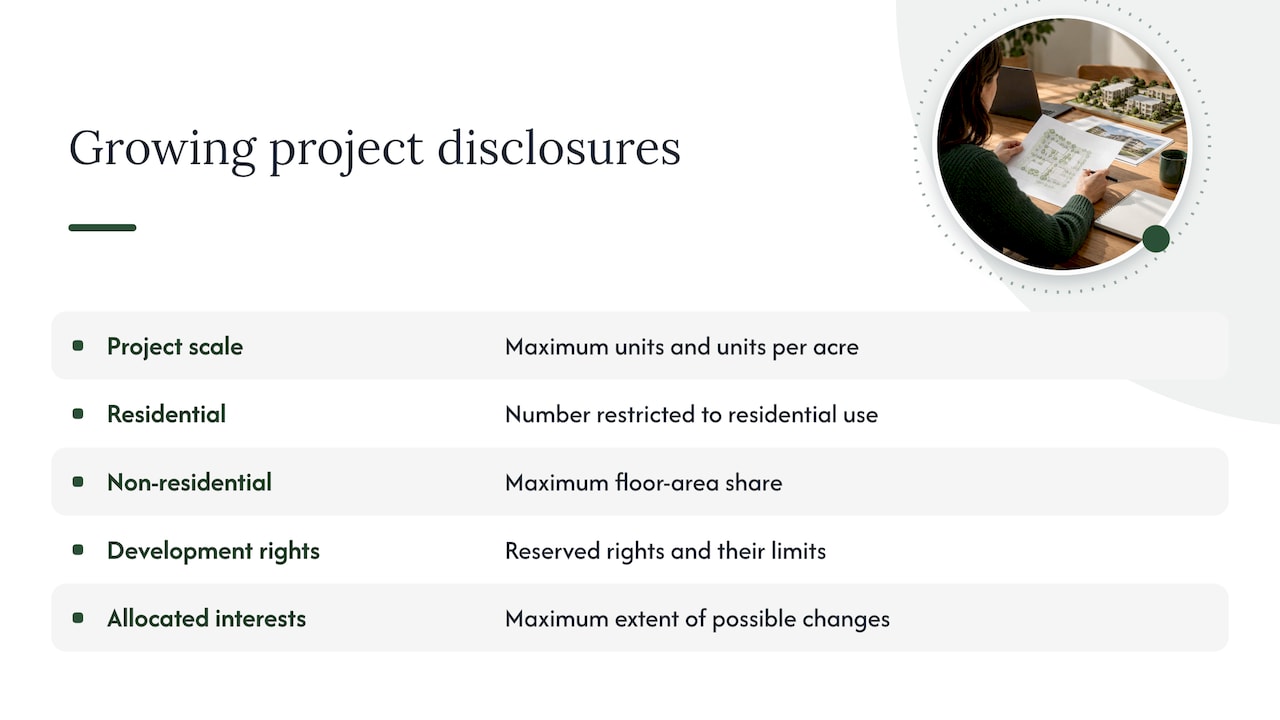
When the developer keeps the right to add units or change the project later, section 1604-104 adds more disclosure. The statement must state the maximum number of units and units per acre that may be created, how many are restricted to residential use, the maximum share of non-residential floor area, a description of the reserved development rights and their limits, and the maximum extent to which each unit’s allocated interests may change.
In plain terms: if you buy unit 4 of a planned 40, you should know that your share of expenses and voting may shift as units are added, and by how much at most.
The short version for small condos
For a condominium of no more than 12 units, with no development rights and no reserved power to make it part of a larger development, the statement may consist of the declaration, including plots and plans, and the bylaws. A four-unit building in a Maine town may therefore hand you two documents rather than a thick binder. Read both fully anyway.
Projects already registered elsewhere
A declarant can satisfy the preparation requirement by delivering a copy of a statement filed with the U.S. Securities and Exchange Commission or Maine’s Office of Securities if the interest is registered with either. For an out-of-state condominium, a similar statement required under that state’s law also works. If a resort-style coastal or lake unit comes with a differently titled packet, ask whether it is being delivered under this rule.
Your right to cancel
This is the part that matters most. Under section 1604-107:
- The person required to deliver the statement must give you a copy of it and all amendments before you sign a contract for sale.
- Unless you acknowledge in writing that you received and reviewed it before signing, you may cancel the contract at any time before conveyance (the transfer of the unit at closing).
- You cancel by written notice to the declarant. It may be hand-delivered or sent by prepaid U.S. mail to the declarant or its agent for service of process.
- Cancellation is without penalty, and your payments must be refunded promptly.
- After you receive and review the statement, you may waive the right expressly and in writing. You cannot cancel under this section once you accept conveyance.
The statement itself must tell you this: under section 1604-103(a)(11), it must say you may cancel a contract with a declarant before conveyance unless you reviewed the statement before signing, and that you lose the right once you accept conveyance.
Worked example
Say you put a deposit down on a new condo in a coastal town after a sales-office visit and sign a contract the same day. Two weeks later you receive the packet by email. You had not acknowledged in writing that you reviewed it before signing. Under the statute you can still cancel by written notice before closing, and the deposit comes back. If instead you signed a line saying you received and reviewed it first, that cancel right is gone, so do not sign that acknowledgment until you have actually read the packet.
Where your deposit sits
The statement must also say that deposits will be held in escrow until closing and returned if you cancel under section 1604-107, and it must name the escrow agent with an address. Check that the name on the packet matches the name on your deposit instructions. For how escrow runs from offer to closing, see our Maine escrow timeline.
Who is responsible if the statement is wrong
Responsibility follows preparation. Under section 1604-102©, whoever prepared a portion of the statement is liable for material misstatements or omissions in that portion. A declarant who only delivers a statement written by others is liable only if they knew, or should have known, of the problem. The practical point for you is to treat the packet as a legal document to be read closely, and to keep every version and amendment you are given.
Public offering statement vs. resale certificate vs. seller disclosure
Most confusion comes from three different documents that sound alike. Here is how they differ.
| Public offering statement | Resale certificate package | Seller property disclosure | |
|---|---|---|---|
| Applies to | New condo units sold by a declarant | Resales of condo units | Residential property sales generally |
| Who provides it | Declarant, or whoever took over preparation | Unit owner, with certificate from the association | Seller |
| Timing | Before you sign the contract | Before contract, or otherwise before conveyance | No later than the time you make an offer |
| If late | Cancel before conveyance unless you acknowledged review | Contract voidable until certificate provided and for 5 days after, or until conveyance | Terminate or withdraw within 72 hours of receipt |
| Law | Title 33, §1604-102 to 1604-107 | Title 33, §1604-108 | Title 33, §174 |
Condo resales
Buying someone’s existing condo is the most common case. There is no developer packet. Instead section 1604-108 requires the owner to give you the declaration (other than plats and plans), the bylaws, the rules or regulations, and a reasonably current certificate. The certificate covers rights of first refusal, monthly common expense assessments and unpaid amounts, other fees, anticipated capital expenditures, reserves, the association’s latest balance sheet and income and expense statement, the current operating budget, unsatisfied judgments and pending suits, and insurance coverage.
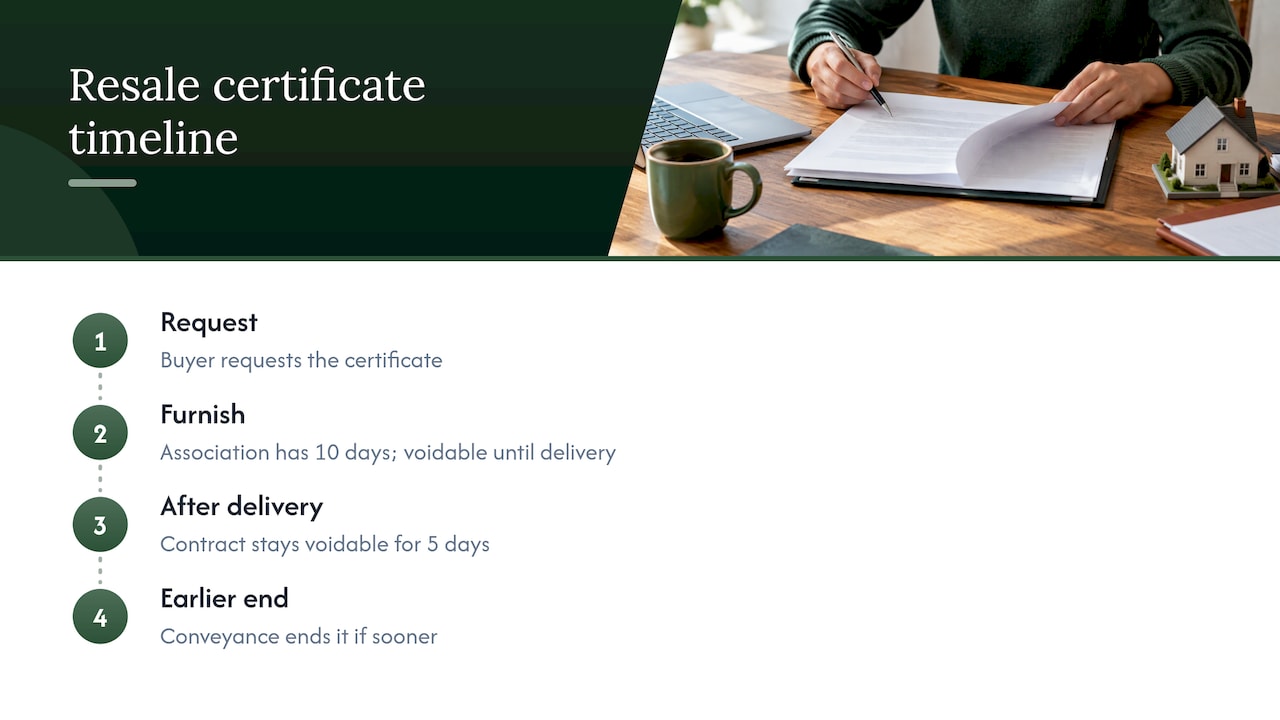
The association must furnish the certificate within 10 days after you request it and pay any reasonable fee. The contract is voidable until the certificate is provided and for 5 days afterward, or until conveyance, whichever comes first. We walk through the timing in our guide to Maine condo documents and the 10 day resale certificate rule.
The seller disclosure for any home
Separately, Maine’s residential property disclosure law requires the seller to deliver the disclosure statement no later than the time you make an offer. If it arrives after the offer, you may terminate the contract or withdraw your offer within 72 hours of receipt, without penalty, and any deposit is promptly returned. Our article on mapping your Maine disclosures to Title 33 covers it from the seller’s side.
How to review the packet, step by step
Here is a routine that works for new-condo buyers. At each step we note where a local agent saves you time.
- Confirm which document you should be getting. New unit from a developer: public offering statement. Resale: resale certificate package. Ordinary house: seller disclosure. An agent who handles condos regularly can tell you in minutes which applies to the listing in front of you.
- Get everything before you sign. Ask for the statement and all amendments in writing. Do not sign any acknowledgment of receipt until you have read them. Where it goes wrong: buyers sign a pile of papers at a sales office and give up their cancel right without realizing it.
- Read the budget and fee sections first. Monthly assessments are what you will live with. Compare them with what you can afford alongside your mortgage. Our guide to HOA fees in Maine lists what to check.
- Check development rights. If the developer reserved rights to add units, find the maximum number and how your share could change.
- Read warranties and cancellation terms. Note who gives the warranty, for how long, and what it covers.
- Confirm the escrow agent. The name and address in the statement should match where your deposit goes.
- Check financing eligibility. If you plan to use an FHA loan, the project may need to be approved. See our FHA condo approval checklist.
- Mind your timeline. Inspection and other contingency windows are short. Our guide to Maine inspection contingencies explains how to book fast.
- Keep your cancel right in view. If you need to cancel, do it in writing and deliver or mail it to the declarant or its agent for service of process. Keep proof.
This packet is a legal document. If a clause is unclear or a dispute arises, a Maine real estate attorney is the person to read it with you. Your agent can flag what to ask about and coordinate the rest.
Who should care most
First-time buyers. New condos are a common starting point, and the paperwork is unfamiliar. The right to review before signing is worth using fully.
Families relocating to Central Maine. If you are buying from a distance, you may receive documents electronically. Build time into your plan so the review happens before you commit.
Seniors downsizing. A condo can simplify upkeep, but monthly fees, reserves and rules decide whether it simplifies your finances too. Read those pages closely.
Vacation buyers on the coast. Seasonal units often sit in larger or phased projects. Development rights, insurance and land-use disclosures deserve extra attention. On the water, our lakefront property checklist adds more to look at.
Investors. Rental plans depend on the declaration and rules. Read them before you assume what you can do with a unit.
Working with a local agent on condo documents
We are David Haydym’s team at RealtorMaine. David is a licensed REALTOR® with 20 years in the Maine market, across central and southern Maine, and over 50 homes sold. Our services include home search, pricing strategy, negotiation, guidance on FHA and conventional financing, and document review for condos and townhouses.
If you are weighing a new condo or a resale unit, talk to us about buying a home, and we will go through the documents with you before you sign.

David is available beyond standard hours, which helps when a signing deadline lands in the evening.
Our perspective
Most buyers meet the public offering statement at the worst moment: at a sales table, with a deposit check in hand and a pen offered. The law was written to slow that moment down, and we think you should use every bit of it.
Our approach is simple. Before you sign anything, we want you to know which document applies, what the monthly cost will be, and what rights you still hold. Over 20 years in Maine, I have found that a transparent process with no pressure beats a rushed one. We review condo and townhouse documents with our clients, explain them in plain words, and use data to price and negotiate so the numbers match the paperwork.
Whether you are a first-time buyer, a family relocating, someone downsizing, an investor or a vacation-home buyer, you deserve an agent who answers when you have a question, including after hours.
David
FAQ
What is a public offering statement?
It is the disclosure packet a condominium developer must prepare and deliver to a buyer before the buyer signs a contract for a new unit. Maine law sets out its contents in Title 33, sections 1604-102 through 1604-106. It covers the project, the budget, the rules, warranties, escrow and your cancellation rights.
Do I get one when I buy a resale condo?
No. For resales, the owner provides the declaration, bylaws, rules and a resale certificate under section 1604-108. The association must provide the certificate within 10 days of your request and payment of any reasonable fee. The contract is voidable until you have it and for 5 days afterward, or until conveyance.
Can I back out if the developer gave me the statement late?
Yes, in many cases. Unless you acknowledged in writing that you received and reviewed the statement before signing, you may cancel by written notice to the declarant at any time before conveyance. Payments must be refunded promptly. You lose this right once you accept conveyance, or if you later waive it in writing after reviewing the statement.
Does a single-family house need a public offering statement?
No. The statement belongs to condominium sales. For a house, the seller must deliver the Maine property disclosure no later than when you make an offer. If it comes after the offer, you have 72 hours from receipt to terminate or withdraw without penalty.
Sources
- Title 33, §1604-102: Liability for public offering statement
- Title 33, Chapter 31: Maine Condominium Act (full text)
- Title 33, Chapter 31: Maine Condominium Act (article index)
- Title 33, §1604-101: Applicability; waiver
- Title 33, §1604-103: Public offering statement; general provisions
- Title 33, §1604-104: Public offering statement; developments subject to development rights
- Title 33, §1604-106: Public offering statement; condominium securities
- Title 33, §1604-107: Purchaser’s right to cancel
- Title 33, §1604-108: Resales of units
- Title 33, §174: Delivery and time of disclosure