
A 1031 exchange lets you sell Maine investment or business real estate and defer the federal capital gains tax by buying other qualifying real property. The federal rules are the same in every state. What is specific to Maine is the real estate withholding on sales by nonresidents, the form that can exempt you from it, and a market where finding the right replacement property inside 45 days is harder than it sounds.
This guide walks through the deadlines, the Maine paperwork, the vacation home trap and the practical side of buying and selling. It is general information from a Realtor, not tax or legal advice. Before you sign a listing agreement or a purchase contract, talk to a CPA or tax attorney and a qualified intermediary.
TL;DR
- A 1031 exchange defers tax only on real property held for business or investment. Your own home does not qualify, according to the IRS instructions for Form 8824.
- You have 45 days to identify replacement property and 180 days to close, or until your tax return due date with extensions if that comes first.
- Maine requires buyers to withhold 2.5% on certain sales of $100,000 or more. A 1031 exchange does not cancel that automatically: you must file Form REW-5 at least 5 business days before closing.
- Vacation homes qualify only if they meet the IRS safe harbor on ownership, rental days and personal use.
- The tax is deferred, not erased. Plan your exit before you buy.
Table of Contents
- What a 1031 exchange does, and what it does not
- The two federal deadlines
- The qualified intermediary and the disqualified person trap
- Maine real estate withholding: the part out-of-state sellers miss
- Exchanging across state lines
- Vacation and seasonal property: the safe harbor
- Tenants, inspections and other closing-table details
- Our perspective: the exchange is won before the listing goes live
- Planning your exit before you enter
- Buying or selling Maine property in an exchange
- A short checklist
- FAQ
- Sources
What a 1031 exchange does, and what it does not
Section 1031 of the Internal Revenue Code lets you swap one investment or business property for another of like kind without recognizing the gain at the time of the swap. The IRS explains in its like-kind exchange tips for real estate that these exchanges involve business or investment property exchanged solely for other business or investment property of the same type. Since 2018, according to the Form 8824 instructions, the treatment applies only to real property, not equipment, vehicles or other personal property.
For real estate, like-kind is broad. A Portland duplex can be exchanged for farmland, a commercial building or a small apartment building, as long as both are held for investment or business use. What matters is how you hold the property, not what it looks like.
Two points surprise people:
- It defers, it does not forgive. The gain rolls into your replacement property through a lower cost basis. Tax experts describe the exchange as a tool for compounding wealth rather than a permanent tax-free pass, a point made in the IRS Revenue Procedure 2008-16 materials investors often cite. Eventually you sell for cash, die holding the property, or keep exchanging. Each path has its own tax consequence, so ask your CPA which one fits you.
- Your primary residence is out. If you are selling the house you live in, the exchange is not available. The Form 8824 instructions point to the Section 121 exclusion instead: up to $250,000 of gain for a single filer and $500,000 for married couples filing jointly, if you meet its tests.
The two federal deadlines
The calendar is the part of a 1031 exchange that cannot be negotiated. Both clocks start when you transfer the property you are selling, which the IRS calls the relinquished property.
| Step | Deadline | Notes |
|---|---|---|
| Identify replacement property | 45 days | Written identification, delivered as the rules require |
| Complete the purchase | 180 days, or your tax return due date including extensions, whichever is earlier | Per the Form 8824 instructions |
The 45 days are not business days, and weekends and holidays do not extend them. In practice, that means you should be touring and analyzing candidates before your own property goes under contract, not after closing.
What the 180-day limit means for an October or November sale
Because the 180 days can be cut short by your tax return due date, a sale that closes late in the year can leave you with less than six months unless you file an extension. Ask your CPA about this before you close, not after. It is a common and avoidable surprise.
The qualified intermediary and the disqualified person trap
In a standard delayed exchange, you never touch the sale proceeds. A qualified intermediary (QI) holds the money between the sale and the purchase. If the cash lands in your account, even briefly, the exchange can fail.
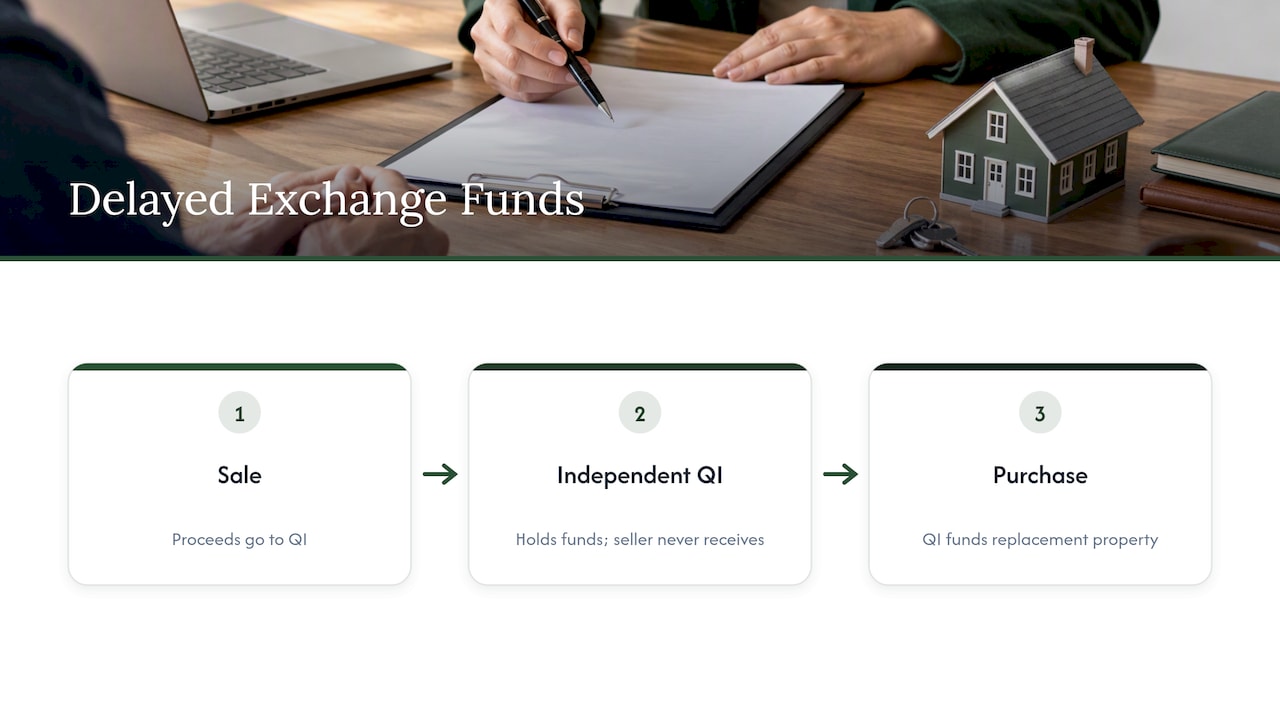
The QI must be independent. Under the IRS rules, your own agent, your attorney or a family member generally cannot serve, because they are disqualified persons. A QI that does not meet the requirements can turn the whole exchange into a taxable sale. That is why we, as your Realtor, never act as your intermediary and will not recommend that you ask one of your own advisers to do it. Choose a firm that does this work full time, ask what protects the funds it holds, and get the QI engaged before your sale contract is signed.
Maine real estate withholding: the part out-of-state sellers miss
This is the Maine-specific piece, and it is where the top search results are most useful, so it is worth getting precisely right.
According to the Maine Revenue Services real estate withholding FAQ, the buyer of Maine real property must withhold 2.5% of the total consideration from a nonresident individual, estate or business seller when the consideration is $100,000 or more. That money is treated as an estimated tax payment toward any Maine tax you owe on the sale. Maine also publishes a real estate withholding overview for nonresidents who sell Maine real property.
A 1031 exchange does not make this go away by itself. The state’s FAQ treats it as a separate requirement, and the same applies if your replacement property is in another state. The federal exchange rules govern the tax deferral, but Maine’s withholding still attaches to the Maine sale.
Filing Form REW-5
To ask for an exemption or a reduction, the seller files Form REW-5, the request for exemption or reduction in withholding of Maine income tax on the disposition of Maine real property. For an exchange you will need to show your 1031 exchange contract.
The practical rules:
- File at least 5 business days before closing. Maine Revenue Services treats this as a hard floor. The state does not issue a retroactive certificate once the sale has closed.
- If you miss it, the buyer must remit the withheld funds. You then recover them only when you file your Maine income tax return, which can tie up cash you planned to put into the replacement property.
- Tell the closing attorney or title company early. They need the certificate or the decision in hand to know what to do with the 2.5%.
Let us put numbers on it. On a $400,000 sale, 2.5% is $10,000. Not much in a deal that size, but if that money is already committed to your replacement purchase, a $10,000 hole at closing can cost you the next deal. If you are a Maine resident selling Maine property, check with your tax professional whether withholding applies to you at all, since the state describes it as applying to nonresident sellers.
For a wider look at what you will pay at the table, see our breakdown of Maine closing costs for buyers and sellers.
Exchanging across state lines
People ask whether they can sell in Maine and buy in Florida, or the reverse. Yes. The Form 8824 instructions are federal, and the exchange rules do not stop at a state border, as long as both properties are U.S. real property held for investment or business use. Foreign real property is not like-kind to U.S. real property.
The state layer is what changes. You still deal with Maine’s withholding on the Maine sale, and the state where you buy may have its own rules for out-of-state buyers or for how it treats gain deferred from another state. Your CPA should confirm both ends before you commit.
Vacation and seasonal property: the safe harbor
Maine’s lakes, islands and coastal towns attract owners who rent a camp for part of the season and use it themselves the rest of the time. That mix is exactly what the IRS scrutinizes. A second home used mainly for personal purposes does not qualify.
IRS Revenue Procedure 2008-16 offers a safe harbor: if you meet its standards, the IRS will not challenge whether the dwelling qualifies as property held for business or investment. As summarized in this analysis of the procedure, the standards are:
- You owned the dwelling for at least 24 months before the exchange (for the property you are selling) or hold it for 24 months after (for the one you are buying).
- In each of the two 12-month periods, you rented it to someone else at a fair rental for at least 14 days.
- Your personal use in each period did not exceed the greater of 14 days or 10% of the days it was rented.
The safe harbor applies to the relinquished property, the replacement property or both, so you have to track the history of each. This is where the famous two-year rule comes from. It is not a flat requirement for every exchange, but it is central to vacation homes. The Tax Adviser’s overview of the procedure is a readable explanation of the background.
Keep rental agreements, payment records and a calendar of personal use. If you are shopping for a seasonal property you intend to exchange into, we can help you screen for towns where short-term or seasonal renting is realistic, and your tax adviser can decide whether your plan fits the safe harbor.
Tenants, inspections and other closing-table details
Most Maine exchange sellers are selling rental property, which brings its own deadlines. If your building has tenants, their security deposits and leases transfer in specific ways, and mishandling them can create liability. Our guide to selling Maine property with tenants covers deposit handling at closing.
On the buying side, a replacement purchase has to survive inspection inside a tight window. Read how inspection contingencies work in Maine before you write an offer with a 45-day clock running. If the property was built before 1978, the lead paint rules add another step. Condos and townhouses bring their own paperwork, covered in our condo documents guide.
Our perspective: the exchange is won before the listing goes live
We have worked in Maine real estate for 20 years, and the pattern is consistent. Exchanges rarely fail because the tax rule is hard to understand. They fail because the sale and the replacement purchase are planned as two separate projects.
A few things we push clients to do:
- Start the replacement search first. Know your target price range, towns and property type before you list. Identifying candidates in 45 days is realistic only if you have already looked at what is for sale.
- Pick the QI and the CPA before the contract. Both need to be in place before closing, and neither is a call you want to make in a hurry.
- Price the sale with the exchange in mind. A comparative market analysis tells you what the property can realistically bring and how long it may take. A listing that lingers eats days you cannot get back, and a failed sale can sink the replacement deal.
- Write contracts that respect the calendar. Closing dates, inspection periods and financing contingencies on the replacement property should be built around the 180-day limit, with a backup property identified.
- Be honest about the replacement property. Buying something just to meet a deadline is a way to turn a tax deferral into a bad investment. A tax saving is not worth a property that does not earn.
We are Realtors, not tax advisers. Our job is to handle the real estate side with care: local knowledge, data-driven pricing, straight talk on negotiation, and being reachable outside regular hours when a deadline is close. The tax structure belongs to your CPA and intermediary, and we work alongside them.
— David
Planning your exit before you enter
Because the gain is carried into the new property, the real question is what you plan to do in 10 or 20 years. Some investors keep exchanging and hold until their estate plan takes over. Others sell and pay the tax at a time when their income is lower. Neither is automatically right.
Owners approaching retirement sometimes compare their options, including borrowing against property, such as through a reverse mortgage on rental property, before deciding whether to exchange or sell. Whatever you consider, run the numbers with a CPA and a financial planner, and include Maine’s own tax treatment alongside the federal one.
The local property tax picture matters too. The effect of the homestead exemption on a primary residence does not apply to a pure rental, so review how Maine property taxes work before you model returns on a replacement property.
Buying or selling Maine property in an exchange
If you own investment or seasonal property in central or southern Maine and are weighing an exchange, we can help with the real estate half of it: a pricing strategy and market analysis for the sale, a focused search for replacement property, and negotiation built around your deadlines. See our investment property and vacation property services or reach out before you list so the timeline is realistic from day one.
A competitive market makes timing harder, particularly on the buying side. Our notes on multiple offers in Maine explain how to stay in the running without overpaying.
A short checklist
- Confirm with a CPA that the property is held for investment or business use and that an exchange suits your situation.
- Engage a qualified intermediary before you sign a sale contract.
- Confirm whether Maine withholding applies to you, and if it does, file Form REW-5 at least 5 business days before closing.
- Start the replacement search before the sale goes live and shortlist more than one property.
- Identify replacement property in writing within 45 days of transfer.
- Close on the replacement within 180 days or by your return due date with extensions, whichever is earlier.
- For vacation homes, document rental days and personal use against Revenue Procedure 2008-16.
FAQ
Can I do a 1031 exchange from Maine to another state?
Yes. The exchange is governed by federal tax law, so the replacement property can be anywhere in the United States if it is held for investment or business use. You still have to deal with Maine withholding on the Maine sale, and your CPA should check the rules where you are buying.
Does Maine withhold tax on a 1031 exchange sale?
The 2.5% withholding applies to covered sales of $100,000 or more by nonresident sellers, and the exchange does not waive it automatically. You request an exemption or reduction on Form REW-5, filed at least 5 business days before closing, with your exchange contract.
What is the 2-year rule for a 1031 exchange?
There is no universal two-year holding period in the statute. The two-year figure comes from the Revenue Procedure 2008-16 safe harbor for dwelling units, which looks at 24 months of ownership and, in each of two 12-month periods, at least 14 days of rental and limited personal use.
What is the downside of a 1031 exchange?
The tax is deferred rather than eliminated, and your cost basis carries over, so the liability can come due when you eventually sell. The strict 45-day and 180-day deadlines also create pressure, and a mistake with the intermediary or the paperwork can make the sale taxable.
Sources
- Instructions for Form 8824, Internal Revenue Service
- Like-kind exchanges, real estate tax tips, Internal Revenue Service
- Real Estate Withholding FAQ, Maine Revenue Services
- Real Estate Withholding (REW), Maine Revenue Services
- Form REW-5, Maine Revenue Services
- Revenue Procedure 2008-16, Internal Revenue Service
- Revenue Procedure 2008-16 analysis, IPX1031
- Tax-Deferred Exchanges of Vacation Homes, The Tax Adviser