
To sell an inherited house in Maine, first settle who has legal authority to sign, then find out what the house was worth on the date of death, clear any liens, and only then price and list it. Most of the money and delay in these sales comes from skipping one of those early steps, not from the market. We work with Maine sellers on pricing, negotiation and the sale itself, and this guide gives you the order that keeps an inherited sale on track.
TL;DR
- Only the person with legal authority can sell. In Maine that is usually the court-appointed personal representative, and the statute requires notice to heirs before a sale of real property unless the will says otherwise.
- Your tax basis is generally the home’s value on the date of death, so a sale near that value often produces little or no taxable gain. Get a date-of-death appraisal early.
- Check for liens and estate tax filings before you list. Maine’s estate tax filing threshold for 2026 is $7,160,000.
- Disagreements among heirs and undocumented transfers are what kill deals. Settle ownership in writing before the first showing.
- Price from comparable sales, not from sentiment, and plan for the timeline from offer to closing.
Table of Contents
- Step 1: Confirm who has the authority to sell
- Step 2: Get ownership clean before you list
- Step 3: Learn your tax basis before you price
- Step 4: Check Maine estate tax and liens
- Step 5: Decide whether to sell, keep or rent
- Step 6: Prepare the house and price it
- Step 7: Expect the timeline from offer to closing
- Our perspective
- Selling an inherited home in central or southern Maine
- FAQ
- Sources
Step 1: Confirm who has the authority to sell
Inheriting a house does not automatically mean you can sign a deed. Someone has to hold legal authority over the estate. In Maine, that is the personal representative, the person named in the will as executor or appointed by the probate court when there is no will or no named executor.
Under Maine’s statute on personal representatives’ powers, a personal representative holds the powers of an absolute owner over estate property, in trust for creditors and other interested persons. Those powers can generally be used without court notice, hearing or order, within the statute’s limits. That is why Maine estates can sell relatively quickly once someone is appointed.
There is one rule worth knowing before you plan a listing date. The same statute requires the personal representative to give successors at least 10 days’ notice before selling or transferring an interest in estate real property, unless the will authorizes a sale without notice. “Successors” simply means the people who stand to receive the property. Build that notice period into your calendar and keep proof that it was sent.
If nobody has been appointed yet, do not list the house. Maine Revenue Services’ 2026 estate tax return instructions note that when no personal representative is appointed, each person in possession of the decedent’s property is treated as one for filing purposes. That is a tax-filing rule, not permission to sell. Start with the probate court and an estate attorney.
This is the point where an attorney is the right professional. Questions about the will, probate and notice to heirs are legal questions, and a Maine estate attorney should answer them before a listing agreement is signed.
Step 2: Get ownership clean before you list
A buyer’s title company will search public records. If the records do not show the seller as the full owner, the sale stalls. The American Bar Association’s November to December 2026 article on selling family-owned property describes how informal or undocumented family transfers can leave the record short of showing 100% ownership. Fixing that can take corrective deeds, re-probate, ownership agreements or quiet-title actions, and any of them can delay or end a deal.
In practice, check these before you call anyone:
- Who is on the current deed, and is that person actually deceased and probated?
- Was a past owner’s death or a family transfer ever recorded?
- Do all heirs agree to sell, and is that agreement written down?
- Is there a mortgage, home equity loan or reverse mortgage that must be paid at closing?
If several siblings or relatives inherit together, the hardest issue is rarely the law. It is that one person wants to keep the house and another wants cash. Settle that first, in writing, with the attorney handling the estate. A listing with an unresolved family dispute behind it loses buyers’ confidence quickly.
Title questions also affect what a buyer pays for coverage. Our guide to title insurance in Maine explains the costs and who pays.
Step 3: Learn your tax basis before you price
The tax part scares most heirs, and it is usually less frightening than expected. Here is the rule in plain words.
Basis is the starting value the IRS uses to measure your profit. For inherited property, the IRS says basis is generally the property’s fair market value on the decedent’s date of death. If the executor files Form 706 (the federal estate tax return) and elects an alternate valuation date, that later value is used instead. You owe tax only on gain above basis, and when a filing is required, the sale is reported on Schedule D and/or Form 8949.
Here is a worked example with made-up numbers. Suppose a parent bought a home decades ago for $90,000, and it was worth $320,000 on the date of death. Your basis is $320,000, not $90,000. If you sell for $330,000, your gain is $10,000 before selling costs, not $240,000. That difference is why a date-of-death appraisal is among the most valuable documents you can order. It also anchors your pricing conversation.
Two cautions from the same IRS page. You may need to use a basis consistent with the value finally determined for federal estate tax purposes, and an accuracy-related penalty may apply in certain cases to an overstated basis. Ask the executor for the date-of-death value, and if you receive a Schedule A to Form 8971, it may affect what you report. If you want a plain-language refresher on the tax itself, here is capital gains tax explained.
Keep the paperwork: the appraisal, closing statements, receipts for selling costs and any documents the executor gives you. A CPA or tax preparer should confirm your numbers before you file. We can supply a comparative market analysis and recent comparable sales, which help show what the home is worth in today’s market, but the tax filing itself belongs with your tax professional.
If the property was a rental, the sale can raise other questions. Our guide to 1031 exchanges in Maine covers the rules and timelines for investors who want to reinvest, and our Maine real estate investing guide is a good next read.
Step 4: Check Maine estate tax and liens
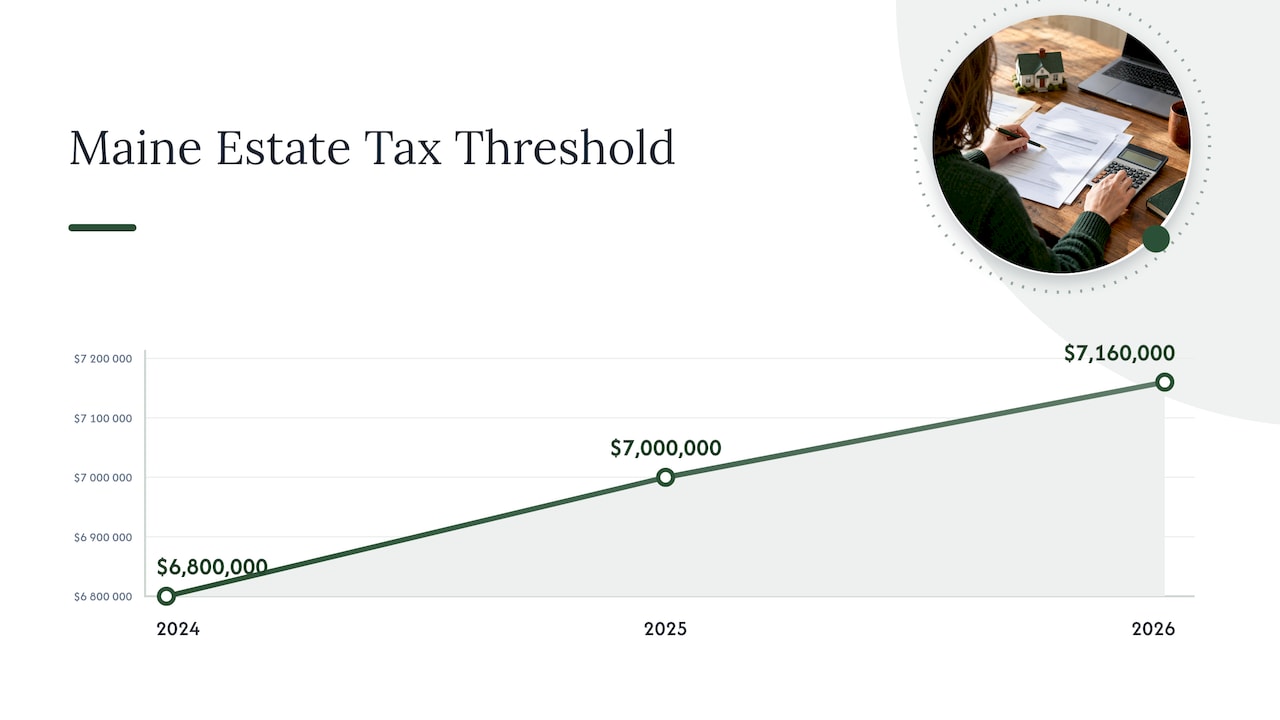
Most Maine estates owe no state estate tax, but you still need to know whether the estate is over the line. Maine Revenue Services lists its estate tax filing threshold as $7,160,000 for 2026, $7,000,000 for 2025 and $6,800,000 for 2024. The 2026 instructions say Form 706ME is required if a federal estate tax return is required, if a Maine QTIP election (a marital-deduction election) is greater than zero, or if the adjusted federal gross estate exceeds $7.16 million. The return is due nine months after death.
The same FAQ says a probate estate may need to file Form 700-SOV or Form 706ME even when no tax is due, and the probate court may require state certification of filing and payment. Ask the estate attorney whether that applies, because a missing certification can hold up the process.
Liens come next. The IRS explains that before selling a deceased person’s real property you may need to remove or discharge it from an IRS lien. If the sale proceeds will fully pay the liability on the lien, contact the IRS Lien Unit for a payoff. If not, apply for a discharge with Form 14135. The IRS also says an estate tax lien attaches to the gross estate when a Form 706 filing requirement exists, even if the lien is not publicly recorded, and an executor or administrator applies for a discharge with Form 4422. For Maine estate tax liens, the 2026 Maine instructions say discharge certificates can be submitted through the Maine Tax Portal or by mail.
None of this needs to scare you. It needs to be known before the house is under contract, so the closing date does not slip while a lien is sorted out.
Step 5: Decide whether to sell, keep or rent
Before listing, take a clear look at what the house will cost you every month you hold it. Taxes, insurance, utilities, winter heating and maintenance keep running on a vacant house. In Maine, property taxes and the homestead exemption matter here. Our guide to Maine property taxes and the $25,000 homestead exemption explains how it works, and the exemption generally applies to a primary residence, so it may not carry over to a house you inherit and do not live in.
The options usually look like this:
| Option | What it means | What to weigh |
|---|---|---|
| Sell on the open market | List with a Realtor, accept the best offer | Usually the strongest price, and the market sets it |
| Keep as a residence | One heir moves in or buys out the others | Needs an appraisal and written agreement among heirs |
| Keep as a rental | Hold and collect rent | Landlord duties, deposits, insurance, vacancy |
| Keep as a seasonal home | Use it, or rent it seasonally | Carrying costs, upkeep through winter |
If the home has tenants, there are specific obligations at closing. See our article on Maine property with tenants and deposit liability before you accept an offer.
Step 6: Prepare the house and price it
Inherited houses tend to arrive full of belongings, deferred repairs and memories. Handle these in order.
Divide and clear contents. Agree among the heirs on who takes what, and remove the rest. A cleared house photographs and shows far better.

Order the date-of-death appraisal if you have not. It serves tax purposes and gives the heirs one shared number to discuss.
Decide what to repair. Fix what a buyer’s inspector will flag: roof leaks, a failing heating system, safety items, water in the basement. Cosmetic updates rarely repay in a single sale, so spend where it protects the price.
Price from comparable sales. The market does not care that the house is inherited. A comparative market analysis looks at similar homes recently sold nearby, adjusts for condition, and gives a defensible range. Pricing too high leaves the house sitting, and pricing by sentiment leaves money on the table. We build pricing from local data, and with 20 years in the Maine market David knows how towns across central and southern Maine behave differently.
If demand is strong, multiple offers can happen. Read our piece on multiple offers in Maine, and for the back-and-forth after the offers arrive, our negotiation guide for Maine buyers and sellers.
Step 7: Expect the timeline from offer to closing
Once a buyer is under contract, the usual steps follow: deposit, inspection, appraisal, financing, title work and closing. Estate sales add a few extras: the personal representative signs, the attorney confirms authority, and the title company wants documentation of the appointment and any notices. Plan for those extras so they do not surprise you. Our Maine escrow timeline walks through what happens between offer and closing.
If the heirs live far away, tell us early. Signing can often be coordinated remotely with the attorney and title company, and responsive communication, including outside standard hours, matters when family is in several time zones.
If the person who died was a senior who moved or downsized, our senior home selling guide covers the emotional and practical side that overlaps with estate sales.
Our perspective
Families usually call us at the hardest time. Someone has died, the house is full, and three people disagree about the next step. The first thing I tell them is that the sale does not have to be rushed. The order matters more than the speed.
In my 20 years in the Maine market I have learned that an inherited sale goes best when the legal authority, the tax basis and the price are all settled before the sign goes up. That is the process I follow with my clients: transparent, no pressure, and built on data, with a comparative market analysis behind the price and an honest conversation about negotiation.
I also tell people to use the right professionals for the right jobs. The estate attorney handles authority and probate, and your tax preparer handles basis and filings. My part is the real estate: pricing the home, presenting it well, negotiating the offer and getting it to closing. I am available beyond standard hours, because families dealing with an estate do not keep a nine-to-five schedule.
David
Selling an inherited home in central or southern Maine
If you are ready to sell, we represent sellers across central and southern Maine, and the work starts with a comparative market analysis and a pricing strategy built on local sales. Whether the house is a family home, a condo or a townhouse, we can review the documents involved and guide you through the offer, negotiation and closing. See how we help on our Selling My Home page.

If the inherited property is a rental or vacation home, we also work with investors and seasonal-property owners, and you can start from the same page.
FAQ
Do I have to pay capital gains tax when I sell an inherited house?
Only on gain above your basis, which is generally the home’s fair market value on the date of death. If you sell for close to that value, the gain is often small. The IRS explains basis and reporting, and a tax preparer should confirm your figures.
Can I sell an inherited house before probate is finished?
You need legal authority first. In Maine, that is generally a personal representative appointed by the probate court. Once appointed, that person has broad powers over estate property, but the statute still requires at least 10 days’ notice to successors before a real property sale unless the will allows otherwise. Ask the estate attorney before listing.
What if several heirs disagree about selling?
Get the agreement in writing before listing. Unresolved ownership questions and undocumented transfers can lead to corrective deeds, re-probate or quiet-title actions, which delay or end sales. An estate attorney can help the family reach a documented plan.
How long does it take to sell an inherited property in Maine?
It depends on how soon authority is established, whether liens or estate tax certifications must be cleared and how the market responds. The sale itself follows the usual timeline from offer to closing. Settling authority, basis and liens first is the surest way to avoid a stall.
Sources
- Title 18-C, section 3-711: Powers of personal representatives (Maine Legislature)
- Instructions for Maine Estate Tax Return, 2026 (Maine Revenue Services)
- Estate Tax FAQ (Maine Revenue Services)
- Gifts and inheritances (Internal Revenue Service)
- Sell real property of a deceased person’s estate (Internal Revenue Service)
- Selling Family-Owned Real Property (American Bar Association)