
Yes, you need title insurance in Maine, and the law spells out exactly what it covers. Under 24‑A M.R.S. §709, title insurance protects a property owner or lender against loss from hidden liens, defective titles, or adverse claims on the property. Your lender will require a lender’s policy; you should buy an owner’s policy too. In most Maine deals, sellers customarily pay for the owner’s policy and buyers cover the lender’s policy, though that split gets negotiated.
TL;DR:
- Title insurance in Maine covers past title defects, encumbrances, and undisclosed claims, paying legal fees and financial losses if problems emerge after closing.
- Buyers typically pay for the lender’s policy while sellers usually cover the owner’s policy, with discounts available for simultaneous issuance of both policies.
- The cost for both policies on a typical home ranges in the low thousands of dollars, influenced by the purchase price, county, and underwriter, making early quotes essential.
- Maine grants buyers the right to choose their own attorney for title work, but the attorney hired by the lender cannot give independent advice on title exceptions.
- Title searches are conducted at county registries, and filing a claim requires immediate notification to the insurer to prevent complications and support prompt resolution.
Table of Contents
- What Title Insurance Covers Under Maine Law
- Lender’s Policy vs. Owner’s Policy: Two Different Protections
- What Title Insurance Costs in Maine, and Who Pays
- Where Title Costs Show Up on Your Loan Estimate and Closing Disclosure
- Closing Protection, County Registries, and How Title Searches Actually Happen
- Your Right to Choose Your Own Closing Attorney
- How to Get Title Insurance in Maine: A Step-by-Step Checklist
- Red Flags Maine Buyers and Sellers Should Watch For
- Filing a Title Insurance Claim in Maine
- Common Title Defects Maine Property Owners Actually Encounter
- Title Insurance Underwriters and Standards in Maine
- How Maine’s Title Insurance Rules Differ From Other States
- A Maine REALTOR’s Take on Coordinating Title Work
- Let RealtorMaine Coordinate the Pieces You Don’t Want to Chase Down
- Sources
- FAQ
What Title Insurance Covers Under Maine Law
Maine’s statute defines title insurance as coverage against loss from encumbrances, defective titles, invalid conveyances, or someone else asserting a claim on your property that surfaces after closing. That’s a real risk category. An old lien nobody recorded correctly, a forged deed three owners back, a boundary dispute buried in a 1962 survey. Title insurance doesn’t prevent these problems. It pays for the legal defense and covers your financial loss if one of them turns up.
Here’s where people get confused: title insurance is nothing like homeowner’s insurance. Homeowner’s insurance protects against future events, fire, storm damage, theft. Title insurance protects against past events that already happened before you bought the property, but haven’t been discovered yet.
- It’s a one-time premium paid at closing, not a recurring annual bill.
- Coverage typically lasts as long as you or your heirs own the property.
- It covers legal defense costs if someone challenges your ownership, not just the financial loss itself.
That last point matters more than most buyers realize. A title claim can mean thousands in attorney fees even when you ultimately win.
Lender’s Policy vs. Owner’s Policy: Two Different Protections
These are two separate contracts, and confusing them is the single most common mistake buyers make in Maine closings.
- Lender’s title insurance protects the mortgage company’s financial interest in the property up to the loan balance. Virtually every mortgage lender in Maine requires it as a condition of funding your loan; understanding what a mortgage rate means can help you navigate such requirements more effectively.
- Owner’s title insurance protects your equity, the full purchase price you paid, against the same title defects. It’s optional. Skipping it means you have zero protection if a title problem surfaces after closing.
- Both policies are typically issued for a one-time premium, and buying them together (simultaneous issuance) usually costs less than buying them separately.
- Enhanced or extended coverage endorsements exist for specific risks like zoning violations or unpermitted additions, and cost a bit more but close real gaps in standard coverage.
The lender’s policy expires once you pay off the mortgage. Your owner’s policy, if you buy one, protects you for as long as you or your heirs hold the property.
What Title Insurance Costs in Maine, and Who Pays
Premiums scale with the purchase price, and Maine doesn’t set a single statewide rate the way some states do, so quotes vary by title company and county. On a typical home purchase, expect the combined lender’s and owner’s premium to be several thousand dollars, with the exact number depending on the underwriter, the loan amount, and whether the policies are issued simultaneously. That simultaneous issuance discount is real: buying both policies together at the same closing typically costs meaningfully less than buying them apart, a mechanic the CFPB explains in its TRID disclosure guidance.
The custom in Maine: sellers typically pay for the owner’s policy, and buyers typically pay for the lender’s policy required by their mortgage. This is a negotiated custom, not a legal requirement, and either side can propose a different split in the purchase agreement.
Factors that shift who pays include the type of financing (FHA and VA loans sometimes carry different lender expectations), a competitive market where sellers concede more, or a private negotiation where the buyer offers to cover both policies to sweeten an offer. Ask your agent to spell this out in the purchase and sale agreement before you’re staring at the Closing Disclosure wondering why a number looks unfamiliar.
Where Title Costs Show Up on Your Loan Estimate and Closing Disclosure
Federal rules under 12 CFR §1026.37 and §1026.38 require lenders to itemize title insurance premiums clearly on both the Loan Estimate and Closing Disclosure, so you can verify the numbers before you sign anything.
- Look for a line item labeled “Lender’s Title Insurance” and, separately, “Owner’s Title Insurance” in the closing cost section.
- The lender’s premium is calculated on the loan amount; the owner’s premium is calculated on the purchase price, which is why the two numbers rarely match.
- When both policies are issued simultaneously, the disclosed owner’s premium often reflects a reduced simultaneous rate, which can look smaller than you’d expect if you only researched standalone pricing online.
- If a number seems off, ask your closing agent to walk through the calculation. TRID exists specifically so you can check this math yourself.
Closing Protection, County Registries, and How Title Searches Actually Happen
A closing protection letter (CPL) is not the same thing as title insurance, and mixing the two up leaves buyers with a false sense of security. Under Maine’s §3202, a CPL indemnifies you against theft or misconduct by the settlement agent handling your closing funds, not against title defects. The fee for issuing a CPL must be filed with the Superintendent, and one fee covers everyone entitled to protection in that transaction.
- Title searches themselves happen at the county level. Maine has 17 county Registries of Deeds, each maintaining the recorded land records for that county, accessible through a statewide portal.
- An abstractor or attorney searches the chain of title at the relevant registry to confirm the seller actually owns clear title before your closing.
- Many county registries also offer free property fraud alert services that notify you when a new document gets recorded against your property, worth signing up for if you own free and clear.
Your Right to Choose Your Own Closing Attorney
Maine gives you a specific consumer protection here, and most buyers have never heard of it. Under 9‑A §3‑311, you have the right to select your own attorney for title work on a residential mortgage transaction covering one to four units, as long as that attorney meets the lender’s reasonable qualification standards. Your lender is required to notify you of this right in writing, and they can’t charge you extra for exercising it.
Here’s the catch buyers miss: the attorney handling your lender’s closing paperwork represents the lender, not you. That attorney generally cannot give you independent advice about title exceptions listed on Schedule B of your title commitment.
- Ask for the title commitment and Schedule B exceptions as early as possible, ideally a week before closing.
- Read Schedule B carefully. It lists every exception to coverage, easements, old mortgages not yet discharged, unresolved liens.
- If anything on Schedule B looks unusual or unclear, hire your own attorney to review it before you sign.
- Get written confirmation of your right to choose counsel from your lender if it wasn’t provided upfront.
How to Get Title Insurance in Maine: A Step-by-Step Checklist
Getting coverage in place isn’t complicated, but skipping a step can cost you time at closing.
- Confirm your lender’s specific title insurance requirements as soon as your offer is accepted.
- Request an owner’s policy quote from a title company or your closing attorney, and ask specifically for a simultaneous issuance rate alongside the lender’s policy.
- Order the title search through the relevant county Registry of Deeds or an abstractor working on your behalf.
- Review the title commitment and Schedule B exceptions in full before your closing date.
- Confirm at closing that both policies were actually issued, not just quoted, and get copies for your file.
Pro Tip: Always ask for a simultaneous-issuance quote in writing before closing. Buying the lender’s and owner’s policies together at the same time, from the same underwriter, is almost always cheaper than buying them separately, and some buyers never find out this option existed until it’s too late.
Red Flags Maine Buyers and Sellers Should Watch For
A little skepticism at the right moment saves a lot of grief later.
- Question any Schedule B exception you don’t understand. “Subject to easement of record” without a specific description deserves a follow-up call.
- Confirm the CPL fee was actually filed with the state and isn’t just a line item someone invented.
- Check your county Registry’s fraud alert service before closing, especially if the property has changed hands multiple times recently.
- Don’t assume an old survey is accurate. Boundary disputes are one of the more common triggers for a title claim in Maine’s older neighborhoods.
Pro Tip: If a title commitment lists more than two or three exceptions beyond the standard printed ones, that’s your cue to loop in an attorney rather than assume it’s routine paperwork.
Filing a Title Insurance Claim in Maine
Filing a claim starts the moment you discover a problem, not when it becomes a crisis. If you receive a letter from someone claiming an interest in your property, get a notice of a lien you didn’t know about, or discover a boundary dispute, contact your title insurance company immediately, even before you’ve fully assessed the situation.
The claims process generally works like this: you notify the title underwriter in writing, describing the issue and providing any documents you’ve received. The company assigns a claims examiner who investigates the chain of title and determines whether the issue falls within your policy’s coverage. If it does, the insurer typically has two obligations: defend you against the claim (covering attorney fees and court costs) and cover your actual financial loss up to your policy limit if the claim succeeds against you.
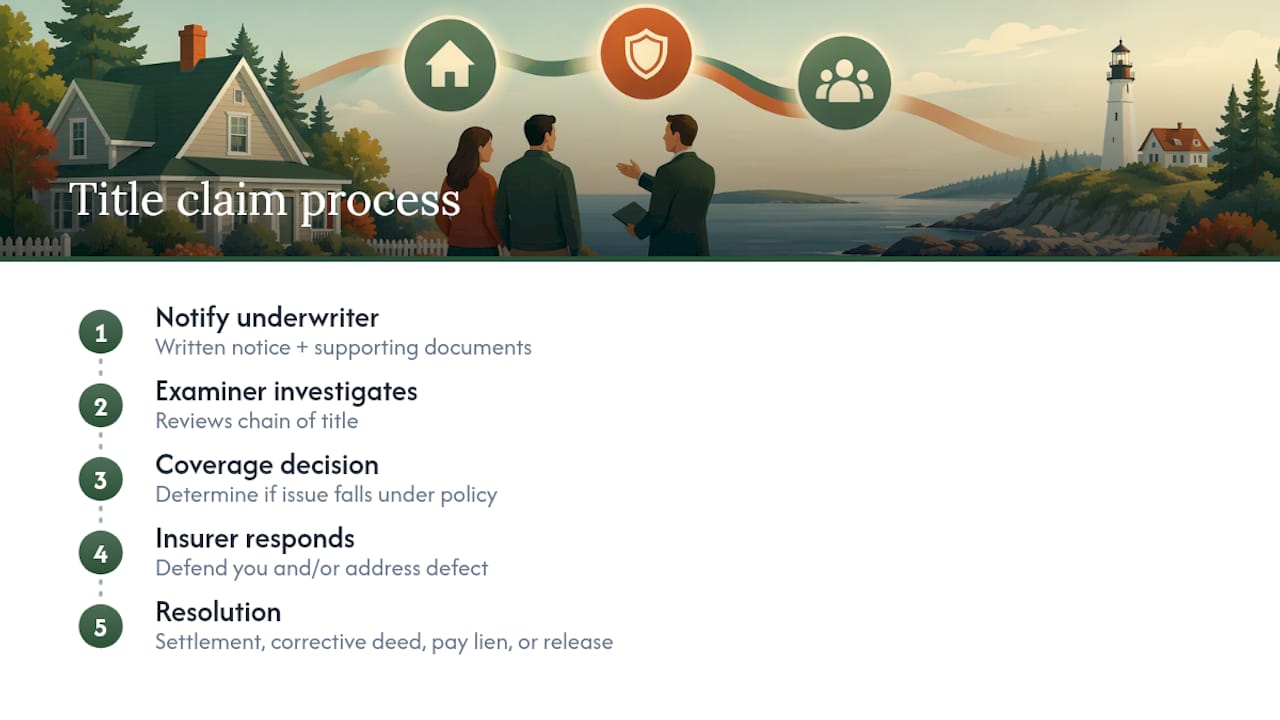
Most claims resolve through the insurer’s attorneys negotiating a settlement or clearing the defect administratively, recording a corrective document, paying off an old lien, or obtaining a release from a prior claimant. Litigation happens, but it’s not the norm.
The biggest mistake homeowners make is delay. Waiting months to report a suspected title issue, hoping it resolves itself, can complicate your claim and, in rare cases, give the insurer grounds to argue you didn’t cooperate in good faith. Report anything unusual the moment you notice it, even a strange piece of mail referencing your property, and let the claims process determine whether it’s serious.
Common Title Defects Maine Property Owners Actually Encounter
Maine’s housing stock skews older than the national average, and that history creates specific defect patterns that title insurance exists to catch.
Boundary and survey discrepancies show up constantly in rural Maine, where properties were often subdivided decades ago using hand-drawn surveys or metes-and-bounds descriptions that don’t match modern GPS measurements. A fence line that’s stood for forty years might not actually sit on the recorded boundary.

Unresolved liens from prior owners are another frequent issue, particularly unpaid contractor liens or old municipal tax liens that never got properly discharged in the public record even after being paid off. Heirs’ property issues also surface in Maine more than in newer housing markets: a property passed down through generations without a formal probate process can leave gaps in the chain of title that only surface when a title search digs into it.
Easement and right-of-way conflicts are common on rural and waterfront parcels, where a neighbor’s historical use of a shared driveway or shoreline access point was never formally recorded. The Maine Title Standards maintained by the Maine State Bar Association give attorneys a consistent framework for evaluating exactly these kinds of ambiguous, decades-old defects, and title insurance is what actually pays if one of them turns into a real dispute after you’ve closed.
Title Insurance Underwriters and Standards in Maine
Several national title insurance underwriters operate throughout Maine, working through local agents, closing attorneys, and independent title companies who handle the actual searches and paperwork. Maine doesn’t require a single state-run underwriter; instead, licensed underwriters compete statewide, and the local attorney or title agent handling your closing typically has a working relationship with one or more of them.
What keeps quality consistent across different underwriters is the Maine Title Standards system. Attorneys and title examiners across the state reference these standards when they hit an ambiguous or unusual title issue, giving Maine a more uniform approach to resolving marketability questions than you’d find in a state without a comparable framework. This matters practically: it means the quality of your title search depends less on which underwriter is behind your policy and more on the diligence of the local attorney or abstractor conducting the search at the county registry.
How Maine’s Title Insurance Rules Differ From Other States
Maine stands out in a few concrete ways compared to many other states. First, title insurance rates here aren’t set or regulated by the state the way they are in a handful of other jurisdictions, so shopping between underwriters and asking for simultaneous issuance quotes genuinely changes your out-of-pocket cost. Second, Maine’s consumer right to choose your own closing attorney under §3‑311 is stronger than what many states offer. Some states let the lender effectively dictate settlement agent choice; Maine puts that choice back in the consumer’s hands, provided your attorney meets reasonable qualification standards.
Third, the customary payment split, seller pays for the owner’s policy, buyer pays for the lender’s policy, isn’t universal. In several other states, the buyer customarily pays for both policies, or the split follows entirely different regional norms. If you’re relocating to Maine from a state with different customs, don’t assume your prior experience predicts how costs get allocated here; it’s a negotiated point in the purchase agreement, not a fixed rule.
Finally, Maine’s reliance on 17 independent county Registries of Deeds, rather than a centralized statewide records system, means the mechanics of a title search here look different from states with unified digital land records. Local knowledge of a specific county registry’s filing quirks still matters.
A Maine REALTOR’s Take on Coordinating Title Work
Buyers rarely stress about title insurance itself. They stress about the paperwork arriving late, or a Schedule B exception nobody explained until closing day. Coordinating the title search and attorney selection early, before it becomes a bottleneck, is where a Maine agent actually earns their keep on this piece of the transaction.
— David
Let RealtorMaine Coordinate the Pieces You Don’t Want to Chase Down
RealtorMaine isn’t a title underwriter and doesn’t issue policies. What David Haydym does is coordinate the moving parts around title, so you’re not the one chasing down a title commitment three days before closing or figuring out which Schedule B exception actually matters.

That means flagging your right to choose an attorney early, making sure your title search gets ordered on a timeline that won’t jeopardize your closing date, and walking through Schedule B exceptions in plain language before they become a surprise. Clients get responsive communication and local knowledge of how county registries actually operate. If you’re buying, selling, or working through an investment or seasonal property purchase in Maine, start the conversation with RealtorMaine and get a closing process that doesn’t leave title questions until the last minute.
Sources
- Title 24‑A, §709: “Title insurance” defined
- 12 CFR §1026.37 — Loan Estimate disclosures (CFPB)
- Maine Registry of Deeds | Maine Registry of Deeds Association
FAQ
How much does title insurance cost in Maine?
Costs vary by underwriter and county, but combined lender’s and owner’s premiums on a typical home purchase usually fall in the low thousands, lower when both policies are issued simultaneously. Get a quote from your closing attorney or title company early so there are no surprises on your Closing Disclosure.
How much is title insurance on a $400,000 house in Maine?
Expect the combined premium for both policies to land in a low-thousands range, with the exact figure depending on the underwriter and whether you request simultaneous issuance. Ask for a written quote before closing to confirm the actual number for your transaction.
Is title insurance ever unnecessary in Maine?
There’s no age or year after which a Maine property becomes automatically exempt from needing title insurance; every transaction carries some risk of an undiscovered defect regardless of how long the property has been owned. Some buyers paying entirely in cash choose to skip the owner’s policy, but that leaves their full equity unprotected against a defect surfacing later.
What happens if you don’t have title insurance and a title problem comes up?
Without an owner’s policy, you’re personally responsible for the legal costs of defending your ownership and for any financial loss if someone else’s claim succeeds, sometimes tens of thousands of dollars for a single dispute. A lender’s policy only protects the mortgage company’s interest, not your equity in the home.
Can I choose my own attorney for title work in Maine?
Yes. Under 9‑A §3‑311, you have the right to select your own qualified attorney for residential title work, and your lender cannot charge extra for it as long as your attorney meets reasonable qualification standards. Your lender must notify you of this right in writing.