Most Maine down payment help comes through MaineHousing, the state housing authority, and it is attached to a mortgage rather than handed out on its own. The standard Advantage option gives $5,000 toward down payment, closing costs and prepaid escrow. The First Generation Program gives a $10,000 grant. You apply through an approved lender, take a homebuyer class, and buy a home that fits the program’s income and price limits. Plan the order of those steps before you make an offer, and the help is easy to use.
TL;DR
- MaineHousing’s Advantage option provides $5,000 toward down payment, closing costs and prepaid escrow, with no rate add-on, no loan increase and no second mortgage.
- First Generation offers a $10,000 grant for down payment and closing costs, plus a fixed rate discounted 1.00% off the First Home Loan base rate.
- You need a 640 credit score, a home inside the purchase-price limit, an income under the limit for your area and household size, and a homebuyer education class.
- Veterans can pair a VA loan with Advantage, and multi-unit buyers can receive more per unit.
- Get pre-approved and pick your lender before you fall in love with a house, because the program rules shape which homes and offers work.
Table of Contents
- How down payment assistance works in Maine
- The main programs and what they pay
- Who qualifies
- How the loan type changes your down payment
- Step by step: using the assistance
- What this means for each kind of buyer
- Our perspective
- Work with a Maine Realtor from the first search
- FAQ
- Sources
How down payment assistance works in Maine
Maine does not run a big menu of stand-alone grants. The help sits inside MaineHousing’s mortgage products. You take a MaineHousing loan, such as the First Home Loan, and the assistance is added to it. A lender approved by MaineHousing, called a First Home Lender, takes your application, and MaineHousing’s Steps to Homeownership page lays out the path: get pre-approved, take homebuyer education, make an offer through a Purchase and Sale Agreement, review the Closing Disclosure three days before closing, then sign at closing.
That structure matters for how you shop. A buyer who finds a house first and asks about assistance second can run into a price limit, a property type that does not qualify, or a class that has not been completed. A buyer who starts with the program knows the target before the first showing.
The main programs and what they pay
Advantage option: $5,000
The Advantage option summary says it provides $5,000 toward down payment, closing costs and prepaid escrow expenses. It does not add to your interest rate, increase your loan amount or require a second mortgage. It works with a MaineHousing First Home, Salute ME or Mobile Home Self-Insured mortgage, and can be combined with FHA, VA, Rural Development, uninsured (20% down conventional) or MaineHousing-approved private mortgage insurance in eligible areas.
Two details to plan around. You must put in at least 1% of the loan amount from your own funds, and a gift can count. There is also no liquid asset test. And no cash comes back to you at closing: any assistance beyond your costs goes to the loan amount, and any principal reduction must be under $500.
First Generation Program: $10,000
The First Generation Program summary describes a $10,000 grant for down payment and closing costs, paired with a fixed-rate mortgage at 1.00% off the First Home Loan base rate, credited at closing. It is built for buyers whose families did not own homes:
- Every borrower must be a true first-time buyer, with no previous ownership interest in a principal residence at any time.
- At least one borrower must have never lived in a home owned by their biological parents or legal guardians, or must have been in foster care as a child.
- Borrowers complete a MaineHousing-approved financial literacy class, then a hoMEworks-approved homebuyer education class, and contribute at least 1%.
- It cannot be combined with Salute ME, the Mobile Home Replacement Initiative or the 2-point option.
If you qualify for First Generation, it is the larger benefit. The summary treats it as its own program with its own rules, so you pick it instead of stacking it on Advantage.
Multi-unit homes
Investors who plan to live in one unit of a duplex, triplex or fourplex have a clear advantage here. According to the First Home Loan Program page, Multi-Unit Advantage gives $5,000 per residential unit: $8,000 for two units, $11,000 for three and $14,000 for four. You also need an approved landlord education course, the hoMEworks class and a 1% borrower contribution.
The obligations are worth knowing early. For multi-unit Advantage properties, the applicant certification limits rent increases on the rental units to 5% a year for two years from closing, so tenants are not displaced.
Veterans: Salute ME
The Salute ME and Salute Home Again page explains that qualified active duty, veteran and retired military borrowers get a 0.50% discount off the First Home Loan 30-year fixed rate. Salute Home Again waives the first-time buyer requirement for veterans who owned a home before. It cannot be used to refinance. Advantage can be used with Salute ME, so a veteran can combine the rate discount with the $5,000. We cover the zero-down route in our guide to buying in Maine with a VA loan plus $5,000 of MaineHousing help.
Who qualifies
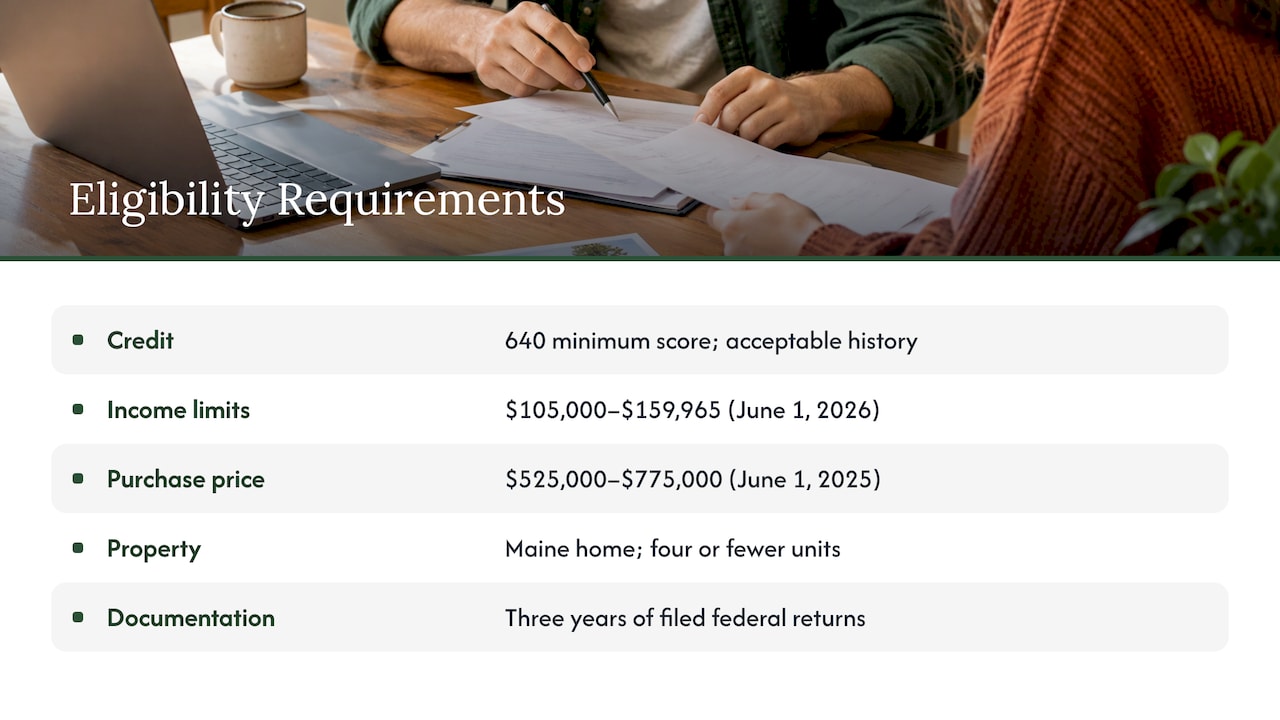
Eligibility comes down to five things: credit, income, price, property and how you will live in the home.
Credit. The First Home Loan requires an acceptable credit history and a minimum score of 640, according to the First Home Loan Program page. Plan to keep your monthly mortgage payment to roughly 30 to 33% of your income.
Income. Limits depend on household size and location. MaineHousing’s homebuyer limits chart shows limits effective June 1, 2026 that run from $105,000 for one- and two-person households in most of the state to $159,965 for households of three or more in the Portland area. The chart updates, so check it for your county and household size before you plan around a number.
Purchase price. On the same chart, limits effective June 1, 2025 run from $525,000 for a one-unit home in most areas up to $775,000 for a four-unit home in Portland, York/Kittery and other areas outside Bangor. Self-insured mobile home limits are $250,000 on owned land and $200,000 on leased land.
Property. Eligible homes include single-family houses, owner-occupied two- to four-unit buildings, condos and permanently attached mobile homes built in the last 20 years, per the First Home Loan page. Under the applicant certification, the home must be in Maine, have four or fewer units, and become your principal residence within 60 days. Acreage is capped at 1 acre for a new home or a mobile home on a new site, and 3 acres for another existing home, unless the land is no more than 30% of the appraised value.
Documentation. The same certification asks you to disclose all income sources, including increases expected within 60 days of closing, and to provide three years of filed federal tax returns. Gather those early.
A quick worked example
Say a family of four wants a $320,000 home in the Waterville area, using an FHA-backed First Home Loan. FHA requires 3.5% down, according to MaineHousing’s First Home Program FAQs, which is $11,200. The Advantage option’s $5,000 can go toward that down payment, closing costs and prepaid escrow. The family also has to bring 1% of the loan from their own funds, a gift counting. Their income must be under the limit for their area and household size, and the price is far under the cap. Exact closing costs and the rate depend on the lender’s quote and rate sheet on the day, so treat this as a map of the pieces, not a quote.
How the loan type changes your down payment
Assistance does not replace the down payment rules of the loan underneath. The First Home Program FAQs list the minimums by guaranty: 0% with Rural Development or VA, 3.5% with FHA, 5% with MaineHousing self-insurance on mobile homes, and 5% with the ARCH private mortgage insurance pilot. Advantage on an uninsured loan assumes 20% down.
So the same $5,000 stretches differently depending on the loan. A veteran with a VA loan may need little or nothing down, so the help can go to closing costs. An FHA buyer uses it against 3.5%. To see what each choice does to your monthly payment, run the numbers in a mortgage payment calculator that includes taxes and insurance. Our guides on when 3.5% down FHA beats conventional and USDA loans in Maine walk through the loan choice, and the one on points versus no points helps if you plan to stay five years or more.
Step by step: using the assistance
- Check the limits. Match your household size, county and target price against the MaineHousing limits chart.
- Choose a First Home Lender. The application goes through an approved lender, who confirms credit, income and program fit.
- Get pre-approved. Our Maine preapproval playbook covers what sellers and state programs look for.
- Take the classes. The hoMEworks homebuyer education course is required for the $5,000 Advantage assistance and is offered in person around the state and online, per the Steps to Homeownership page. First Generation adds the financial literacy class first.
- Search with the program in mind. Eligible property types, the price limit and acreage rules narrow the field. This is where a local agent saves the most time.
- Make the offer. The Purchase and Sale Agreement should fit your financing timeline.
- Review the Closing Disclosure. You get it three days before closing. Compare it to your estimate.
- Close and move in. Plan to occupy the home as your principal residence within 60 days.
What this means for each kind of buyer
First-time buyers. You qualify for the standard options, and if neither parent’s home was ever yours to live in, First Generation may fit. Our first-time homebuyer guide goes deeper on qualifying.
Families relocating to central Maine. Income and price limits are lower outside Portland, but home prices are too, so many central Maine towns fit well under the caps. If you have owned before, the first-time requirement can be a barrier, except for veterans using Salute Home Again.
Investors. The route is owner-occupied multi-unit: live in one unit, rent the others, and receive $5,000 per unit. Mind the 5% rent increase cap for two years and the landlord education course. If the property comes with tenants, read about deposit liability at closing.
Seniors downsizing. The program is for principal residences, and first-time status is required for the standard options, so many downsizers who have owned before will not fit the First Home Loan unless they are veterans using Salute Home Again. Your equity from the sale of a larger home often does the work a grant would.
Vacation buyers on the coast. The assistance requires you to live in the home as your principal residence, so a second or seasonal home is not eligible. Plan a conventional down payment for that purchase.
Our perspective
We have spent 20 years helping people buy in central and southern Maine, and the pattern is the same: the buyers who use assistance well are the ones who sort out the program before they sort out the house.
The money is real, but it comes with rules about price, property type, education and occupancy. A home that falls outside them can cost you the help after you have already fallen for it. That is why we start with your numbers, your loan type and the limits, and then search for homes that fit all three.
We guide buyers through FHA and conventional financing, run comparative market analyses so you do not overpay, and negotiate on your side. Questions do not keep office hours, so we make ourselves available beyond standard hours, and we keep the process transparent and pressure-free.
David
Work with a Maine Realtor from the first search
If you want the assistance to fit the home you buy, start with an agent who knows the program limits and the local market. We help first-time buyers, relocating families, investors, seniors and vacation property seekers across central and southern Maine, from the home search and pricing through negotiation and document review for condos and townhouses. With over 50 homes sold, we know how to line up the pieces. Start your Maine home search with us.

FAQ
Is Maine down payment assistance a grant or a loan?
The First Generation $10,000 is described by MaineHousing as a grant. The Advantage $5,000 is added with no rate increase, no loan increase and no second mortgage, so there is no separate lien to pay off. Ask your lender to confirm the terms for your loan.
Can I combine Advantage and First Generation?
No. They are separate options, and First Generation replaces Advantage rather than stacking on it. If you qualify for both, compare the $10,000 grant and the 1.00% rate discount with the standard option for your situation.
Do I need to complete a class?
Yes. All applicants for Advantage complete a hoMEworks-approved homebuyer education course before closing, either in person or online. First Generation buyers also take a financial literacy class first.
Can I use assistance on a condo or multi-unit home?
Yes. Condos and owner-occupied two- to four-unit homes are eligible property types, and multi-unit buyers can receive $5,000 per unit. Condo buyers should have the association documents reviewed before they commit.
Do the income and price limits change?
Yes. MaineHousing updates them, with the income limits effective June 1, 2026 and the price limits effective June 1, 2025 on the chart at the time of writing. Check the chart before you set a budget, and confirm with your lender.
Sources
- MaineHousing Advantage Option Summary
- MaineHousing First Home Loan Program
- MaineHousing First Generation Program Summary
- MaineHousing SaluteME and Salute Home Again
- MaineHousing Homebuyer Income and Purchase Limits
- MaineHousing Applicant Certification
- MaineHousing Steps to Homeownership
- MaineHousing First Home Program FAQs