For most Maine homes, a whole-home heat pump now costs less to run than an oil furnace, and rebates shrink the price of installing one. Oil still has real strengths: it works with the ductwork and boilers many older houses already have, and the equipment is familiar to every service company in the state. The right answer depends on your house, your budget this year and how long you plan to stay.
We are real estate agents, not HVAC contractors, so we look at this the way buyers and sellers meet it: at a showing, in an inspection report and on a closing timeline. Below you will find current prices, the rebate structure, what cold-weather performance really looks like and how the heating system affects a purchase or a sale.
TL;DR
- Heating oil in Maine is averaging about $5.97 per gallon according to the state’s early-October 2026 survey, and the state’s own cost-per-MMBtu comparison shows heat pumps delivering heat for less.
- Efficiency Maine rebates reach up to $3,000 for any household, $6,000 for moderate income and $9,000 for low income on qualifying systems.
- Cold-climate models keep heating down to -22°F or lower, but a heat pump that fights an old oil thermostat can raise your bills. Design matters more than the brand.
- Buying a home? Ask for winter fuel and electric bills and the age and service history of the system, not only whether a heat pump is there.
Table of Contents
- Where heating oil prices stand in Maine
- Comparing the real cost of heat
- Rebates: what Efficiency Maine pays
- Do heat pumps really work at 10 below?
- The mistake that makes heat pumps look bad
- Maintenance, comfort and the summer bonus
- When you buy or sell: what the heating system means for the deal
- Our perspective: heating is a closing-table question
- Choosing between a heat pump and oil: a quick framework
- Working with us
- FAQ
- Sources
Where heating oil prices stand in Maine
Maine is the most oil-dependent state in the country for home heating. The state’s Department of Energy Resources reports that 52% of households use fuel oil as their primary heat source. That exposure is why a price swing in the global market lands directly in Maine kitchens.
The Department of Energy Resources surveys delivered-fuel retailers every week. Its early-October 2026 figure is $5.97 per gallon statewide, and during the 2025-2026 heating season the weekly average frequently went above $5.00. Prices vary by region and by retailer. One consumer price tracker showed a county range from about $5.40 in Oxford County to $5.96 in Penobscot County in mid-October, so a quote from your own supplier is the number that counts.
Two habits help when you read these numbers:
- Treat any single price as a snapshot. Oil is bought by the delivery, and the price you pay in January may not be the price you see in October.
- Compare fuels by delivered heat, not by the price on the sticker. A gallon of oil and a kilowatt-hour of electricity are not the same thing, which is the next section.
Comparing the real cost of heat
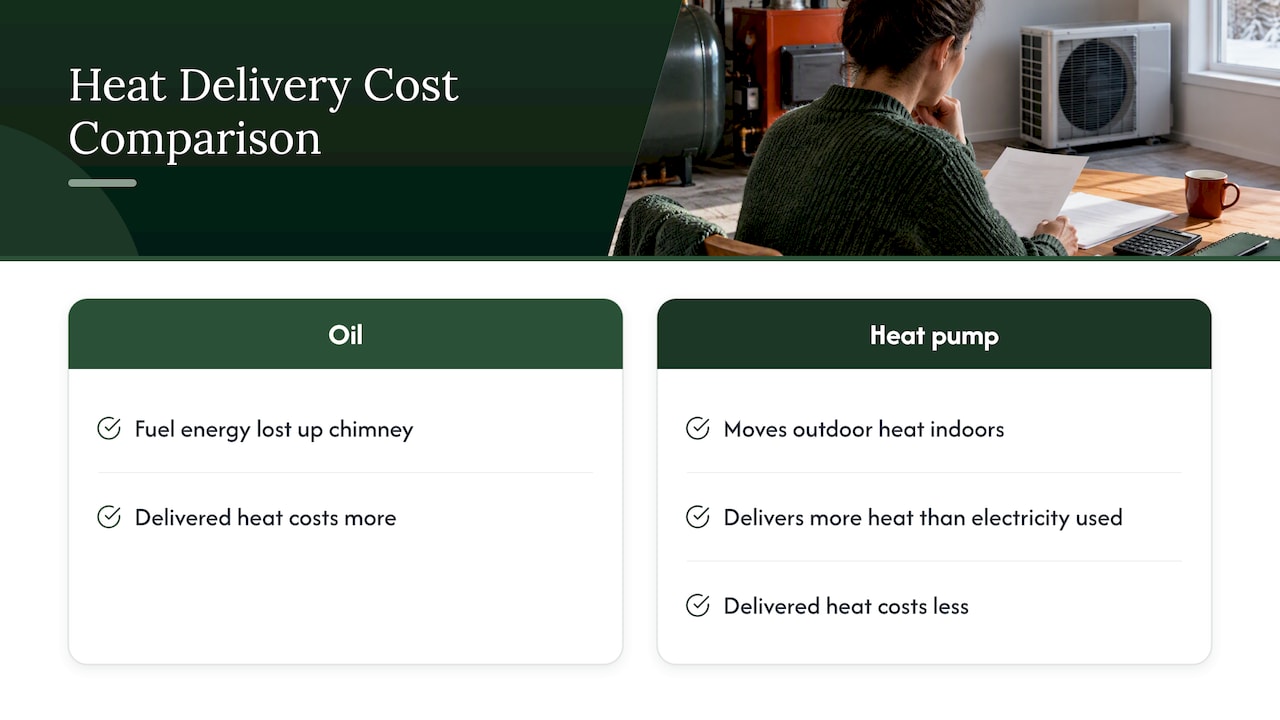
A fair comparison puts every fuel on the same scale. The state does this with dollars per million Btu (MMBtu), which accounts for how much of each fuel’s energy actually becomes heat in your rooms. An oil furnace or boiler loses part of its fuel energy up the chimney. A heat pump does not burn anything. It moves heat from outdoor air into the house, so it can deliver more heat than the electricity it uses. On that basis, the Department of Energy Resources’ analysis shows heat pumps delivering heat for less than oil, even after counting the electricity they draw.
You do not need to do the math by hand. Efficiency Maine publishes a residential heating system cost calculator where you enter your own price per gallon, your electric rate and the system type, and it shows annual cost with editable efficiency assumptions. Run it twice: once with today’s oil price and once with a price a dollar higher. That second run tells you how much of your budget rides on the oil market.
If you want to see how a heating bill fits inside your whole monthly housing budget, a home affordability calculator is a useful companion, especially when you are weighing a house with a newer heat pump against a cheaper one with an aging furnace.
What changes the result in your house
- Insulation and air sealing. A leaky house costs more to heat with any system. Fix the envelope first or alongside.
- Your electric rate. The cost advantage depends on what you pay per kilowatt-hour, so use your actual bill.
- Equipment placement and settings. Efficiency Maine notes that outdoor unit placement, restricted indoor airflow and fan speed can make units underperform, even in homes built to the same design standard.
- Whether the old system still runs. More on this below. It is the most common reason people say a heat pump did not save them money.
Rebates: what Efficiency Maine pays
Upfront cost is where oil tends to win the first conversation, and rebates are where the conversation changes. Efficiency Maine’s residential rebate brochure lists rebates of up to $3,000 for standard households, $6,000 for moderate-income households and $9,000 for low-income households on cold-climate heat pumps. In the brochure’s typical example of an installation with two indoor units, those rebates can bring the out-of-pocket cost down to as low as $4,000 for low-income households.
The program’s whole-home rebate page breaks it down further:
| System type | Low income | Moderate income | Any income |
|---|---|---|---|
| Ducted whole-home system | $9,000 | $6,000 | $3,000 |
| Other whole-home systems | $3,000 per eligible outdoor unit | $2,000 per eligible outdoor unit | $1,000 per eligible outdoor unit |
The same page lists a limited-time extra $500 per housing unit for eligible whole-home upgrades completed, with claims sent, between March 1 and December 31, 2026. Single-wide mobile homes can qualify for more, but not for that bonus. Rules and amounts change, so confirm current terms with Efficiency Maine before you sign a contract. For a plain-language walk-through of how these savings connect to buying a home, see our guide to Maine heat pump costs and rebates.
Do heat pumps really work at 10 below?
This is the question every Mainer asks, and it was fair ten years ago. Today, cold-climate models are designed to heat efficiently down to -22°F or lower, and many serve as a whole-home solution with no fossil-fuel backup. Efficiency Maine reports that more than 200,000 heat pumps are installed in the state and that they are now more common than oil heat in new homes.
A federal field study backs up the general picture for cold New England climates. The U.S. Department of Energy’s Building America program studied inverter-driven heat pumps in Connecticut, Massachusetts and Vermont. It is older and from states with milder winters than northern Maine, so read it as supporting evidence, not as a guarantee for Aroostook County.
Where heat pumps disappoint, the cause is usually one of three things:
- Units sized or placed for the wrong rooms, leaving a bedroom wing or basement cold.
- A single indoor unit in an open living area, expected to heat a whole two-story house.
- Fans left on low and filters left dirty.
These are design and habit problems, which is good news, because they can be fixed.
The mistake that makes heat pumps look bad
Many Maine homeowners add a heat pump and keep the oil system running. That can work well as a stepping stone, but it can also backfire. Efficiency Maine warns that running heat pumps alongside an old oil-fired central system can raise your heating bills. The old thermostat may call for heat in the whole house, which fires the boiler and causes the heat pump to cycle off early.
The program’s practical advice is either to install a true whole-home heat pump system or to design the zones carefully so the two systems do not fight. Partial installations also tend to miss the full savings because the oil system stays the main heat source.
If you are a seller with a partial setup, be ready to explain how it is controlled. If you are a buyer, ask the same thing at the showing.
Maintenance, comfort and the summer bonus
Oil systems need yearly cleaning, and the chimney needs inspection. Heat pumps need filter cleaning and occasional professional service, but Efficiency Maine’s guidance points to lower maintenance than oil furnaces and the added benefit of cooling and dehumidifying in summer. As Maine summers get warmer and more humid, that second job matters for sleep and for the health of a house.
Oil heat has its own comfort advantage. Many people like the strong, steady warmth of a boiler with baseboard or radiators, and a tank in the basement means you are not dependent on the grid. Power outages are real in Maine, and a heat pump does not run without electricity. Owners who rely on a heat pump often pair it with a generator, a battery system or a wood stove for backup. Plan for that before the first ice storm, not during it.
When you buy or sell: what the heating system means for the deal
Heating is one of the first things buyers ask about, and one of the most expensive things to get wrong. Here is how we handle it on both sides of a transaction.
If you are buying
- Ask for the numbers. Maine law requires sellers of residential property to give buyers a property disclosure statement, and the heating system’s age and servicing history are part of it. Performance in deep cold is not something the form can tell you, so ask for the electric and oil bills from December through March.
- Find out what the heat pump actually heats. Count outdoor units and indoor heads, and ask whether the oil system is a backup, a co-primary or just disconnected.
- Check the age of the tank and boiler. A 25-year-old boiler is a bill waiting to arrive, and it shapes your negotiation.
- Ask about rebates already claimed. Program rules and income tiers are tied to households and housing units, so confirm what applies after you take ownership.
- Use the inspection. Our guide on vetting Maine home inspectors covers the questions to ask, and heating is a good place to start. Radon is another cost to price in, and we explain it in our piece on radon testing in Maine homes.
If you are selling
A modern whole-home heat pump with documented low winter bills is a selling point. Gather your bills, the installer paperwork, any rebate documents and service records before you list. If you still heat with oil and the boiler is well maintained, say so and have the service history ready. Buyers pay for certainty. The heating system also feeds into price, and our article on pricing a Maine home explains why a headline number is only a starting point.
For buyers comparing a new build to an older house, heating is one of the clearest differences. Our notes on new construction versus resale cover that trade-off.
Our perspective: heating is a closing-table question
After 20 years of working with buyers and sellers in central and southern Maine, we have seen the heating conversation change completely. Years ago, buyers asked whether a house had a heat pump as an extra. Now they ask what the winter bills were, and they are right to.
Our view is simple. A whole-home heat pump, installed with sensible design and the available rebates, is the better long-term answer for most Maine homes we see. It is also the system we would want to be able to document if we were selling. But we do not push buyers toward it when the house is not ready. A well-kept oil system in a tight house with a fair price can be a reasonable place to start, and a buyer on a stretched budget may do better to buy the house they can afford and upgrade in stages when rebates and cash flow allow.
What we insist on is information. Look at real bills, not estimates. Ask who installed the system and when. Have an inspector look at the equipment. Then weigh it against the whole cost of owning the home, including taxes and insurance, which is where our cost of living breakdown for Maine regions can help. We give advice without pressure, and we are available outside standard hours because heating questions tend to come up the night before an offer deadline.
— David
Choosing between a heat pump and oil: a quick framework
| Your situation | What usually makes sense |
|---|---|
| Staying 5+ years, house is reasonably tight | Whole-home heat pump with rebates; keep oil only as a documented backup |
| Old boiler near end of life | Price a heat pump replacement before buying another boiler |
| Tight cash this year | Partial heat pump in the main living area, with zones designed so they do not conflict with the oil thermostat |
| Frequent outages, rural location | Heat pump plus a backup source for the coldest, darkest days |
| Planning to sell within 2 years | Gather bills and records; upgrade only if the numbers support it |
No table replaces a quote. Ask a qualified heat pump installer to assess the house, and compare at least two bids that show the number and location of units, the rebate they expect to claim and how they will handle the existing system.
Working with us
If you are buying, selling or looking at an investment or seasonal property in central or southern Maine, we can help you read the heating system like the major line item it is, from the first showing to the negotiation. See what we offer for buyers, sellers, investors and vacation property seekers and get in touch before you write an offer on a house with an unusual setup.
FAQ
Is it worth switching from oil to a heat pump in Maine?
For many homeowners it is. The state’s per-MMBtu analysis shows heat pumps delivering heat for less than oil, and rebates of up to $3,000, $6,000 or $9,000 depending on income cut the upfront cost. The savings are strongest with a whole-home design, so get quotes that show how the old system will be handled.
How much is heating oil in Maine right now?
The Maine Department of Energy Resources reported a statewide average of $5.97 per gallon in early October 2026. Prices differ by county and supplier, so call local dealers for a current quote before you compare.
Can a heat pump heat a Maine home without a backup?
Cold-climate models are built to run down to -22°F or lower, and many homes use them as the only heat source. It depends on sizing, placement and the insulation of the house. Ask your installer for a design that covers every occupied room, and consider an outage backup.
Should I keep my oil furnace after installing a heat pump?
You can, but set it up on purpose. Efficiency Maine says running both without a plan can increase heating bills because the oil thermostat may override the heat pump. Either commit to a whole-home system or have the zones designed to avoid conflict.
Sources
- Maine Department of Energy Resources: heating fuel prices
- Maine Department of Energy Resources: energy efficiency
- Efficiency Maine: heat pump systems for Maine homes
- Efficiency Maine: whole-home heat pump solutions
- Efficiency Maine: whole-home heat pump rebates
- Efficiency Maine: residential rebates brochure
- Efficiency Maine: residential heating system cost calculator
- U.S. Department of Energy: field performance of inverter-driven heat pumps in cold climates
- Maine Revised Statutes, Title 33, §173: required disclosures
- Heating oil prices in Maine by county