Test your Maine home for radon: it is the only way to know whether you and your family are breathing air above the EPA’s action level of 4 pCi/L, and levels between 2 and 4 pCi/L still deserve a second look. If your home is listed for sale in Maine, state law requires a registered tester. Well water carries its own advisory level that is regulated at a level considered safe by state authorities.
TL;DR:
- Testing during winter provides more accurate radon level readings because concentrations tend to rise during the heating season.
- Homes with radon levels near 4 pCi/L should still be considered risky, especially when the test was done in summer or when water radon levels are high.
- Typical mitigation costs for air radon reduction systems range from $1,500 to $3,000, with water treatment often costing more and requiring specific equipment.
- Maine law mandates registered testers handle radon testing during home sales, and documentation is essential for disclosures and negotiations.
- Early testing and mitigation can prevent delays, disputes, and price reductions during real estate transactions involving radon concerns.
Table of Contents
- How to test for radon in air and water in Maine
- Understanding radon numbers: what the thresholds actually mean
- How high radon is fixed in Maine: methods, costs, and what to expect
- Maine rules for testing, disclosure, and mitigation during home sales
- Testing private wells for radon and when water treatment is needed
- Local realtor perspective: handling radon when buying or selling in central and southern Maine
- Our take on Maine’s radon landscape
- How RealtorMaine can support a sale or purchase where radon is involved
- FAQ
- Sources
How to test for radon in air and water in Maine
Winter gives you the clearest picture. Radon concentrations run higher during the heating season, typically from fall through winter, so a short-term test during these months produces more representative readings than one taken in July. If you want your home’s true annual average, run a long-term test (90 days or more) instead.
Place any device on the lowest livable level of the house, meaning the lowest floor you use regularly, even if that’s a finished basement. From there, the process is straightforward:
- Choose a short-term kit for a quick read or a long-term test for an annual average.
- Close windows and doors as instructed and leave the device undisturbed for the full test period.
- Mail the kit to a lab or download the data if using a Continuous Radon Monitor (CRM).
- Repeat testing if results sit near 4 pCi/L or if you change heating or ventilation systems.
If you’re testing because a home is on the market, Maine law requires a registered tester to handle it, and professionals typically use a CRM with a tamper indicator that flags any interference with the device, which protects both buyer and seller from disputed results.
Pro Tip: Look up registered testers and mitigators through the Maine Radon Control Program before you sign a contract, not after a buyer asks for one.
Understanding radon numbers: what the thresholds actually mean
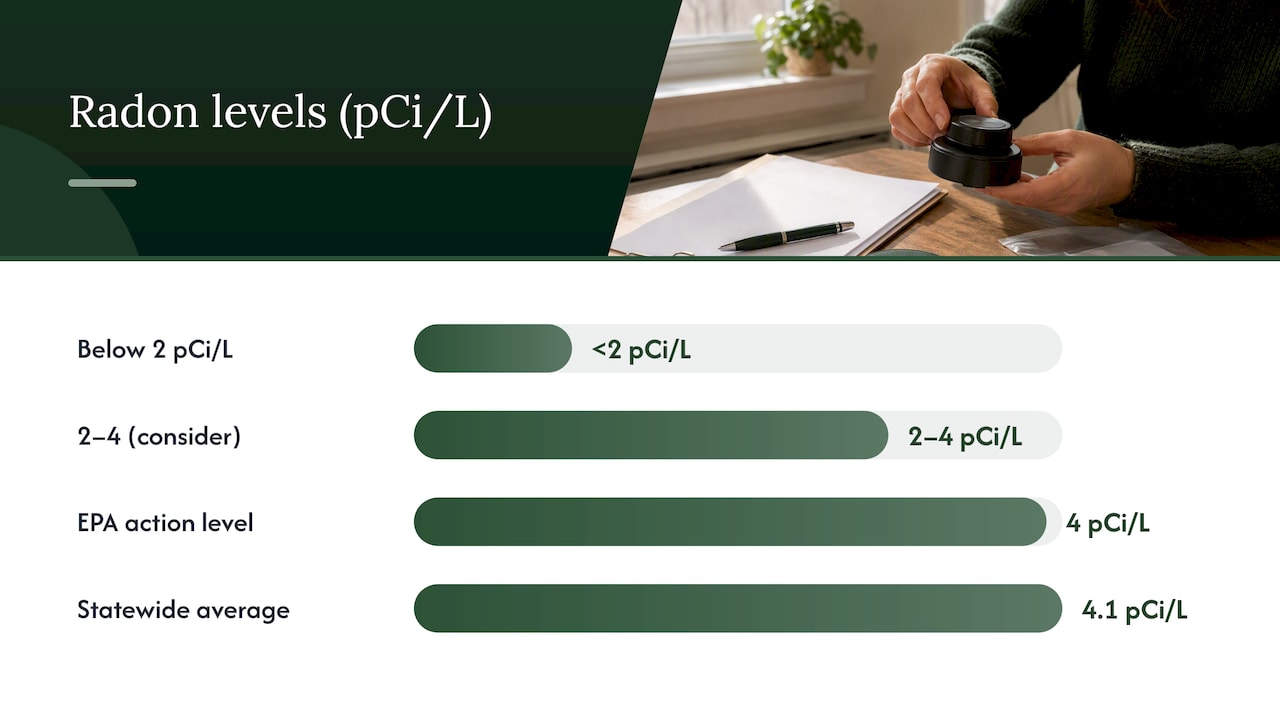
Radon is measured in picocuries per liter of air (pCi/L). The EPA sets 4 pCi/L as the point where action is recommended, but risk doesn’t start at a hard line. Levels between 2 and 4 pCi/L still carry enough risk that the Maine Radiation Control Program suggests homeowners consider reducing them.
Water adds a separate layer. Maine’s advisory level for radon in water is 4,000 pCi/L, and treatment is strongly considered as levels approach 10,000 pCi/L. As a rough rule, every 10,000 pCi/L of radon in water translates to about a 1 pCi/L increase in indoor air, so a well testing at 4,000 pCi/L contributes only a modest amount to air levels on its own.
Statistic: At least 25% of homes tested in Maine show elevated radon levels, and the statewide average residential reading is about 4.1 pCi/L, already at the EPA’s action threshold.
- Radon problems turn up in every part of Maine, not just certain towns or soil types.
- A reading just under 4 pCi/L is not automatically “safe” and still merits a conversation with a tester.
- Air and water results should be read together, not in isolation.
How high radon is fixed in Maine: methods, costs, and what to expect
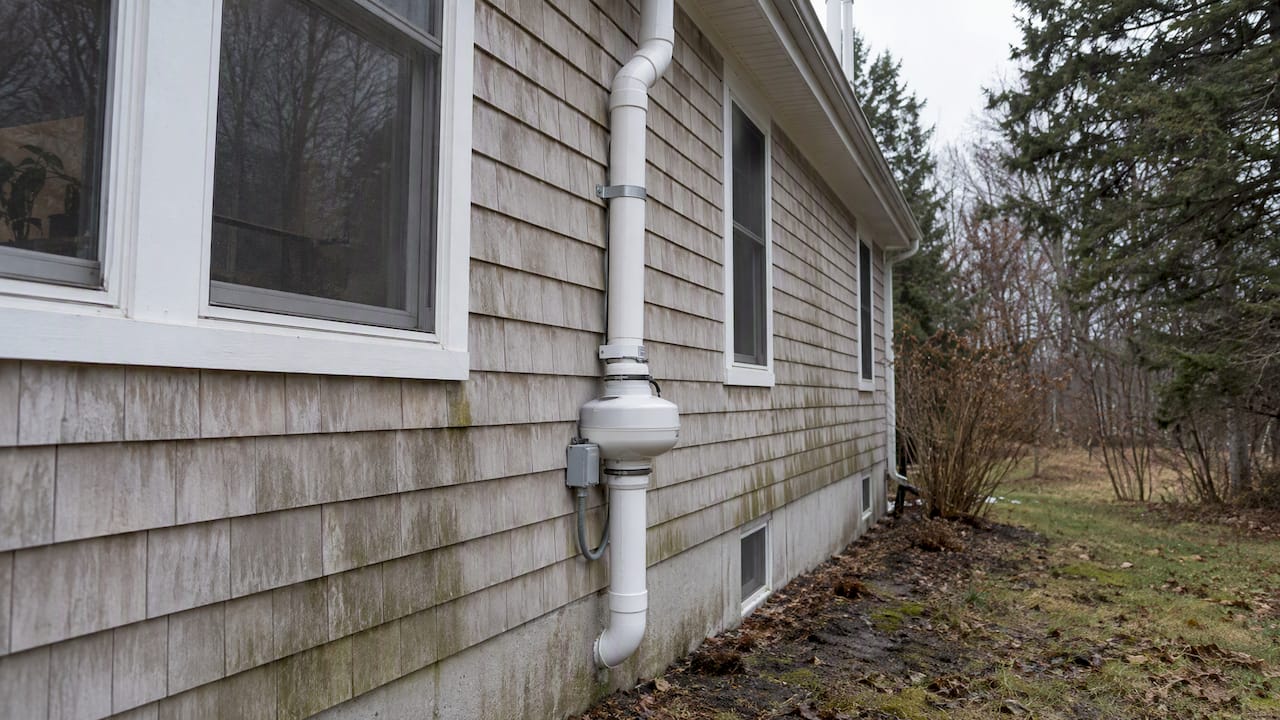
Most homes with elevated air readings get fixed with active sub-slab depressurization (ASD), a system that draws soil gas from beneath the foundation and vents it above the roofline before it enters living space. Homes with crawlspaces often use submembrane depressurization instead, which seals the crawlspace floor under a plastic membrane and vents from underneath it. Ventilation upgrades, like an HRV, sometimes play a supporting role but rarely replace a depressurization system on their own.
- A typical ASD or submembrane system for air mitigation runs roughly $1,500 to $3,000, though older homes or complex foundations can push costs higher.
- Water treatment, typically aeration or granular activated carbon (GAC) filtration, tends to cost more than air-only systems because it requires dedicated equipment at the point of entry.
- Sealing cracks and openings alone rarely brings levels down enough to matter, since radon finds new paths through a foundation easily.
- Post-mitigation testing is not optional. It confirms the system actually brought levels below 4 pCi/L.
Before hiring anyone, confirm the mitigator is registered with the Maine Radon Control Program, ask what warranty covers the system, and get a written commitment to retest after installation.
Pro Tip: Get the post-mitigation test results in writing before you consider the project finished, not just a verbal assurance that the fan is running.
Maine rules for testing, disclosure, and mitigation during home sales
Selling a home in Maine comes with specific obligations once radon enters the picture. State statute requires that any radon testing or mitigation performed in connection with a property sale be done by someone registered with the Maine Radon Control Program, not just any contractor with a monitor.
- Order testing from a registered tester as early in the listing process as possible.
- Disclose results to buyers, since Maine law ties reporting and notice requirements to real estate transactions.
- Address elevated readings through a registered mitigator rather than a DIY fix, especially once the home is under contract.
- Keep documentation: test reports and mitigation invoices become part of the transaction record and can prevent disputes at closing.
Landlords face similar disclosure duties toward tenants, and failing to meet them can carry penalties. Testing before you list, rather than waiting for a buyer’s inspection to surface a problem, tends to prevent the renegotiation or last-minute cancellation that comes from discovering high radon mid-contract as explained in pre-listing inspection or skip repairs?.
Maine’s Gold Standard initiative offers some relief here: qualifying homeowners and landlords can receive testing support and up to $600 toward mitigation costs through the program, which can offset part of the expense for sellers working against a closing deadline.
Testing private wells for radon and when water treatment is needed
If your home relies on a private well, test the water separately from the air. Public surface water supplies generally carry much lower radon risk, but groundwater pulled from bedrock wells, common across Maine, can carry significant radon that off-gasses into household air every time you run a faucet or shower.
- Maine’s advisory level for radon in water is 4,000 pCi/L, with treatment strongly considered as levels climb toward 10,000 pCi/L.
- Aeration systems strip radon from water before it enters your plumbing, while GAC filtration absorbs it, and either approach typically costs more than an air-only mitigation system.
- Because water contributes only a fraction of total air exposure, pair your well results with your air test before deciding where to spend mitigation dollars.
Coordinating both results matters most when air levels sit close to 4 pCi/L. A well-water contribution that seems small on its own can be enough to push a borderline home over the action threshold.
Local realtor perspective: handling radon when buying or selling in central and southern Maine
After 20 years representing buyers and sellers across central and southern Maine, I’ve watched radon derail more closings than almost any other inspection item, mostly because it surfaces too late. Testing before you list removes that risk entirely.
Collect your documentation early: the original test report, any mitigation invoices, and proof the contractor was registered with the state. Buyers’ agents ask for these, and having them ready speeds up negotiations considerably.
On the negotiating side, sellers who complete mitigation before going under contract rarely lose leverage over price. Sellers who wait until a buyer’s inspection finds elevated levels often end up splitting costs or facing a lower offer, because now the clock is working against them instead of for them.
Our take on Maine’s radon landscape
The conventional advice tells homeowners to test “at some point” before selling. That’s too vague to be useful. Maine’s radon problem is widespread enough, with at least a quarter of tested homes showing elevated levels, that waiting until a buyer requests a test is a bet most sellers lose.
What gets underrated is timing relative to the heating season. A test run in July can understate your actual exposure, and a homeowner who tests in summer and gets a clean result may be sitting on a problem that only shows up once the furnace kicks on. If you own a Maine home, especially one with a finished basement or a private well, the single highest-value action is testing during the colder months before you have any reason to, not after a sale is already in motion.
Mitigation itself is rarely the hard part. Systems are well understood, contractors are registered, and costs are predictable. The friction comes from discovering a problem at the worst possible moment in a transaction. Prioritize early testing over everything else on this list.
— David
How RealtorMaine can support a sale or purchase where radon is involved
Radon doesn’t have to complicate a sale or purchase when it’s handled early. We help sellers build a pre-listing testing timeline, connect buyers and sellers with registered testers and mitigators, and interpret results so neither side is guessing about what a number means for the deal.

- We coordinate registered radon testing and mitigation scheduling so it doesn’t stall your closing timeline.
- We review test reports and mitigation invoices with you before they become a negotiating point.
- We help structure offers and counteroffers around repair costs instead of letting radon become a deal-breaker.
If you’re buying or selling a home anywhere in central or southern Maine, reach out through RealtorMaine to talk through your specific timeline and next steps.
This article is general information, not a substitute for advice from a qualified doctor. Consult a qualified healthcare professional about your own circumstances before acting on anything here.
FAQ
Which states are the worst for radon?
Radon risk varies widely across the United States depending on local geology, and some regions consistently report higher indoor levels than others. Maine is one of the higher-risk states, with at least 25% of homes tested showing elevated radon and a statewide average near the EPA’s action level.
How common is radon in Maine?
Radon problems occur in every part of Maine, not just specific towns or soil types. At least a quarter of homes tested statewide show elevated levels, with the average residential reading around 4.1 pCi/L.
Do air purifiers clear out radon?
No, air purifiers and HEPA filters do not remove radon gas, even high-quality models. Reducing radon requires a mitigation system, such as sub-slab depressurization, that stops soil gas from entering the home or treats water before it off-gasses indoors.
Is it safe to shower in water with radon?
Radon in well water can off-gas into indoor air during showering, which is why Maine sets an advisory level of 4,000 pCi/L for water and recommends treatment as levels approach 10,000 pCi/L. Testing your well is the only way to know where your water falls on that scale.
What should I do if my test comes back above 4 pCi/L?
Retest to confirm the result, then contact a mitigator registered with the Maine Radon Control Program to design a system for your home’s foundation type. After installation, insist on post-mitigation testing to confirm the level has dropped below the action threshold.