Short-term rentals typically post higher gross revenue, but long-term rentals usually deliver steadier net income with far less operating intensity. Before you commit to either, run one test: model the property as a long-term rental with conservative numbers. If it cashflows there, you have a floor to fall back on. If it doesn’t, look at mid-term as your compromise before chasing short-term’s bigger, riskier upside.
TL;DR:
- Modeling a property as a long-term rental first provides a financial safety net, as it often cashflows even with conservative occupancy assumptions.
- Short-term rentals can generate significantly higher gross revenue, but higher expenses and operational costs often narrow or erase the net income advantage.
- Local regulations, zoning rules, and homeowner association restrictions are critical in determining the feasibility of each rental strategy and must be verified beforehand.
- Stress-testing short-term rental projections at 65% occupancy helps assess real profitability and avoid overestimating margins.
- Mid-term rentals offer a balanced alternative, often outperforming long-term income with less management effort and lower regulatory risk in cities with steady corporate or medical demand.
Table of Contents
- Short Term vs Long Term Rental at a Glance
- What Counts as Short Term, Mid Term, and Long Term Rental?
- Gross Revenue vs. Net Income: Where the Real Comparison Happens
- How Do Taxes and Local Regulations Affect Your Return?
- How Much Time Does Each Rental Strategy Actually Take?
- Is Mid-Term Rental the Best of Both Worlds?
- How Do You Decide Between STR, MTR, and LTR for Your Property?
- What Twenty Years in Maine Real Estate Teaches About Rental Strategy
- Get Local Market Guidance Before You Choose a Rental Strategy
- Where to Verify Rental Rules and Market Data
- Sources
- FAQ
Short Term vs Long Term Rental at a Glance
Three models, three very different owner experiences. Here’s the quick version before you dig into the math:
- Short-term rental (STR): Stays under 30 days, booked through platforms like Airbnb or Vrbo, aimed at tourists and business travelers who want a furnished space with hotel-like flexibility.
- Mid-term rental (MTR): Stays of 30 to 180 days, popular with traveling nurses, corporate relocators, and remote workers who need a real home base without signing a full lease.
- Long-term rental (LTR): Leases of six to twelve months or longer, the standard model for tenants who want stability and a fixed monthly cost.
A worked example makes the gap concrete. Say a two-bedroom condo could rent long-term for about two thousand two hundred dollars a month, or roughly twenty-six thousand dollars a year with minimal turnover cost. As a short-term rental, the same unit might book at about one hundred fifty dollars a night. At a conservative 60% occupancy, that’s substantially higher gross revenue, which sounds like a clear win. But once you subtract cleaning, platform fees, higher utilities, and furnishing costs, the net gap narrows fast, sometimes disappearing entirely. That gap between gross and net is where most STR decisions go wrong.
What Counts as Short Term, Mid Term, and Long Term Rental?
The stay-length cutoffs aren’t arbitrary. They determine which taxes apply, which local laws kick in, and what kind of tenant shows up at your door.
- Short-term: Under 30 days. Tenants are usually tourists or event travelers. The unit needs to be fully furnished, utilities are typically included, and bookings run through a listing platform.
- Mid-term: Roughly 30 to 180 days. Tenants include traveling healthcare workers, insurance-displacement renters, and corporate relocators. Furnishing is still required, but turnover and platform fees drop sharply.
- Long-term: Six to twelve months or more. Tenants sign a standard lease, usually cover their own utilities, and the property often goes unfurnished.
According to Steadily’s guide to rental durations, these categories aren’t just industry jargon. They determine whether a municipality treats your property as a hotel-style business subject to permits and occupancy taxes, or a standard residential rental governed by landlord-tenant law. Get the classification wrong and you can end up filing taxes incorrectly or operating outside your city’s zoning rules without realizing it.
Gross Revenue vs. Net Income: Where the Real Comparison Happens
Gross revenue is the number everyone quotes. Net income is the number that pays your mortgage. Practitioner data compiled by BiggerPockets shows STR gross revenue often running 2 to 3 times higher than a comparable long-term lease in tourist-friendly markets. After factoring in cleaning, management, utilities, platform fees, and furnishing amortization, that premium typically shrinks to somewhere around 1.2 to 1.8 times LTR income, and in weaker markets it can vanish altogether.
Here’s what actually eats into STR revenue:
- Cleaning and turnover: Typically 10 to 15% of gross revenue, scaling with how often the unit turns over.
- Platform fees: Airbnb and Vrbo commissions generally run 3 to 15% depending on your pricing structure.
- Utilities and internet: Usually 5 to 8% of gross, since you’re covering electricity, water, and Wi-Fi that a long-term tenant would pay themselves.
- Furnishing amortization: Initial furnishing costs, spread over 3 to 5 years, often add another 5 to 10% of annual gross.
- Higher insurance: Short-term rental policies commonly cost 20 to 50% more than standard landlord insurance due to higher claims frequency.
- Management or co-hosting fees: If you’re not self-managing, expect another 15 to 30% off the top.
Long-term rentals carry a leaner expense profile: property management around 8 to 10% of rent, vacancy typically budgeted at 5 to 8% annually, and maintenance reserves of roughly 1% of property value per year. No furnishing, no cleaning turnover, no platform cut.
Statistic Callout: A widely used stress test in real estate investing is to model STR revenue at just 65% of your optimistic projection, per guidance from Cavmir Learn’s Airbnb vs. long-term rental comparison. If the property still pencils out at that discounted number, you have real margin for safety. If it only works at 90%+ occupancy, you’re one slow season away from a loss.
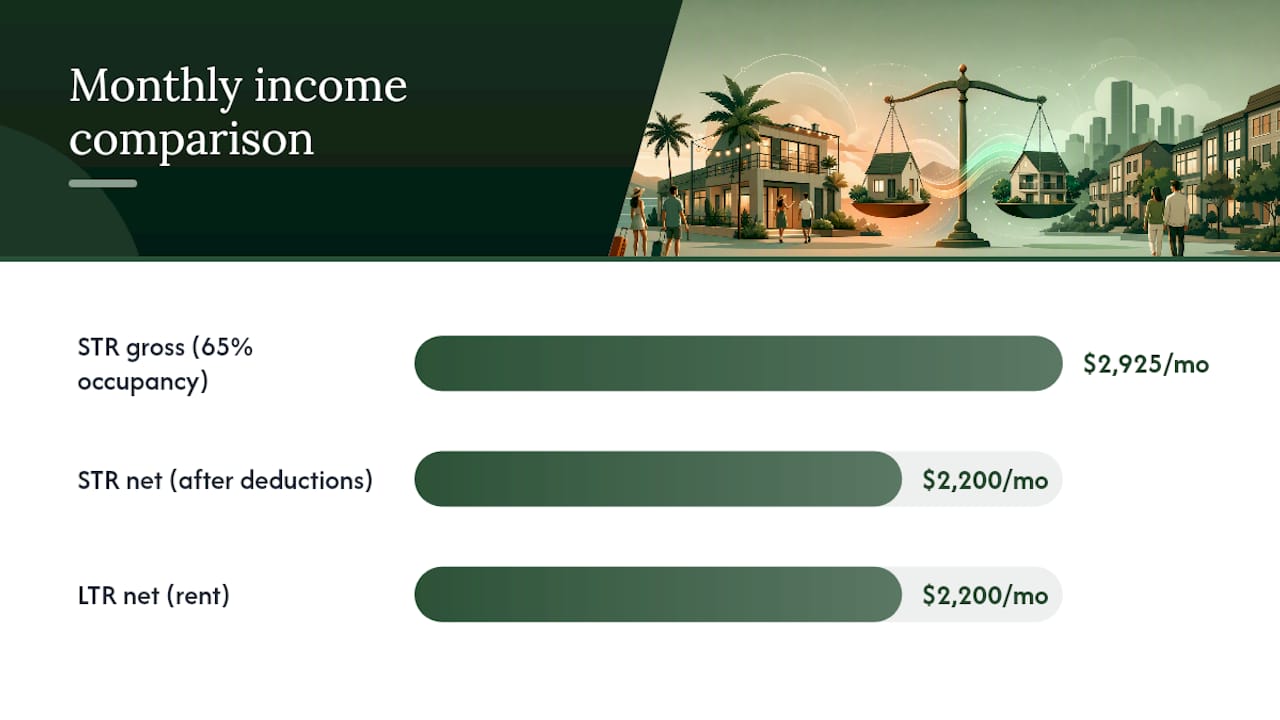
Let’s run the numbers on that same condo renting long-term for about two thousand two hundred dollars per month. As a short-term rental at around one hundred fifty dollars per night and 65% stressed occupancy, gross revenue is notably higher. Subtract estimated combined cleaning, fees, utilities, furnishing, and insurance costs, and you’re left with net income close to long-term rental net, which reflects typical deductions from gross revenue. Compare that to long-term rent with its own standard deductions, and the net incomes are often similar. In this scenario, the “higher revenue” option actually nets less once you stress-test it honestly.
How Do Taxes and Local Regulations Affect Your Return?
Tax treatment is where a lot of STR owners get blindsided. Long-term rentals are almost always reported on Schedule E as passive rental income. Short-term rentals can land on Schedule E too, but if you provide “substantial services,” similar to a hotel, think daily cleaning, meals, or concierge-style amenities, the IRS may require you to file on Schedule C instead.
IRS Publication 925 also covers material participation tests, which matter if you’re trying to use rental losses to offset other income. STR owners who average less than seven days per guest stay and materially participate in operations can sometimes qualify for non-passive treatment, letting them deduct losses against active income, an advantage long-term rental owners generally don’t get.
Regulation is the other wildcard. Cities including New York, San Francisco, and Honolulu have adopted primary-residence requirements or outright caps on non-owner-occupied short-term rentals, and PBS reported that these rules have materially shrunk STR supply in affected markets. According to AirDNA’s regulatory guide, municipal rule changes remain one of the biggest risks to STR viability because they can turn a profitable listing into a non-compliant one overnight.
- Check your city’s short-term rental permit requirements before buying furniture or building a listing.
- Confirm whether your HOA or condo association bans or restricts short-term stays.
- Ask your municipal planning office about occupancy caps, primary-residence rules, and licensing fees.
- Verify how your state defines “substantial services” if you plan to offer hotel-style amenities.
Pro Tip: Call your city’s zoning or code enforcement office directly before you sign a purchase agreement for an STR. Listing platform data on “STR-friendly” areas is often outdated by the time you close.
How Much Time Does Each Rental Strategy Actually Take?
Time is the hidden cost nobody puts in the spreadsheet. Self-managed long-term rentals typically require 2 to 5 hours a month once a tenant is settled: rent collection, occasional maintenance calls, annual inspections. Self-managed short-term rentals run closer to 5 to 15 hours a week per property, according to time estimates from RealEstate-Explained, covering guest messaging, cleaning coordination, restocking supplies, and handling pet waste removal, and handling same-day issues.
Recurring tasks look different for each model:
- LTR: Rent collection, lease renewals, annual maintenance walkthroughs, occasional repair calls.
- STR: Guest screening, check-in coordination, cleaning scheduling, restocking toiletries and linens, price adjustments based on demand, review management.
- MTR: Tenant screening, lease drafting for shorter terms, periodic check-ins, less frequent turnover cleaning than STR.
A property that manages fine as a side project with one unit often needs a professional manager once you add a second or third, unless you’re prepared to treat hosting as a part-time job.
Is Mid-Term Rental the Best of Both Worlds?
Mid-term rentals fill the gap for a reason. Tenants are typically traveling professionals, insurance-displacement renters, or corporate relocators staying 30 to 180 days, and they want a furnished home without a full year’s commitment.

Revenue-wise, MTR often captures a meaningful premium over standard long-term leases while avoiding STR’s constant turnover. Market research from StaySTRA finds mid-term rentals frequently outperform LTR income with far fewer of the operating headaches that come with nightly bookings. In cities with steady corporate travel, hospital systems, or university-adjacent housing demand, mid-term often beats both alternatives: better cashflow than a standard lease, dramatically less turnover and regulatory exposure than nightly rentals.
How Do You Decide Between STR, MTR, and LTR for Your Property?
Run this checklist in order rather than jumping straight to whichever model sounds most exciting.
- Model the LTR baseline first. Calculate net income using realistic vacancy and management assumptions. If it cashflows here, you have a safe default.
- If LTR falls short, stress-test STR and MTR. Apply the 65% occupancy rule to any short-term projection before trusting it.
- Check regulatory risk and HOA covenants. Confirm your city and building actually permit the model you’re planning.
- Confirm convertibility. Can the property switch back to LTR quickly if STR regulations tighten or demand drops?
- Assess your real time tolerance. Be honest about whether you’ll self-manage or need to budget for a manager.
- Make the call and set a reserve. Whatever you choose, hold three to six months of expenses in reserve for the slow season or a regulatory surprise.
Pro Tip: Before furnishing a unit for STR, ask your insurance agent for a quote on short-term rental coverage. The premium difference alone has changed the math for more than a few investors after the fact.
What Twenty Years in Maine Real Estate Teaches About Rental Strategy
Most first-time investors default to long-term rentals, and that’s usually the right call, especially in suburban markets or towns with tighter STR ordinances. Steady tenants, predictable cashflow, and none of the licensing headaches make it the safer entry point.
Short-term rentals earn their place when a property has something genuinely distinct, a water view, proximity to a ski resort or year-round tourism demand, and when the owner either self-manages well or can absorb management fees without wrecking the margin. I’ve seen investors underestimate furnishing costs by thousands of dollars, and just as often get blindsided by an HOA vote that banned short-term rentals after they’d already signed a listing agreement. Check governing documents before you check design blogs.
— David
Get Local Market Guidance Before You Choose a Rental Strategy
Numbers on a spreadsheet only tell part of the story. Local zoning quirks, HOA rules, and neighborhood-specific rental demand often decide whether a strategy that works two towns over will work for your property. An experienced local Maine real estate professional can help property owners run realistic cashflow scenarios before they commit to furnishing, permits, or a listing.

When you reach out, expect a straightforward conversation about your property’s numbers: comparable rental rates, realistic occupancy assumptions, and a check on local regulatory exposure before you sign anything. Whether you’re evaluating a first investment property or deciding whether an existing rental should switch strategies, RealtorMaine’s investment property services can help you pressure-test the decision with someone who knows the local market rather than a national average. Start with a conversation about your specific property and goals.
Where to Verify Rental Rules and Market Data
- IRS Publication 925 for passive activity and material participation rules.
- AirDNA’s regulatory guide for short-term rental market data and local rule tracking.
Sources
- Short-term, mid-term, long-term rental guide — Steadily
- IRS Publication 925 — Passive Activity and At-Risk Rules
- Long-term vs mid-term vs short-term renters — BiggerPockets
FAQ
What’s the difference between short-term and long-term rentals?
Short-term rentals involve stays under 30 days, typically booked through platforms and furnished for tourists or travelers, while long-term rentals are standard leases of six to twelve months or more for tenants seeking stability. The stay-length distinction also determines which tax rules and local regulations apply to the property.
Is it better to lease short-term or long-term?
It depends on your property, market, and time tolerance. Long-term leases generally offer steadier, lower-risk income with minimal time commitment, while short-term rentals can produce higher gross revenue but require far more active management and carry more regulatory risk.
Is it better to invest in short-term or long-term rentals?
Long-term rentals are usually the safer starting point, especially for first-time investors or properties in suburban markets with tighter short-term rental rules. Short-term rentals can outperform on net income in tourist-heavy markets with unique properties, but only after accounting for cleaning, furnishing, and management costs that can narrow the gross revenue advantage significantly, as BiggerPockets’ analysis shows.
What is a mid-term rental and when does it make sense?
A mid-term rental covers stays of roughly 30 to 180 days, aimed at traveling professionals, relocators, and insurance-displacement tenants who need a furnished space without a full lease. It often makes sense in urban markets with steady corporate or medical-travel demand, where it can outperform long-term rent with far less turnover than nightly bookings.
Can RealtorMaine help me decide between rental strategies?
Yes. RealtorMaine offers investment property guidance that includes market analysis and local regulatory context to help you evaluate which rental strategy fits a specific property. Current details on working together are available through RealtorMaine’s site.