
Portland, Maine is an excellent fit if you want a walkable, coastal city with a serious food and arts scene, but you’ll pay Maine’s highest housing costs to get it. With roughly 68,000 residents and a median household income in the mid $70,000s, the city rewards people who value lifestyle over square footage. After 20 years selling homes across central and southern Maine, David Haydym has watched this exact trade-off play out with client after client. If winter tolerance and a housing budget stretch are dealbreakers, look inland first.
TL;DR:
- Portland’s housing costs are significantly higher, especially on the peninsula, with one-bedroom rents exceeding Maine’s average, and mortgage prices varying widely by neighborhood.
- The Maine Homestead Exemption can cut up to $25,000 off property tax bills if filed by April 1, but missing this deadline often results in waiting a year for the exemption.
- Winter weather is severe with snow from November to March, snow bans are common, and utilities like heating oil substantially increase winter bills.
- Neighborhood choices impact affordability and lifestyle, with options like Deering and Libbytown offering more space and easier parking at a lower cost than Old Port or West End.
- Knowledge of local market conditions, seasonal factors, and proper planning from an experienced realtor can save buyers money and help them navigate Portland’s competitive real estate market.
Table of Contents
- Living in Portland, Maine: The Numbers Behind the Decision
- Cost of Living in Portland: Housing Budgets and Property Tax Timing
- Best Places to Live in Portland: Neighborhoods and Nearby Towns
- Jobs and the Local Economy in Portland
- Schools in Portland Maine and Family Considerations
- What Daily Life Looks Like in Portland
- Getting Around Portland Without Losing Your Mind in Winter
- Moving to Portland Maine: A First-Year Timeline From a Local Realtor
- Healthcare Facilities and Access in Portland
- Local Government and Community Services in Portland
- Cultural Diversity and Community Demographics
- Parks and Recreation Beyond the Basics
- Utilities and Internet Service Costs in Portland
- Author Perspective: A Local Realtor’s Honest Take
- How Realtor® David Haydym Can Help Your Portland Move
- Sources
- FAQ
Living in Portland, Maine: The Numbers Behind the Decision
Portland’s population sits around 68,000 within city limits, but the metro area surrounding it functions more like a small regional hub than a sleepy New England town. The Census Bureau’s QuickFacts data puts median age in the mid 30s and median household income in the mid $70,000 range, both signals of a working professional population rather than a retirement community.
Crime rankings vary by source, but most place Portland below the national average for violent crime while flagging property crime, mostly car break-ins and theft, as the more common concern downtown. Weather is the one variable nobody sugarcoats: expect snow from November through March, several nor’easters most winters, and summers that rarely crack 85 degrees.
Quick snapshot:
- Population: approximately 68,000 (city proper)
- Median household income: mid $70,000s
- Average commute: 16 to 17 minutes
- Climate: cold, snowy winters; mild, short summers
Portland by the numbers: a compact city of roughly 68,000 people with one of the shortest average commutes of any comparable New England city, according to Census QuickFacts.
Cost of Living in Portland: Housing Budgets and Property Tax Timing
Housing is the line item that changes everything about the cost of living in Portland. Local market data consistently ranks Portland as Maine’s most expensive housing market, with peninsula neighborhoods commanding a real premium over inland pockets and nearby suburbs.
A single renter budgeting for a one-bedroom on or near the peninsula should plan for a meaningfully higher rent than the statewide average, with utilities, parking, and renter’s insurance adding to that monthly number. A buyer household looking at a starter home will find peninsula prices well above what the same dollars buy in Westbrook or South Portland, so the neighborhood you choose has as much impact on affordability as the loan you get.
Typical monthly considerations:
- Rent (one bedroom, peninsula area): higher than Portland’s outer neighborhoods
- Rent (inland pockets like Deering or Libbytown): noticeably more affordable
- Mortgage principal and interest: varies widely by neighborhood and down payment
- Heating oil or gas: a real winter line item most newcomers underestimate
One detail trips up almost every new buyer: Maine’s Homestead Exemption can knock up to $25,000 off the taxable value of your primary residence, but you have to own and occupy the home and file your application with the municipal assessor by April 1. Miss that window and you’re often waiting a full extra year for the tax relief to kick in.
Pro Tip: If you’re closing on a home in late winter or early spring, ask your Realtor to help you calendar the April 1 homestead deadline the same week you close. It’s an easy date to lose track of during a move.
Buyers comparing FHA against conventional financing should look closely at how 3.5% down FHA loans stack up against putting more down conventionally, since the math shifts depending on how much cash you have left after a Maine move. A rent versus buy calculator can help translate these local numbers into a longer-term wealth comparison before you commit either way.
Best Places to Live in Portland: Neighborhoods and Nearby Towns
1. Old Port
Cobblestone streets, restaurants, and the highest price tag on the peninsula. Great for people who want to walk everywhere and don’t mind tourist foot traffic in summer.
2. West End
Portland’s most architecturally distinct neighborhood, full of Victorian houses and tree-lined streets. It draws families who want peninsula walkability without Old Port’s nightlife noise.
3. East End and Munjoy Hill
Water views, a strong sense of neighborhood identity, and prices that have climbed fast over the past decade. Younger buyers and professionals gravitate here.
4. Deering, Back Cove, and Libbytown
Mainland pockets with more house for the money, larger yards, and easier parking. These areas suit families who want city access without peninsula prices, according to local market data.
5. South Portland, Westbrook, Falmouth, and Cape Elizabeth
Each nearby town trades a longer commute for meaningfully better affordability. Cape Elizabeth leans upscale and family oriented; Westbrook and South Portland tend to run cheaper with easy highway access back into the city.
Before picking a neighborhood, run through a short checklist: commute distance to work, which school district you’ll land in, whether you’ll have off-street parking in winter, and how the area handles snow removal. Peninsula streets get plowed fast but parking bans during storms catch newcomers off guard every year.
Jobs and the Local Economy in Portland
Healthcare and education anchor Portland’s job market, alongside a hospitality and tourism sector that swells every summer. A growing cluster of small tech and creative firms has settled downtown over the past several years, drawn by the same walkability that attracts residents.
Remote work has reshaped who moves here. Plenty of newcomers keep a job based in Boston or New York while working from a home office in Portland, treating the short average commute of 16 to 17 minutes as a bonus rather than a necessity.
For jobseekers:
- Check local job boards and the Portland Regional Chamber for openings before assuming remote is your only path
- Networking happens informally, at breweries, farmers markets, and community events, more than through formal industry meetups
- A recruiter makes sense in healthcare and skilled trades, where demand regularly outpaces supply
Schools in Portland Maine and Family Considerations
Portland Public Schools runs the city’s district system, with enrollment tied to your home address and specific elementary zones feeding into a smaller number of middle and high schools. Families relocating mid-year should contact the district directly, since Portland’s zones can shift a family’s options more than they’d expect coming from a suburb with open enrollment.
One notable option outside the traditional zoning system is Baxter Academy for Technology and Science, a tuition-free public charter high school with a STEM focus that draws students from across the metro area. Private schools portland maine families often consider include a handful of independent day schools, though tuition and space vary year to year.
Before you commit to a house, check:
- Which elementary zone the address falls into
- Class sizes and whether the school offers the extracurriculars your kids care about
- Whether suburban districts like Falmouth or Cape Elizabeth better match your priorities
- Enrollment deadlines, especially if you’re moving mid-school-year
What Daily Life Looks Like in Portland
Portland punches well above its weight on food. The city has more than 300 restaurants packed into a walkable core, plus a real brewery scene and a First Friday Art Walk that turns the Old Port into a monthly open house for local galleries, according to Visit Portland’s relocation guide.
Outdoor access is just as central to daily life here. Casco Bay puts boating and island hopping within a short ferry ride, hiking trails start at the edge of most neighborhoods, and ski areas like Sunday River and Sugarloaf are within a two-hour drive for winter weekends.
What shapes life here season to season:
- Summer brings heavy tourist traffic downtown, which changes parking and restaurant wait times
- Fall is arguably the best season, cool weather with peak foliage nearby
- Winter demands real gear, snow tires included, not just a warm coat
- Spring is short and muddy, locals call it “the fifth season” for a reason
Getting Around Portland Without Losing Your Mind in Winter
The peninsula itself is genuinely walkable, with bike lanes connecting most central neighborhoods. Once you move inland to Deering or out toward the suburbs, a car stops being optional.
METRO runs local bus service, the Portland International Jetport sits minutes from downtown, and the Casco Bay Lines ferry connects the city to the islands. Street parking gets tight and winter parking bans kick in during snowstorms, so know your building’s parking situation before you sign a lease.
Pro Tip: If you’re renting on the peninsula, ask specifically about off-street parking before you sign. Overnight street parking bans during snow events catch nearly every first-year renter off guard.
Moving to Portland Maine: A First-Year Timeline From a Local Realtor
- Three to six months out: Shortlist two or three neighborhoods and visit in winter, not just summer, to see the real version of the city.
- Two to three months out: Run your numbers through an affordability calculator, and get pre-approved so you know your real price range.
- Closing week: Align your occupancy date with the calendar so you don’t miss Maine’s April 1 Homestead Exemption filing deadline.
- First 90 days: Set up utilities, confirm homeowner’s insurance, and file your homestead paperwork with the municipal assessor.
- Renters: Lock in lease timing before winter if possible, confirm the security deposit terms, and ask about snow removal responsibilities in writing.
Missing the April 1 cutoff commonly means waiting an extra full year before that up to $25,000 valuation reduction applies. A local Realtor who knows which neighborhoods are moving fast, and which sellers will negotiate, routinely saves buyers real money and stress during the search itself.
Healthcare Facilities and Access in Portland
Maine Medical Center, the state’s largest hospital, sits right in Portland and anchors a dense cluster of specialists, urgent care clinics, and primary care practices across the metro area. Newcomers rarely struggle to find a general practitioner, though specialist wait times can run longer than in bigger cities simply because Maine’s population is spread thin outside Greater Portland.
Mercy Hospital and Northern Light Mercy add capacity on the peninsula and in South Portland, and most major neighborhoods have at least one urgent care within a short drive. Dental and mental health providers are more concentrated downtown, so anyone relocating from a rural area will likely find access easier here, not harder.
Prescription pickup, physical therapy, and pediatric care are all well represented, and most insurance networks common in the Northeast are accepted locally. The one caveat: if you need a niche specialist, you may still end up referred to Boston, about two hours south, for the most advanced procedures.
Local Government and Community Services in Portland
Portland runs under a council manager system, with an elected mayor handling a largely ceremonial and advocacy role while a city manager oversees day to day operations. City council meetings are open to the public and cover everything from zoning changes to the annual budget, and they’re a genuinely useful place to gauge how a neighborhood is changing before you buy.
The city maintains active public works, code enforcement, and social services departments, plus a well used public library system with branches beyond the main downtown location. Residents dealing with permitting, code questions, or snow removal complaints typically go through the city’s 311 style service line rather than calling individual departments directly.
Community services extend to General Assistance programs, a robust parks and recreation department, and active neighborhood associations that hold regular meetings, a good way for newcomers to get a read on local issues before they’ve lived here long enough to notice them on their own.
Cultural Diversity and Community Demographics
Portland has grown noticeably more diverse over the past two decades, driven in large part by refugee resettlement programs that brought sizable Somali, Sudanese, Iraqi, and Congolese communities to the city, concentrated especially in the Kennedy Park and East Bayside areas. That shift shows up in daily life through halal markets, African grocery stores, and a school system where dozens of languages are spoken at home.
The city’s population remains majority white, but the demographic mix in the public schools skews considerably more diverse than the city overall, particularly in elementary grades. Portland’s LGBTQ+ community is also well established and visible, with the city consistently ranking among the more welcoming small cities in New England for that community.
For newcomers used to more homogenous small towns, Portland reads as noticeably more cosmopolitan than its size would suggest, a byproduct of decades of immigration layered onto an old New England port city.
Parks and Recreation Beyond the Basics
Beyond the boats and hiking trails that show up in every tourism brochure, Portland’s park system runs deeper than most newcomers expect. Deering Oaks Park anchors the west side with a pond, tennis courts, and a summer farmers market, while the Eastern Promenade offers miles of walking and biking trails with unbroken water views.

Baxter Boulevard loops around Back Cove and functions as the city’s unofficial running track, busy with joggers and dog walkers on any given morning regardless of season. The city also maintains a network of smaller neighborhood parks and community gardens, plus public tennis and pickleball courts that have expanded noticeably in recent years as the sport’s popularity grew.
Youth sports leagues, adult recreational leagues, and a genuinely active senior center round out the picture. If organized recreation matters to your family, Portland’s parks and recreation department publishes seasonal program guides that are worth checking before you assume a suburb is your only option for youth sports access.
Utilities and Internet Service Costs in Portland
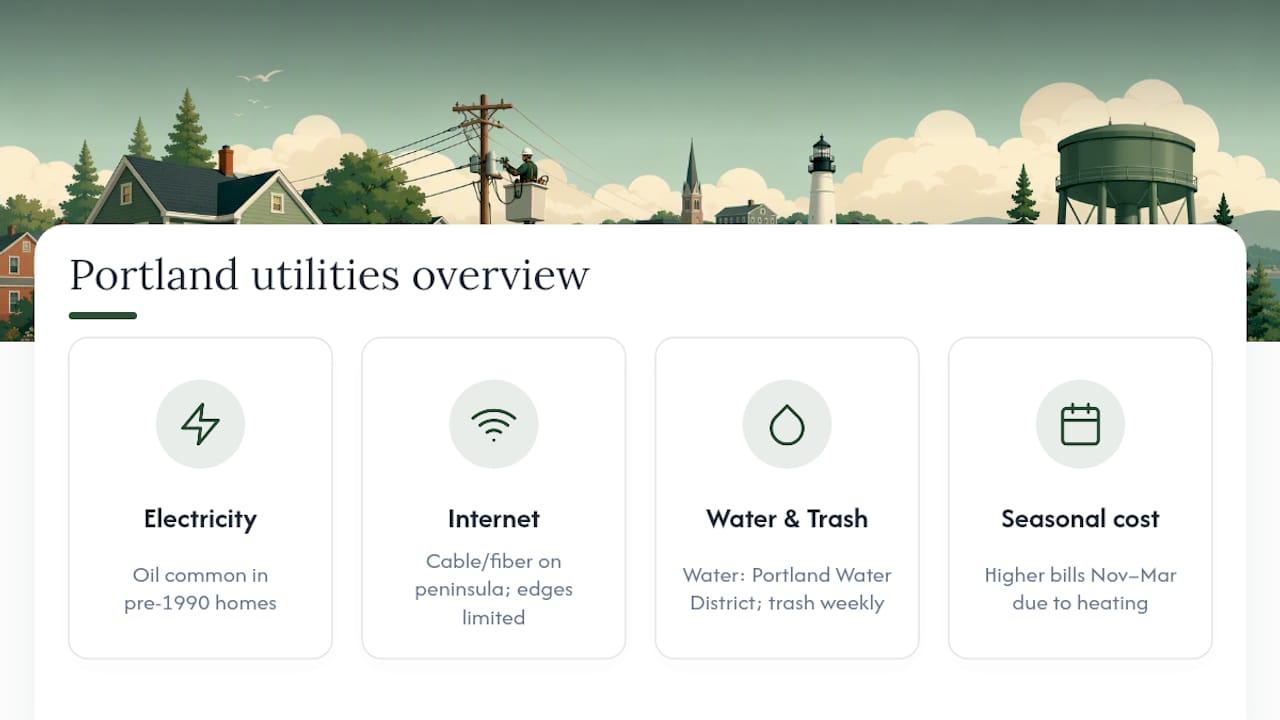
Electricity in Portland runs through Central Maine Power, and winter heating is the line item that surprises transplants most, whether your home uses oil, natural gas, or heat pumps. Homes built before the 1990s often still run on oil heat, which means budgeting for periodic deliveries rather than a flat monthly gas bill.
Internet access is solid on the peninsula and in most inner neighborhoods, with cable and fiber options from major regional providers covering the core city. Move further out toward the edges of Cumberland County and options narrow, so it’s worth confirming provider availability at a specific address before signing a lease, particularly if remote work depends on it.
Water and sewer are billed through the Portland Water District, and trash and recycling pickup is handled by the city on a set weekly schedule. None of these costs are dramatically out of line with other New England small cities, but the combination of oil heat and long winters means your all in utility bill runs noticeably higher between November and March than it does in July.
Author Perspective: A Local Realtor’s Honest Take
The mistake I see most often: buyers fall for the Old Port in July, then get surprised by the same street in February. I’ve steered plenty of clients toward Deering or Westbrook once they actually ran their numbers against a peninsula listing. Budget for winter before you budget for charm.
— David
How Realtor® David Haydym Can Help Your Portland Move
RealtorMaine gives you a straight answer instead of a sales pitch when you’re comparing Old Port charm against a Westbrook commute. A local Realtor with extensive experience matching buyers to central and southern Maine neighborhoods can provide insight into neighborhood-specific conditions and seller negotiation tendencies.

Working with a knowledgeable local real estate agent can provide comparative market analyses, FHA versus conventional financing guidance, and negotiation help tailored to Maine’s seasonal market. Clients typically receive transparent, pressure-free service with responsive communication to assist after standard business hours. If you’re ready to talk through your Portland move, reach out through RealtorMaine’s contact page to schedule a conversation about your specific budget and neighborhood shortlist.
Sources
- U.S. Census QuickFacts — Portland city, Maine
- Ultimate Relocation Guide for Moving to Maine | Visit Portland
- Living in Portland, Maine: Neighborhoods, Cost of Living & Jobs 2026
FAQ
Is Portland, Maine a good place to live?
Yes, for people who value walkability, food, arts, and outdoor access enough to pay a housing premium for it. It’s a weaker fit for anyone who needs cheap rent or dislikes long winters, and neighborhoods like Westbrook or South Portland offer a middle ground worth exploring with help from a local Realtor.
Is Portland, Maine liberal or conservative?
Portland leans strongly liberal in its voting patterns and civic culture, consistent with most small New England port cities. Surrounding towns and rural Maine counties trend more conservative, so political culture shifts noticeably once you move outside city limits.
What salary do you need to live comfortably in Portland, Maine?
There’s no single official comfortable salary figure, since it depends heavily on whether you rent or own and which neighborhood you choose. Portland’s median household income sits in the mid $70,000 range, and a household near or above that figure typically covers peninsula rent or a mainland mortgage without major strain.
What is the best place to live in Maine for retirees?
Cape Elizabeth and Falmouth draw retirees who want coastal access with a quieter pace than the peninsula, while Portland itself appeals to retirees who want walkable amenities and healthcare access close by. The right choice depends on whether you prioritize quiet acreage or proximity to restaurants, medical care, and cultural events.