
A seller rent-back, also called post-closing occupancy, is permitted in Maine only when it exists as a signed written addendum to the purchase and sale agreement, and only when the buyer’s lender knows about it in advance. Without that paperwork, possession passes to the buyer the moment the deed records. Before you agree to anything, lock in exact dates, tell the loan officer, and confirm how the arrangement will show up on the Closing Disclosure.
TL;DR:
- For applications dated October 7, 2024, or later, Fannie Mae excludes rent back credits from eligible funds for down payments, closing costs, or reserves.
- Maine forms may count closing as a seller occupancy day, so specify the exact departure time and whether occupancy starts that day.
- Set a specific dollar remedy for a late departure, such as daily rent, and arrange any escrow holdback with the title company before closing.
- Rent backs lasting a few days to a few weeks usually face less underwriting friction, while longer stays invite more scrutiny.
- If underwriting objects, shorten the occupancy period or replace a cash credit with a smaller holdback that does not affect eligible funds.
Table of Contents
- What a Rent-Back Agreement Is in Maine and Why You Need It in Writing
- How Lenders Affect Rent-Back Deals: Fannie Mae Rules and Coordination
- Key Terms Every Rent-Back Addendum Should Include
- Timing and Closing Coordination: Aligning the Rent-Back With Your Loan
- Negotiation and Drafting Tips From a Maine REALTOR®
- Quick Checklist to Finalize a Rent-Back
- Maine REALTOR® Notes on What Actually Goes Wrong
- How RealtorMaine Can Help You Close With a Lender-Compliant Rent-Back
- FAQ
- Sources
What a Rent-Back Agreement Is in Maine and Why You Need It in Writing
A seller rent-back lets the seller stay in the home for a set period after closing, paying the new owner rent or accepting a credit in exchange for that time. It only works as a formal addendum, not a handshake or a side text message.
Most sample Maine purchase and sale agreements grant possession to the buyer at closing unless a separate addendum states otherwise. If you want the seller to stay even one extra night, that needs to be in writing before the closing table, not negotiated after the fact.
A written rent-back addendum accomplishes three things:
- It fixes exact start and end dates for occupancy so nobody is guessing.
- It spells out payment terms, whether rent, a credit, or a holdback.
- It assigns liability for damage, utilities, and insurance during the overlap period.
How Lenders Affect Rent-Back Deals: Fannie Mae Rules and Coordination
Lenders care about rent-back arrangements more than most buyers expect, and the rules changed in a way that affects how these deals get structured.
Under Fannie Mae’s updated selling guide, effective for loans with application dates on or after October 7, 2024, a rent-back credit paid by the seller cannot be used as eligible funds for the buyer’s down payment, closing costs, or reserves. Lenders must underwrite the loan as if that credit does not exist. Fannie Mae’s Rent-Related Credits guidance confirms the credit can still appear on the Closing Disclosure, but it cannot influence how much cash the buyer is shown to have on hand.
One policy detail changes how every rent-back should be structured: a seller rent-back credit cannot be used as eligible funds for the buyer’s down payment or closing costs under Fannie Mae’s current guidance.
Occupancy dates also matter to the security instrument itself, since most loans assume the borrower will occupy within a set window after closing. To avoid problems:
- Tell your loan officer about the rent-back as soon as it’s discussed, not after it’s signed.
- Get written lender acknowledgment of the exact occupancy dates.
- Confirm the Closing Disclosure reflects the rent-back credit correctly, separate from the buyer’s eligible funds calculation.
Buyers using state or federal assistance programs should pay extra attention here; our first-time homebuyer guide covers how those programs calculate eligible funds.
Key Terms Every Rent-Back Addendum Should Include
A rent-back addendum is short, but every line in it does real work. Leaving one out is how disputes happen after closing, when leverage has already shifted.
- Duration and exact move-out date and time. Many Maine purchase and sale forms count the day of closing as a seller day, so specify whether the clock starts at closing or the next morning.
- Rent amount or credit structure, including how and when it’s paid and exactly how it appears on the Closing Disclosure.
- Security deposit or escrow holdback, plus remedies for a late move-out such as daily per diem rent or a liquidated damages figure.
- Insurance and indemnity terms, naming who keeps homeowner’s insurance active and who covers damage during the rent-back window.
- Utilities, prorations, and delivery condition, spelling out whether the home must be broom-clean, who holds keys, and whether the buyer can schedule a walkthrough before move-out.
- Signatures and effective date, with acknowledgment that the lender, title company, and escrow agent have all been notified where required.
Pro Tip: Write the move-out remedy in dollars, not vague language like “reasonable damages,” so there’s nothing to argue about if the seller overstays.
Timing and Closing Coordination: Aligning the Rent-Back With Your Loan
A rent-back that isn’t coordinated with the lender’s timeline can delay funding, even when both parties agree on the terms.
Raise the rent-back during negotiation, not after the purchase and sale agreement is signed, so it becomes an addendum rather than a last-minute side deal. As soon as terms are roughly agreed, notify the lender and request written acknowledgment, and confirm the escrow or title company has instructions matching the addendum.
In the final week before closing:
- Confirm the lender has formally accepted the rent-back terms in writing.
- Verify the Closing Disclosure shows the rent-back credit correctly and separately from eligible funds.
- Set up any escrow holdback with the title company before the closing date, not the morning of.
- Confirm that lead paint or other disclosure timelines, covered in our guide to Maine disclosure rules, don’t conflict with the rent-back schedule.
If the lender objects or underwriting timelines shift, the fallback is usually to shorten the rent-back window or convert a cash credit into a smaller holdback that doesn’t touch the buyer’s eligible funds calculation at all.
Negotiation and Drafting Tips From a Maine REALTOR®
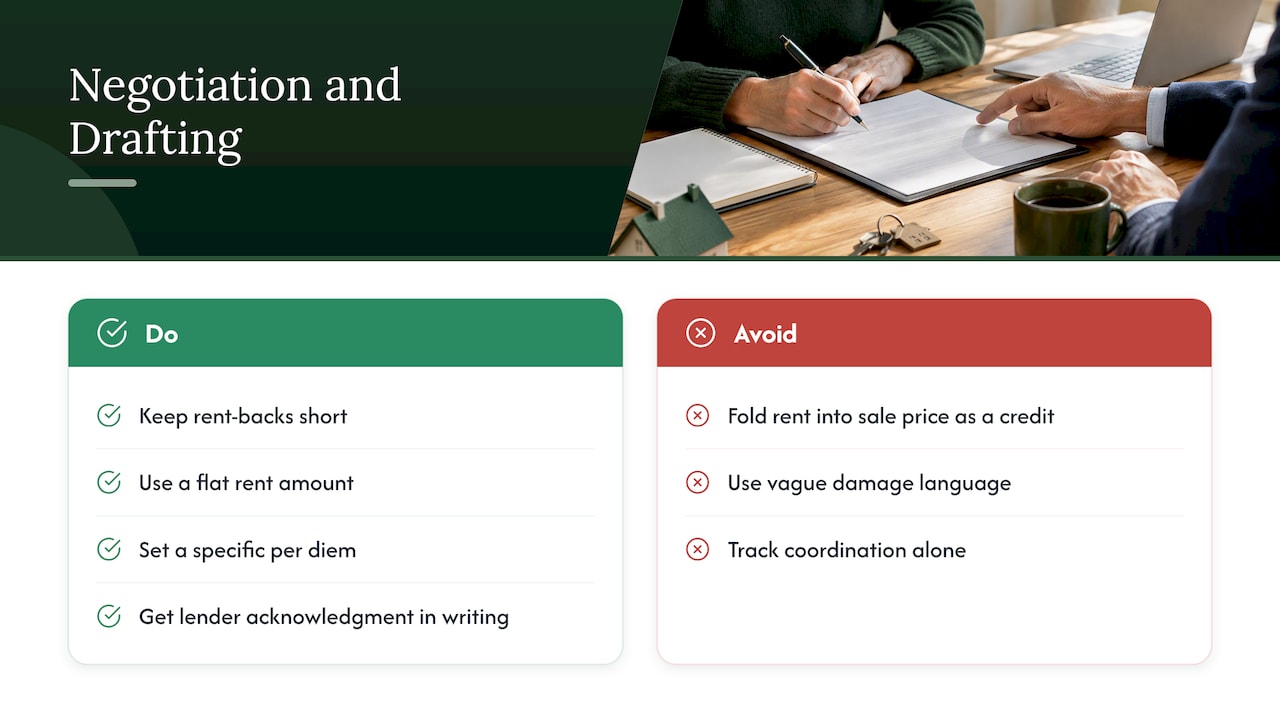
Short rent-backs lasting a few days to a few weeks are the most common arrangement seen in central and southern Maine, and they’re usually the easiest to get a lender to accept without friction. Longer rent-backs are negotiable but invite more scrutiny.
Structuring the payment as a flat rent amount rather than folding it into the sale price as a credit tends to keep underwriting cleaner, since it avoids any appearance of touching the buyer’s eligible funds. For move-out remedies, a simple per diem rate tied to a specific dollar figure, built into the addendum itself, holds up better than vague language about damages.
Pro Tip: Ask your agent to confirm lender acknowledgment in writing and double-check the Closing Disclosure entries before you sign anything at the closing table.
Coordinating all of this, the lender sign-off, the escrow holdback, and the final disclosure review, is usually the agent’s job, not something either party should try to track alone.
Quick Checklist to Finalize a Rent-Back
Before closing day, run through this sequence with your agent or attorney:
- Sign the Possession After Closing addendum with exact dates, dollar amounts, and signatures from both parties.
- Secure written lender acknowledgment of the rent-back terms before the closing date.
- Confirm the Closing Disclosure and the buyer’s eligible funds calculation exclude any rent-back credit, per Fannie Mae’s rent-related credits policy.
- Document the condition of the home, hand over keys on schedule, and set a move-out inspection date.
Our guide to Maine closing costs outlines who typically pays what at the table, which helps when deciding how a rent-back credit should be allocated.
Maine REALTOR® Notes on What Actually Goes Wrong
Most rent-back problems trace back to one thing: the lender finds out too late. Loan officers and underwriters view occupancy through the lens of when the buyer physically takes possession, and failing to disclose a rent-back early can stall funding right before closing.
In practice, the arrangements that go smoothly are the ones where the agent loops in the lender the same week terms are discussed, not the week of closing. Getting the addendum signed early and the lender’s acknowledgment in hand is the difference between a routine transaction and a scramble.
— David
How RealtorMaine Can Help You Close With a Lender-Compliant Rent-Back
Negotiating a rent-back that satisfies both a nervous seller and a cautious underwriter takes more than a template. We can assist with drafting and reviewing rent-back addenda and help coordinate communication with your lender and title company to align escrow instructions with the agreement.

Here is how we assist buyers and sellers:
- Drafting or reviewing the Possession After Closing addendum language.
- Coordinating with your loan officer regarding rent-back terms.
- Confirming escrow and title instructions mirror the agreed terms.
- Advising on move-out remedies and holdbacks.
If you’re buying or selling in Maine and a rent-back is on the table, reach out through our site to talk through the terms before you sign anything.
FAQ
Can a seller stay in the home after closing in Maine?
Yes, but only through a signed written addendum, often called a Possession After Closing addendum, that spells out exact dates, payment, and liability terms. Without that document, possession passes to the buyer at closing under typical Maine purchase and sale practice.
Can rent-back credit be used toward the buyer’s down payment?
No. Under Fannie Mae’s current guidance, a rent-back credit cannot be used as eligible funds for the buyer’s down payment, closing costs, or reserves, and the lender must underwrite the loan without considering it.
How long can a rent-back agreement last?
Terms are negotiable and vary by transaction, but shorter arrangements of a few days to a few weeks tend to move through underwriting with less friction than extended occupancy periods. The exact length should be written into the addendum with a firm move-out date.
Does the lender need to know about a rent-back agreement?
Yes. Failing to disclose a post-closing occupancy arrangement to the lender can create underwriting or occupancy compliance issues, since the loan’s security instrument assumes the borrower will occupy within a set timeframe.
What happens if the seller doesn’t move out on time?
The addendum should include a specific remedy, such as a daily per diem rent charge or a liquidated damages figure, so there’s no ambiguity if the seller overstays. Setting a security deposit or escrow holdback in advance gives the buyer a clear path to enforce the agreed terms.
Sources
- Selling Guide Announcement (SEL-2024-05)
- Rent-Related Credits | Fannie Mae
- Post-purchase occupancy: lender considerations (CompMort)
- PURCHASE AND SALE AGREEMENT (sample Maine form)