A Zestimate is a free, instant algorithmic guess at what your home is worth; an appraisal is a licensed, in-person valuation that lenders and courts actually accept. For casual curiosity or an early pricing conversation, the Zestimate is fine. For a mortgage, a refinance, a divorce settlement, or a property tax appeal, only a professional appraisal will hold up.
TL;DR:
- Zestimates tend to overstate property values by around 16 to 18 percent in dense urban markets like New York City.
- A professional appraisal includes an interior inspection, measures condition and upgrades, and usually costs several hundred dollars, taking about 10 to 16 days.
- AVMs work best in neighborhoods with many similar recent sales but can be inaccurate for unique properties, rural land, or homes with unreported improvements.
- Use a professional appraisal for mortgage financing, legal disputes, or properties with unusual features; rely on a Zestimate for basic neighborhood trends or listing rough estimates.
- When appraisal and Zestimate values differ significantly, gather evidence for reconsideration or seek a second independent appraisal to negotiate or confirm property worth.
Table of Contents
- Zestimate vs Appraisal: How Zillow Builds Its Number
- What a Licensed Appraiser Actually Does
- Why the Two Numbers Rarely Match
- When a Zestimate Is Enough, and When You Need an Appraisal
- What to Do When the Appraisal and Zestimate Don’t Match
- A Maine Realtor’s Take on Trusting the Numbers
- Get a Real Number Before You List or Buy
- Sources
Zestimate vs Appraisal: How Zillow Builds Its Number
Zillow’s Zestimate pulls from public records, recent sales in your area, active listing feeds, and any details you or a previous owner have submitted directly to the site. A statistical model, trained on machine learning, crunches that data and spits out a value in seconds, with no one ever walking through your kitchen. Zillow itself describes the Zestimate as a starting estimate, not an appraisal, which is the single most important fact in this whole comparison.
That model does well in certain conditions and struggles in others:
- Works well in neighborhoods with lots of similar homes and frequent recent sales, where the algorithm has plenty of comparable data to lean on.
- Struggles with unique properties, rural land, or homes with owner-submitted data that’s years out of date.
- Misses entirely any interior renovation, finished basement, or upgrade that never made it into public records.
If your street has ten nearly identical capes that all sold in the last year, the Zestimate is probably close. If you live on five acres with a hand-built barn, it’s guessing.
What a Licensed Appraiser Actually Does
An appraisal is a formal, in-person job performed by a state-licensed professional, and it looks nothing like an algorithm scanning a database; for more details on the appraisal process and factors considered, visit Haio. Wells Fargo notes that a real appraisal includes a physical interior and exterior inspection, something no Zestimate ever does. Here’s what that process typically involves:
- The appraiser visits the property, measures the square footage, photographs each room, and notes condition, layout, and any upgrades or deferred maintenance.
- They research recent comparable sales nearby and, depending on the property, apply the sales-comparison approach, the cost approach, or occasionally an income approach for rental properties.
- They compile a report that becomes the official basis for the lender’s loan decision.
Lenders order and typically require the borrower to pay for this, with costs commonly running several hundred dollars and the full process taking about 10 to 16 days from order to delivery. Appraisers follow independence standards and industry protocols like USPAP, which is exactly why the National Association of Realtors calls the appraisal an independent, third-party opinion of value that lenders can trust when confirming collateral.
Why the Two Numbers Rarely Match
Expect a gap, sometimes a large one. AVMs (automated valuation models) work from incomplete data, and that gap shows up most in markets where properties aren’t cookie-cutter.
One 2025 benchmarking study measured this directly against official assessments in New York City and found AVMs overstated values by roughly 16 to 18% in that dense urban market. That’s not a rounding error. It’s the difference between a home appearing to qualify for a refinance and actually not qualifying once a real appraiser walks through it.
A few practical reasons the numbers diverge:
- Stale or missing records. If your town’s assessor database hasn’t caught up with your new roof or finished basement, the algorithm never sees it.
- Thin comparable data. Rural Maine towns with only a handful of sales per year give the model very little to work with, compared to a subdivision in a fast-turnover suburb.
- Micro-market differences. Two houses a half-mile apart can sit in very different school districts or flood zones, details an AVM often flattens into one regional average.
- Condition blindness. A Zestimate can’t tell a gut-renovated kitchen from one that hasn’t been touched since 1987.
Where AVMs tend to land closer to reality: active on-market listings in busy suburban markets with frequent, similar sales. Where they tend to drift: waterfront camps, historic farmhouses, new construction not yet in the tax records, and anything genuinely one-of-a-kind. The research insight worth remembering is that AVMs can be competitive with listing prices in homogeneous urban markets but still show systematic overstatement in complex submarkets, and Maine has plenty of the “complex” kind.
When a Zestimate Is Enough, and When You Need an Appraisal
Not every situation calls for a licensed professional walking your property. The trick is matching the tool to the stakes.
Get a full appraisal when:
- You’re financing a purchase with a mortgage. Nearly every lender requires it.
- You’re refinancing and need an accurate loan-to-value ratio.
- You’re navigating a divorce settlement, estate division, or property tax appeal, where a defensible number matters legally.
- Your home has unusual features that an algorithm can’t evaluate: acreage, outbuildings, or a major unpermitted renovation.
A Zestimate, or a similar automated estimate, is enough when you’re just browsing listings, tracking neighborhood trends, or sanity-checking a number before a bigger conversation. It’s a starting point, not a conclusion.
There’s a middle ground too. Some lenders offer appraisal waivers on certain refinances or low loan-to-value deals, letting an AVM stand in for an in-person visit, but eligibility depends entirely on the lender’s rules and how much reliable data exists for your property. A comparative market analysis from a local agent sits between the two: not a legal appraisal, but grounded in actual comps and local knowledge an algorithm doesn’t have.
Pro Tip: If you’re about to list your home, ask your agent for a CMA before you ever look at your Zestimate. Anchoring on an algorithm’s number first can make a well-researched CMA feel wrong even when it’s the more accurate one.
What to Do When the Appraisal and Zestimate Don’t Match
A low appraisal doesn’t have to end the deal. Here’s the order of operations that actually works.
- Gather your evidence first. Pull together photos of upgrades, permits for renovations, receipts for major work, and a list of genuinely comparable recent sales.
- Request a reconsideration of value (ROV) through the lender. Agents often assemble this supporting documentation on the buyer’s behalf, since a well-documented ROV carries far more weight than a phone call complaining about the number.
- Consider a second, private appraisal or renegotiate the price. If the ROV doesn’t move the number, you can order an independent appraisal or use the gap as leverage at the negotiating table.
Keep in mind that lenders assign the appraiser under independence rules, so neither the buyer nor the agent gets to pick who shows up. The agent’s real leverage is in the paperwork that follows.
A Maine Realtor’s Take on Trusting the Numbers
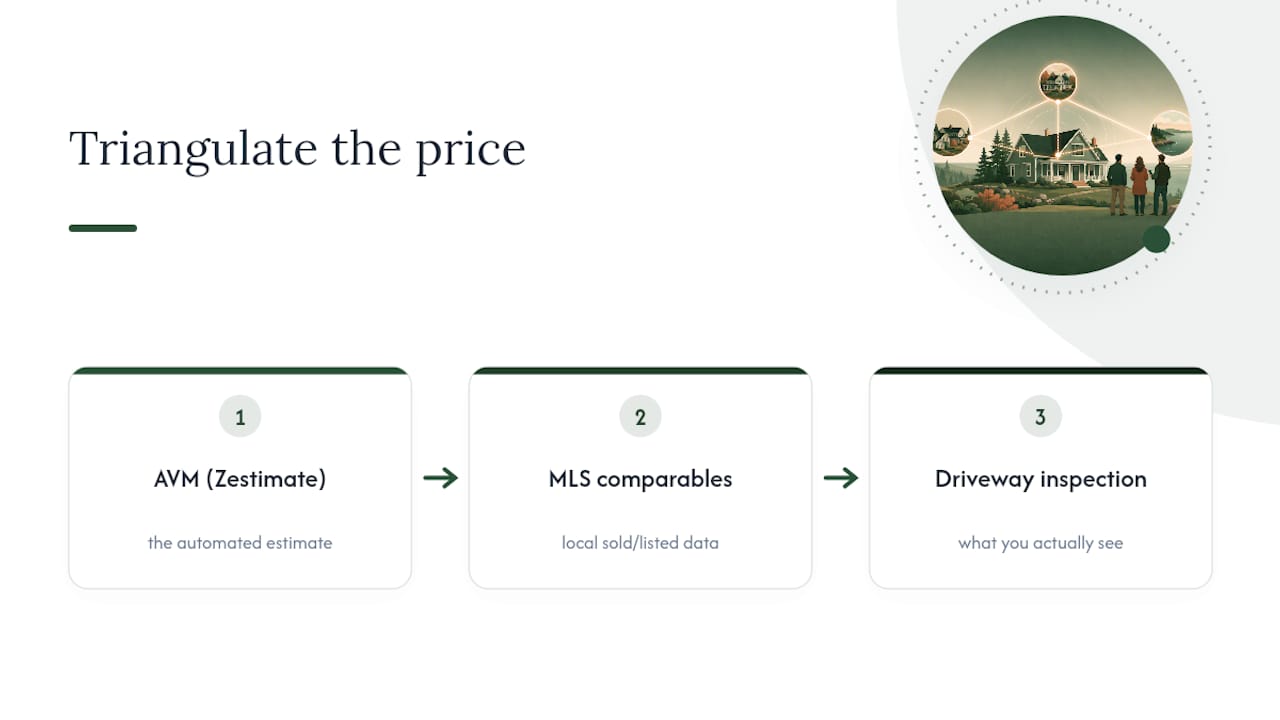
Pricing a home well means triangulating three things: the AVM number, real MLS comparables, and what you actually see standing in the driveway. I’ve watched Zestimates miss badly on properties with unfinished basements that got finished last year, on camps with lot lines that confuse the algorithm, and on farmhouses where a kitchen renovation never made it into the town’s records.
None of that makes the Zestimate useless. It just means it’s a rough sketch, not a blueprint. The real work happens when a local agent’s read on the market meets an appraiser’s independent report. When those two line up, sellers price with confidence and buyers walk into closing without surprises. When they don’t, that’s exactly when a documented reconsideration of value or a private second opinion earns its cost.
— David
Get a Real Number Before You List or Buy
A practical next step when a Zestimate isn’t enough to price with confidence is to get a comparative market analysis built from actual local comps, plus a referral to a licensed appraiser when the transaction calls for one.

David Haydym has spent 20 years pricing homes across central and southern Maine, and that local read catches details an AVM simply can’t: a renovated kitchen the town records haven’t updated, a lot line that confuses the algorithm, a school district that shifts value block by block. Whether you’re preparing to list, negotiating after a low appraisal, or just want a second opinion before you make an offer, reach out through RealtorMaine to get a pricing conversation grounded in real market data instead of a guess.
Sources
- What is an appraisal and an inspection? | Wells Fargo
- Zestimate vs. reality: benchmarking automated valuations against New York City assessments | ACR Journal
- Consumer guide: the appraisal process | NAR
- Home appraisal process: what it is, how long and how much | SoFi
- Home appraisal guide | Opendoor