Choose a condo if you want lower personal maintenance and shared amenities; choose a townhouse if you want land ownership and more control over your exterior. The bigger trap is assuming style tells you the legal structure. Some “townhomes” are condos on paper. Before you fall for a listing photo, check the deed, the HOA’s reserve study, and how your lender treats the property, because those three things decide your real monthly cost.
TL;DR:
- Verify the property’s legal ownership through the deed and HOA declaration, as style alone does not determine whether it is a condo or townhouse.
- Townhouses usually include land ownership and may appreciate more like single-family homes, while condos typically involve shared amenities with higher fees.
- Review HOA financial documents, including reserve studies and recent meeting minutes, to avoid future assessments and determine the property’s true cost.
- Financing conditions differ; condo approvals depend heavily on building health and occupancy ratios, often making the process more complex than for townhouses.
- Confirm insurance coverage requirements, with condos needing HO-6 policies and townhouses requiring full homeowners insurance, and always clarify maintenance responsibilities upfront.
Table of Contents
- Townhouse vs Condo: Definitions Buyers Get Wrong
- Who Owns What: Ownership Scope And The Documents That Prove It
- HOA Fees, Amenities, and Who Really Runs the Show
- What Townhouses and Condos Cost to Finance
- Insurance and Maintenance: Who Pays When Something Breaks
- Resale Value: Why Land Ownership Changes the Math
- How to Choose Between a Townhouse and a Condo
- A Realtor’s Take: The Mistakes That Actually Cost Buyers Money
- Work With a Local Agent Who Reads the Fine Print First
- Sources
Townhouse vs Condo: Definitions Buyers Get Wrong
A condo is a legal ownership structure. You own the interior of your unit, “walls in,” while an association owns and maintains the building, roof, and grounds. A townhouse is a style: a multistory, attached home with its own entrance, often with a small yard or patio.
Here’s the part that trips up a lot of buyers: those two categories aren’t opposites. A property can look like a classic townhouse, two stories, shared walls, a front stoop, and still be legally organized as a condominium. Chase’s breakdown of condo versus townhouse ownership makes this distinction clear, and it’s the single most important thing to verify before you write an offer.
What this means in practice:
- Style tells you nothing about legal ownership. Only the deed and HOA declaration do.
- Condos cluster in denser settings with pools, gyms, or elevators; townhouses usually skip communal amenities in favor of private outdoor space.
- Always request the deed, the declaration of covenants, and the recorded plat map before assuming how ownership is structured.
Who Owns What: Ownership Scope And The Documents That Prove It
Condo ownership typically stops at your unit’s interior walls. The association owns the building shell, roof, and common areas. Townhouse ownership more often includes the structure itself and the land it sits on, known as fee-simple ownership, though Calymavel’s comparison of townhome and condo structures notes plenty of exceptions where townhome-style units are still condo-owned.
That single difference changes who pays for a new roof, who insures the exterior, and how maintenance costs get split. Before you get attached to a listing, pull these documents:
- The recorded deed, to confirm what you’re actually buying (unit only, or unit plus land).
- The HOA declaration and bylaws, which spell out maintenance responsibilities line by line.
- The master insurance policy, so you know what the association covers versus what you’ll need to insure yourself.
- Recent HOA meeting minutes, which often reveal upcoming repairs or disputes before they hit your budget.
HOA Fees, Amenities, and Who Really Runs the Show
Condo HOAs tend to charge more because they’re maintaining more: roofs, elevators, lobbies, pools, and building systems that a townhouse HOA simply doesn’t touch. That fee difference isn’t random. It reflects genuine cost, and Experian’s comparison of condo and townhouse expenses points out that reserve funding and special assessments are where budgets quietly blow up.
A healthy reserve fund means the HOA can pay for a new roof without hitting owners with a surprise bill. A thin one means you could be handed a substantial assessment the year after closing. Ask the HOA directly:
- When was the last special assessment, and what was it for?
- What percentage of the reserve fund is currently funded?
- Are there rental caps, pet restrictions, or rules on exterior changes?
Pro Tip: Ask for the last three years of HOA financial statements, not just the current budget. A pattern of “emergency” assessments is a bigger red flag than the current fee amount.
What Townhouses and Condos Cost to Finance
Townhouses often carry a higher purchase price than comparable condos in the same area, mostly because the price includes land, which tends to hold value. Condos can look cheaper on paper, but the ongoing HOA fee closes some of that gap over time.
Financing is where the two properties really diverge. Lenders treat condo loans differently because they’re not just underwriting you, they’re underwriting the entire building. SoFi’s guide to buying a townhouse explains that condo approval often depends on the building’s financial health, not just the buyer’s.
Expect your lender to check:
- The HOA’s budget and reserve study for overall project health.
- The building’s owner-occupancy ratio (too many renters can disqualify a loan).
- Pending litigation involving the HOA.
- FHA or conventional project approval status, which you can often verify through HUD’s condo lookup tool if you’re going the FHA route.
Start gathering HOA documents the day you go under contract. That paperwork is usually the bottleneck that delays condo closings.
Insurance and Maintenance: Who Pays When Something Breaks
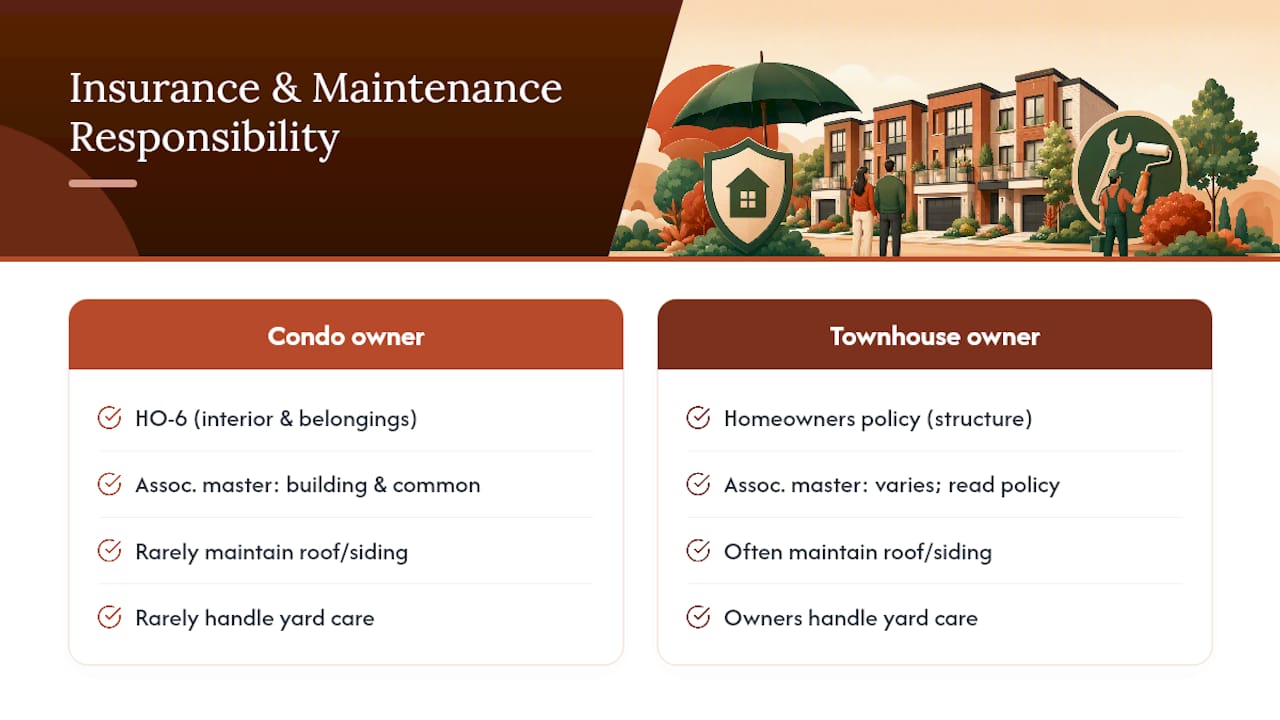
Condo owners typically carry an HO-6 policy, which covers your unit’s interior and belongings, while the association’s master policy covers the building structure and common areas. Townhouse owners usually need a standard homeowners policy since they own more of the structure outright, per Chase’s explanation of condo versus townhouse coverage.
Maintenance follows the same split. Condo owners rarely touch the roof or siding; townhouse owners often handle both, along with yard care.
Reading the fine print matters here. Master policies vary widely in what they exclude, so read the HOA’s policy for gaps before assuming you’re covered. A good rule of thumb: budget for HO-6 coverage on a condo and full homeowners coverage plus exterior maintenance reserves on a townhouse.
Resale Value: Why Land Ownership Changes the Math
Townhouses tend to appreciate more like single-family homes because you own the land beneath them, and land is the asset that historically drives long-term value. NerdWallet’s analysis of townhouse ownership points to this land component as the reason townhouses often track closer to detached-home appreciation than condos do.
Condos can still appreciate well, but a few specific risks tend to drag resale value down:
- Low reserve funds, which scare off future buyers and lenders alike.
- Pending or recent litigation involving the HOA.
- A high percentage of renter-occupied units, which can limit financing options for the next buyer.
Before you buy either, pull comparable sales from the last 12 to 18 months and ask for the HOA’s assessment history going back at least five years. Patterns repeat.
How to Choose Between a Townhouse and a Condo
Match your top priority to the property type, then verify before you offer.
| Priority | Better fit |
|---|---|
| Minimal personal maintenance | Condo |
| Land ownership and appreciation | Townhouse |
| Shared amenities (pool, gym) | Condo |
| Private yard and full control over exterior | Townhouse |
| Lower upfront price | Condo, usually |
| Simpler, faster loan approval | Townhouse, usually |
Once you’ve picked a lane, work through this before you write an offer:
- Pull the deed and confirm the legal ownership structure, not just the style.
- Request the HOA declaration, bylaws, and the last three years of financials.
- Review the reserve study percentage funded, ideally above 70%.
- Confirm insurance scope with your agent, HO-6 for condos, full homeowners for most townhouses.
- Get pre-approval specific to the property type, since condo loans need extra project review.
Pro Tip: If the HOA can’t produce a reserve study or recent financials within a few days, treat that as a warning sign, not a paperwork delay.
Walk away, or at least pause, if you find no funded reserves, active litigation against the association, or maintenance responsibilities that aren’t clearly assigned in writing.
A Realtor’s Take: The Mistakes That Actually Cost Buyers Money
The buyers who get burned aren’t the ones who chose condo over townhouse or vice versa. They’re the ones who skipped the HOA documents, assumed a “townhome” was automatically fee-simple, or didn’t realize their insurance had a gap until after a claim. A good agent pulls the declaration, the reserve study, and recent meeting minutes before you ever make an offer, not after.
Use your agent for that document pull specifically. When you tour a property, ask for HOA financials on the spot, not after you’ve fallen in love with the kitchen.
— David
Work With a Local Agent Who Reads the Fine Print First
Mainerealtordavid gives you something most online listings never will: a local read on which HOA documents actually matter before you fall for a property’s curb appeal. David Haydym has spent over 20 years in central and southern Maine real estate, pulling reserve studies and HOA declarations for buyers so surprises show up before closing, not after.

Whether you’re comparing a condo in a coastal town or a townhouse near Portland, this is the kind of local knowledge that catches the assessment history a generic search never surfaces, and the data-driven comparisons that keep you from overpaying for either. If you’re actively touring listings in central or southern Maine, reach out through Mainerealtordavid to get a comparative market analysis started and a document checklist built around the specific property you’re considering.