Most of Maine qualifies for a USDA home loan, but two separate boxes have to be checked before you write an offer: the property’s address and your household’s income against the county limit. Start with the USDA property eligibility tool, then confirm which of the two loan types, Guaranteed or Direct, fits your situation.
TL;DR:
- Check the specific property address on the USDA eligibility map before touring to avoid falling in love with a home that is outside eligible zones.
- Household income must stay below county-specific limits, which vary based on household size, for USDA Guaranteed loan approval, but credit score and debt ratios are evaluated separately.
- Property condition issues like aging septic systems or heating sources commonly delay USDA closings, especially if verified inspections are not completed early in Maine’s winter.
- Rate quotes fluctuate weekly and require comparison from multiple USDA-approved lenders; guaranteed loans generally have 30-year fixed terms, while direct loans may extend repayment for eligible low-income borrowers.
- Approaching the process with early address verification and repair negotiations can prevent underwriting failures and streamline the closing timeline in Maine.
Table of Contents
- Types of USDA Home Loans Available in Maine
- Is Your Property in a USDA-Eligible Area of Maine?
- USDA Income Limits and Credit Requirements in Maine
- How to Confirm USDA Eligibility Before You Make an Offer
- USDA Loan Benefits, Fees, and Typical Terms in Maine
- Applying for a USDA Loan in Maine: Documents, Timeline, and What to Expect
- Maine USDA Contacts and Official Resources
- What Maine Buyers and Agents Should Do Differently With USDA Financing
- Current USDA Loan Interest Rates and Payment Options in Maine
- Why Address-Level Checks Matter More Than General Advice Suggests
- How RealtorMaine Helps You Buy With USDA Financing
- Sources
Types of USDA Home Loans Available in Maine
USDA financing splits into two main tracks, and mixing them up wastes time with the wrong lender.
The Section 502 Guaranteed Loan is the one most Maine buyers end up using. A participating bank or mortgage company issues it, USDA backs it, and it works a lot like an FHA or conventional loan in terms of process and paperwork.
The Section 502 Direct Loan works differently. USDA itself is the lender, and it’s reserved for very-low-to-low-income applicants who can’t get financing elsewhere on reasonable terms. Direct loans can include payment assistance that lowers the effective monthly payment, and the home must be your primary residence.
A few other programs round out the picture:
- Site loans help finance building lots ahead of construction.
- Home improvement/repair loans and grants target existing low-income homeowners fixing safety or health hazards, not new purchases.
- Direct loans can extend repayment terms well beyond the standard 30 years for qualifying applicants.
Is Your Property in a USDA-Eligible Area of Maine?
Most of Maine’s land area falls inside USDA’s eligible zone, based on a population threshold of 35,000 or fewer residents, mapped using 2020 Census data that stays in effect through 2027. Portland, Bangor, and Lewiston’s urban cores are generally excluded. Most suburbs, small towns, and everything in between usually qualifies.
That said, eligibility isn’t a statewide yes/no. It’s decided address by address:
- Go to the USDA property eligibility site and enter the exact street address, not just the town.
- Read the result carefully. It will state directly whether that specific parcel qualifies for the Single Family Housing program.
- Save or screenshot the result for your file. Lenders will ask for it, and having it up front speeds up preapproval.
One side of a street can be inside the eligible boundary while the house across the road is not. That’s not a glitch. It’s how the census-based mapping draws lines around excluded metro areas.
Pro Tip: Run the address check before you fall in love with a listing. It takes two minutes and can save you a wasted showing or, worse, an accepted offer that falls apart in underwriting.
USDA Income Limits and Credit Requirements in Maine
Address eligibility is only half the equation. Your household income has to fall under the county-specific limit for the Guaranteed program, and that limit shifts based on how many people live in the household.
Guaranteed program income limits are commonly set near the area median income for a given county, though the exact dollar figure varies from county to county and rises with household size. A family of five in Cumberland County has a higher ceiling than a couple in Aroostook County, for instance.
On the credit side, most lenders look for:
- A credit score considered sufficient for automated USDA underwriting approval.
- Manual underwriting is still possible below that threshold, but it requires more documentation and a stronger overall file.
- Debt-to-income ratios that lenders evaluate case by case, alongside residual income.
Meeting the income limit doesn’t guarantee credit approval, and a strong credit score doesn’t override an income limit that’s exceeded. Both checks run independently, and both have to clear.
How to Confirm USDA Eligibility Before You Make an Offer
Get the sequence right and you’ll avoid inspection fees on a house that never had a shot.
- Run the exact address through the USDA eligibility map first, before scheduling a showing.
- Pull the current income limit table for the county and calculate your household’s total qualifying income against it.
- If the property or income situation is ambiguous, call the Maine USDA Rural Development office directly for clarification rather than guessing.
- Ask any lender you’re considering three things: Are they an approved USDA Guaranteed lender? How many Maine USDA closings have they handled? What’s their realistic timeline right now?
Have your last two years of tax returns, recent pay stubs, and two months of bank statements ready. It shortens every conversation that follows.
USDA Loan Benefits, Fees, and Typical Terms in Maine
The headline benefit is straightforward: no down payment. For a first-time buyer in Maine scraping together closing costs, that alone can be the difference between buying this year and waiting three more.
USDA loans also carry two fees worth understanding upfront:
- A one-time upfront guarantee fee, financed into the loan rather than paid in cash at closing.
- An annual fee, charged monthly as part of the payment, similar in function to FHA’s mortgage insurance premium.
Compared to FHA loans, USDA’s ongoing annual fee tends to run lower over the life of the loan, which matters if you’re not planning to refinance or sell within a few years.
Guaranteed loans typically run as 30-year fixed mortgages. Direct loans can extend repayment terms further for very-low-income borrowers, and combined with payment assistance, the effective interest rate can drop below market rate for qualifying applicants. That combination benefits rural, lower-income households the most, particularly in counties like Washington or Piscataquis where median incomes run lower and USDA financing is often the most realistic path to ownership.
Applying for a USDA Loan in Maine: Documents, Timeline, and What to Expect
The process runs in three phases, and each one has its own Maine-specific wrinkle.
- Preapproval. Gather W-2s or tax returns, recent pay stubs, and two to three months of bank statements. Ask your lender for their full checklist upfront, since USDA documentation requirements run slightly heavier than a standard conventional file.
- Offer and appraisal. USDA appraisals check functional condition, not cosmetics: working heat source, sound roof, and a working water and septic system are the big three in Maine. If an inspection flags an aging oil furnace or a septic system near end of life, negotiate seller repairs into the purchase agreement before you’re deep into underwriting.
- Underwriting and closing. Guaranteed loans go through two layers: your lender’s underwriting, then a USDA review before final sign-off. Budget about one to one-and-a-half months from accepted offer to closing table. Direct loans route entirely through USDA, and payment assistance calculations get built into your monthly figure during this stage.
Pro Tip: In Maine, a failed water test or a septic system that can’t be verified in winter ground conditions is the single most common closing delay on USDA files. Push for inspections early in the season if you’re touring in late fall.
Maine USDA Contacts and Official Resources
Maine’s USDA Rural Development state office sits in Bangor, with area offices covering Presque Isle, Lewiston, and Scarborough. Reach the Maine Rural Development office directly for Direct loan questions or program specifics that fall outside a lender’s scope.
Key tools to bookmark:
- The property eligibility map for address checks.
- The county income limits PDF for household qualification.
- The MyRDLoan portal for managing an existing loan file.
For Guaranteed loans, your approved lender handles day-to-day processing. Contact USDA directly only for Direct loan applications or program clarification.
What Maine Buyers and Agents Should Do Differently With USDA Financing
Sequence matters more than most buyers realize. Check the address on the eligibility map before you tour, not after you’ve fallen for the listing. That single habit avoids the worst outcome in a USDA transaction: an accepted offer that dies in underwriting because nobody confirmed the parcel qualified.
Property condition is where Maine deals actually stall. Build a repair negotiation checklist before you’re under contract: roof age, heating system type and age, and water/septic verification. Winterized homes that sat vacant over a Maine winter often have hidden issues USDA appraisers will flag, so push for inspections that specifically check these systems rather than a generic walkthrough.
Because Guaranteed loans run through two underwriting layers, lender and USDA, build extra buffer into your closing timeline. A buyer’s agent who’s coordinated USDA closings before knows which delays are normal and which ones signal a real problem.
Current USDA Loan Interest Rates and Payment Options in Maine
USDA Guaranteed loan rates track closely with conventional 30-year fixed rates, since participating lenders set them based on the same broader mortgage market, adjusted slightly for the government backing that reduces lender risk. Rates move week to week, so the number you’re quoted today can differ from what a neighbor locked in last month. Your best move is asking two or three USDA-approved lenders for current quotes on the same day, since rate sheets vary by institution even for an identical program.
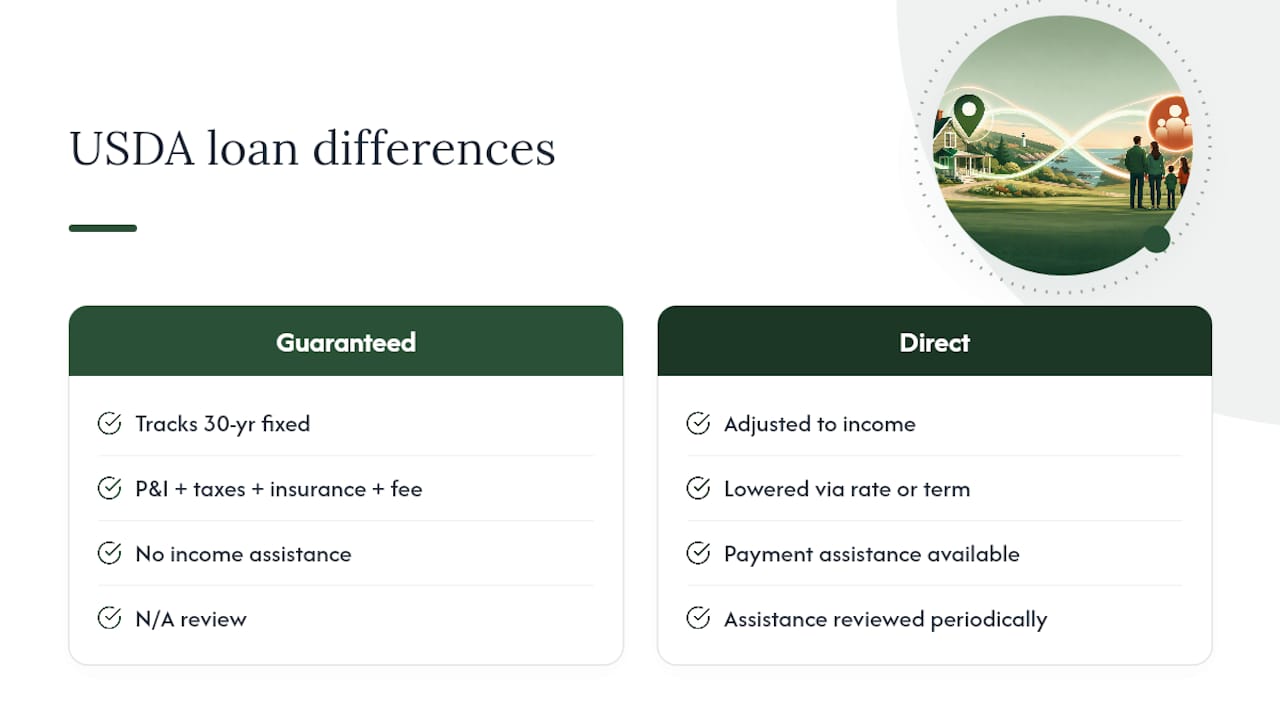
Payment structure is where USDA options diverge more meaningfully. Guaranteed loan borrowers pay principal, interest, taxes, insurance, and that annual fee, all wrapped into one monthly payment like a conventional mortgage. Direct loan borrowers who qualify for payment assistance see something different: USDA adjusts the effective interest rate or extends the term, sometimes both, to bring the payment down to a level tied to the household’s income. That assistance isn’t permanent charity. It’s reviewed periodically, and payments can adjust if income rises.
Rate locks work the same way they do with any mortgage: once you’re under contract and your lender issues a lock, the rate holds for a set window, typically 30 to 60 days, regardless of what the broader market does before closing. Given that Guaranteed loans often take 30 to 45 days to close because of the two-stage underwriting review, ask your lender about lock extension costs upfront. A rate lock that expires two weeks before closing because of a USDA review delay is an avoidable expense if you negotiate the lock term correctly from the start.
Why Address-Level Checks Matter More Than General Advice Suggests
Most USDA content treats eligibility as a simple map: rural good, city bad. That framing misses what actually trips up Maine buyers. The real risk sits at the boundary lines, where one house qualifies and the one two doors down doesn’t, and where a property that looked promising on a wide zoomed-out map turns out to sit just inside an excluded metro pocket.
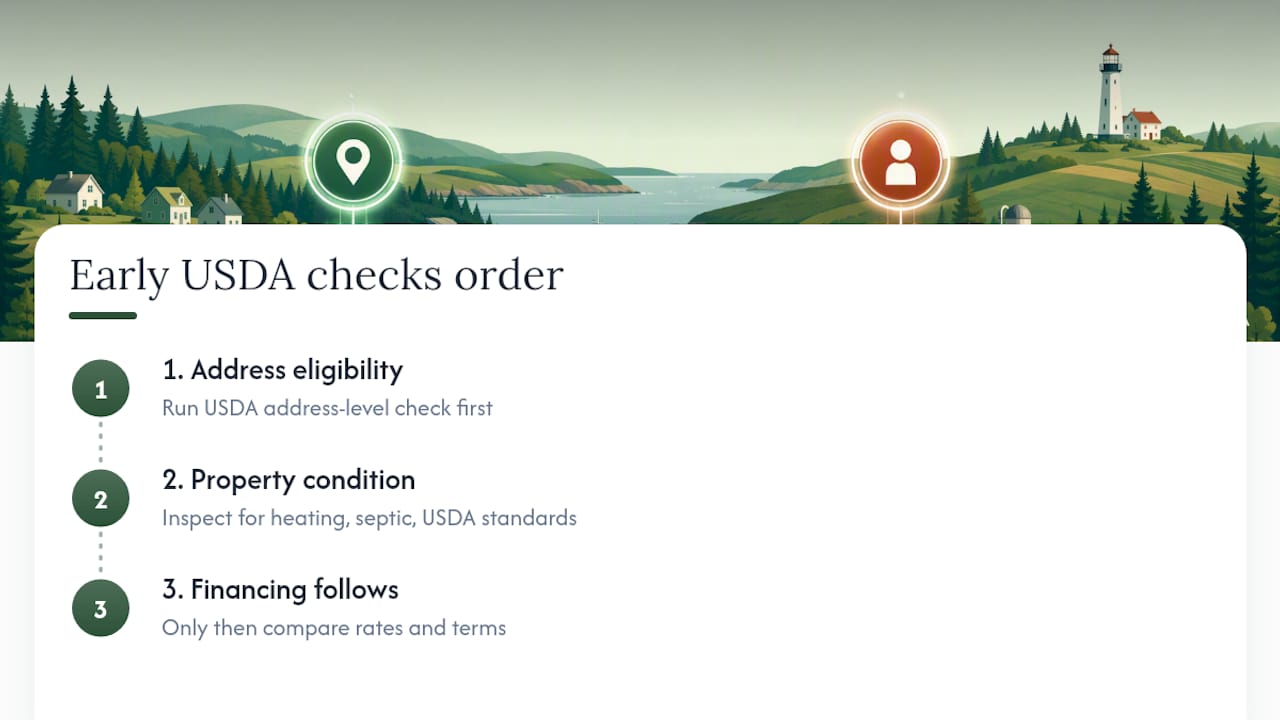
The conventional advice to “just check if you’re in a rural area” undersells how granular this gets. I’d tell any buyer to treat the address-level check as a non-skippable first step, not a formality you get to after falling for a listing. Property condition is the second blind spot. Maine’s climate turns a soft heating system or a marginal septic into a closing-day problem, and sellers who don’t expect that scrutiny get caught off guard during negotiation.
What should come first: run the address, then walk the property with USDA’s condition standards in mind before you get emotionally invested. Everything else, financing terms, rate shopping, follows from getting those two things right early.
— David
How RealtorMaine Helps You Buy With USDA Financing
Running a USDA eligibility check on your own is doable, but knowing which Maine towns sit near a boundary line, which lenders actually close USDA files without delay, and how to negotiate a septic or heating repair before it derails your closing takes local reps most buyers don’t have time to build. David Haydym has spent 20 years working central and southern Maine’s residential market and can walk your target addresses through eligibility, connect you with lenders experienced in USDA closings, and handle the repair negotiations that trip up first-time USDA buyers.

If you’re ready to find out whether a specific property qualifies, or you want a second set of eyes before you make an offer, visit RealtorMaine and schedule an eligibility review. It’s a fast way to know exactly where you stand before you’re competing for a house you can’t finance the way you planned.
Sources
- Single Family Housing Direct Home Loans in Maine
- USDA Income and Property Eligibility Site
- Maine | Rural Development
- USDA Guaranteed Housing Program income limits (PDF)
- MyRDLoan portal