A conventional loan is a mortgage that is not part of a government program such as FHA, VA or USDA. To qualify, you need a credit score of roughly 620 or higher, steady income, a debt load your income can carry, and a down payment of at least 3% on an eligible primary home. You cannot buy with nothing down on a conventional loan, but some other loans allow it. Which one fits you depends on your credit, savings and the home you want. Sorting that out before you make offers is part of how we guide buyers across central and southern Maine.
TL;DR
- Most conventional loans call for a credit score of 620 or above, and the best pricing goes to higher scores.
- The minimum down payment is 3% on eligible primary homes, 5% is common, and 20% avoids private mortgage insurance.
- Lenders look at your debt-to-income ratio (monthly debts divided by gross monthly income). Roughly 36% is the comfortable zone, and approved files can go higher.
- A true zero-down purchase is not a conventional option. VA and USDA loans are the zero-down routes.
- The home has to qualify too: safe, sound, insurable and fit for year-round living.
Table of Contents
- What counts as a conventional loan
- Credit score requirements
- Income and employment history
- Debt-to-income ratio
- Down payment: do you need 20%?
- Can you buy a house with no down payment?
- Property requirements
- Second homes and investment properties
- Why lenders give different answers
- A quick readiness checklist
- Our perspective
- Work with a Maine Realtor from the start
- FAQ
- Sources
What counts as a conventional loan
The Consumer Financial Protection Bureau (CFPB) defines a conventional loan as one that is not backed by a specific government program. Most are “conforming,” meaning they fit the size limits and rules set by Fannie Mae and Freddie Mac, the two companies that buy most U.S. mortgages from lenders.
For 2026, the Federal Housing Finance Agency set the baseline conforming limit at $832,750 for a one-unit home, up from $806,500 in 2025. High-cost areas go up to $1,249,125. Limits for two-, three- and four-unit homes are higher. The limit is reset each year, so confirm the figure for your county when you start shopping. A loan above the limit is a “jumbo” loan, with its own stricter rules.
Credit score requirements
The figure you will see everywhere is 620. The CFPB’s buyer checklist notes that for some loans lenders want a minimum credit score of 620 unless you have a large down payment. Fannie Mae’s own rules are more layered. Its Eligibility Matrix (August 2026) lists different minimum scores for manually underwritten loans, depending on loan-to-value ratio (the loan as a percentage of the home’s value) and debt-to-income ratio. For a one-unit primary home, the matrix shows 680 when the loan-to-value is above 75% and 640 at or below it, at a 36% maximum debt ratio.
What that means for you in practice:
- A score near 620 can work, but you will pay more in rate and mortgage insurance.
- Scores in the 740 range and up are generally where the best pricing begins.
- Lenders add their own rules on top of the agency minimums, called overlays. That is why two lenders can give the same borrower different answers.
- Fannie Mae and Freddie Mac now accept newer credit score models, so the score your lender pulls may differ from an app you check yourself.
If your score sits just under a tier, a few months of paying down card balances and avoiding new credit can change your options. Tell us your range early and we can map it to realistic price points before you tour a single house.
Income and employment history
There is no minimum salary for a conventional loan. What the lender checks is whether your income supports the payment you are asking for. The CFPB says lenders look for at least two years of regular, steady income, good credit, few long-term debts and a saved down payment, plus money to cover closing costs, moving costs and repairs.
Wage earners typically document income with pay stubs and W-2s. Self-employed buyers, including many Maine seasonal and small-business owners, document it with tax returns, so the profit your return shows is what counts, not your gross sales. If you changed jobs recently, expect to explain it. A move within the same field usually causes less trouble than a jump into a new one.
Debt-to-income ratio
Debt-to-income (DTI) is the share of your gross monthly income that goes to debt payments, including the new mortgage. A common yardstick is the 28/36 rule: no more than 28% of pretax income on housing and 36% on housing plus other debts. Housing costs include principal and interest, property taxes, homeowners insurance, mortgage insurance and any association dues. Other debts include student loans, car loans and credit card minimums.
Worked example: on $7,000 of gross monthly income, 36% is $2,520. If you already pay $600 a month on a car and student loans, that leaves about $1,920 for the full housing payment under that guideline.
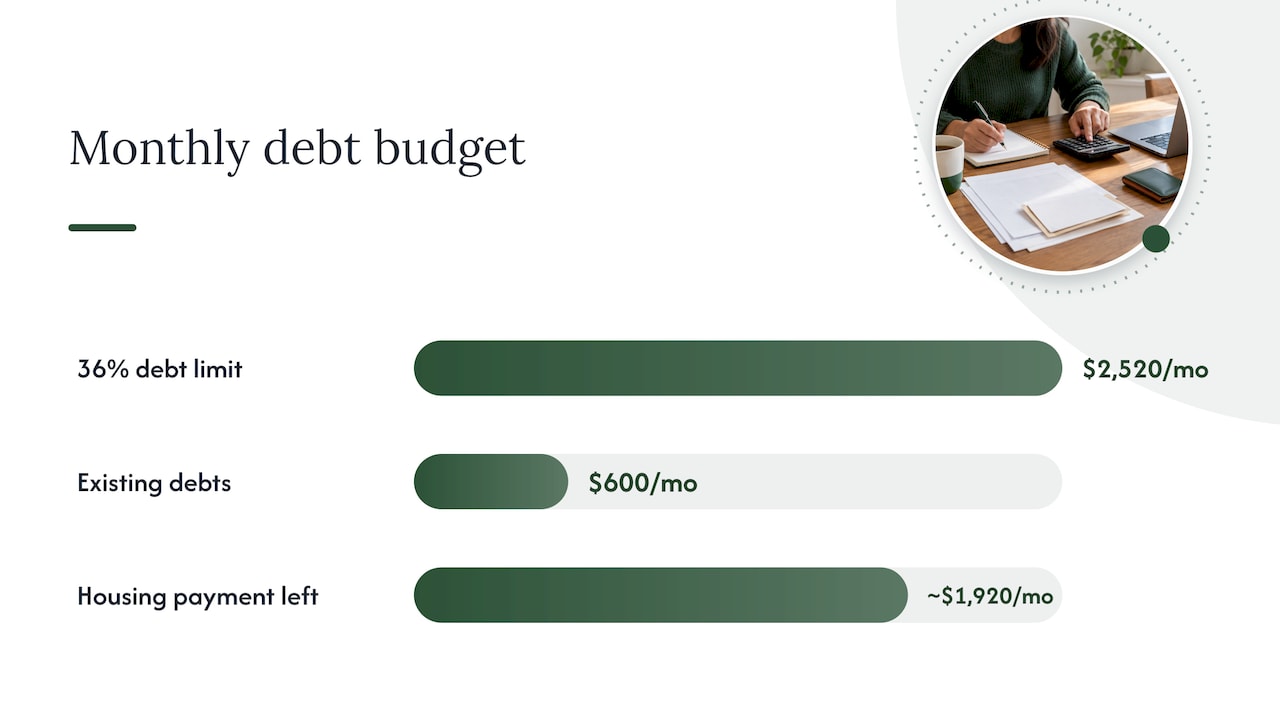
The 36% figure is a guideline, not a wall. According to Fannie Mae’s Eligibility Matrix, manually underwritten loans can reach 45% with stronger credit scores and reserves. Loans run through Fannie Mae’s automated system can be approved at higher ratios, up to 50%. Reserves (savings left after closing), a long credit history and a lower loan-to-value all help a borderline file.
Down payment: do you need 20%?
No. The CFPB explains that private mortgage insurance (PMI) is required on conventional loans with less than 20% down, and that at 20% it is not required and you may get a lower rate. PMI can be a monthly premium, a one-time payment at closing, or both. The same page notes lenders sometimes offer “no PMI” in exchange for a higher interest rate, so compare the whole cost, not just the line item.
The CFPB’s down payment guidance says you need at least 3% in most cases, many lenders want 5% or more, and you save more at 10% and the most at 20%. Lenders usually price in 5% steps, so being a point short of a tier earns you nothing. The same page suggests keeping three to six months of expenses in reserve rather than emptying your savings at closing.
Here is how the minimums run by how you will use the home, according to Fannie Mae’s Eligibility Matrix:
| Property and use | Maximum loan-to-value | Minimum down payment |
|---|---|---|
| One-unit primary home | 97% | 3% |
| Two- to four-unit primary home | 95% | 5% |
| One-unit second home | 90% | 10% |
| One-unit investment property | 85% | 15% |
On a $300,000 Maine home, that is $9,000 at 3% and $15,000 at 5%. Add closing costs on top of either number.
The 3% programs
Three-percent-down conventional loans come through programs such as Fannie Mae’s HomeReady, Freddie Mac’s Home Possible and Standard 97 or HomeOne. Some carry household income caps tied to the area median, and some require at least one first-time buyer. Your lender confirms which you fit. If you are a first-time buyer in Maine, our guide on qualifying and getting up to $10,000 as a first-time homebuyer in Maine covers state assistance that can sit alongside your loan.
Can you buy a house with no down payment?
Not with a conventional loan. The lowest down payment is 3%. If your goal is zero down, the CFPB’s home loan toolkit points to two loan types:
- VA loans for qualifying veterans and service members. We explain how this works with state help in buying in Maine with $0 down through a VA loan.
- USDA loans for eligible rural borrowers. Eligibility turns on the property address and household income, which we cover in the two checks that decide USDA loans in Maine.
The toolkit also lists FHA at 3.5% down. If your credit score is lower or your debt load is heavier, FHA can come out ahead of conventional, and we compare the two in when 3.5% down FHA beats conventional. Down payment assistance is another path: gift funds from family, employer help or state programs can cover part of the 3% or 5%.
Property requirements
The house must qualify, not only you. Conventional conforming loans cover one- to four-unit residential dwellings. According to The Mortgage Reports, the home must have good title, be safe, sound and structurally secure, be insurable, have road access that meets local standards, connect to utilities and suit year-round use.
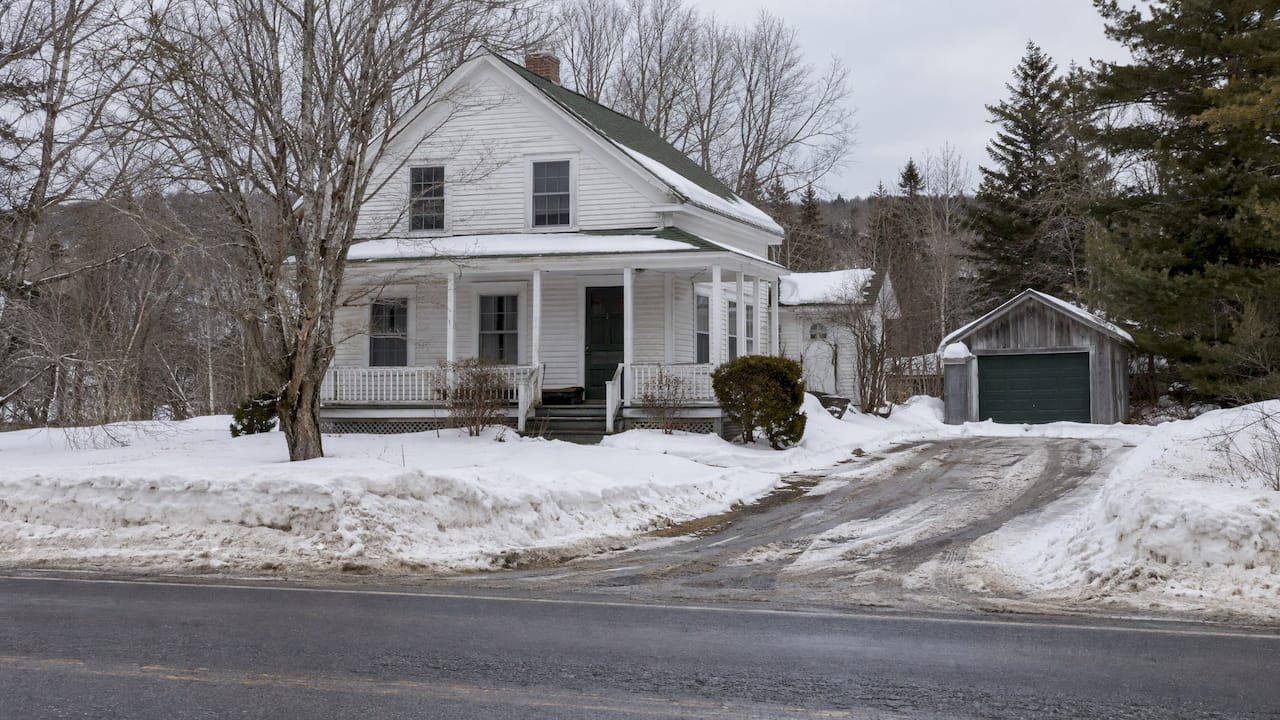
Issues that commonly trigger further review include shared wells or septic systems without enforceable maintenance rights, buried oil tanks, financed solar panels, pests, moisture problems, lead paint, asbestos and radon. A conventional loan does not require a home inspection, but the appraiser notes obvious defects, and lenders generally want repairs finished before closing.
This matters a great deal in Maine, where older farmhouses, well and septic systems, oil heat and seasonal camps are common. A condo or townhouse adds another layer, because the lender also reviews the association’s documents and budget. Our note on HOA versus condo association dues explains what shows up at closing.
Second homes and investment properties
If you are buying a vacation home on the coast or a rental, the rules tighten. Fannie Mae’s occupancy definitions say a principal residence is one you occupy within 60 days of closing and for at least a year afterward. A second home must be a one-unit dwelling suitable for year-round occupancy and not primarily a rental or timeshare. An investment property is anything else, and all investment-property loans carry an added pricing adjustment.
In practice, expect the larger down payments in the table above, a higher rate than a primary home, and closer scrutiny of reserves. A seasonal cottage without year-round heat or access can fail the second-home test no matter how strong your finances are. Check the property type with us before you fall for the view.
Why lenders give different answers
Two buyers with the same score can walk away with different quotes. Lenders set their own overlays, and mortgage insurance is priced by private insurers, so the same credit score can cost different amounts at different lenders. This is why we suggest getting preapproved with more than one lender, and our Maine preapproval playbook shows what sellers and state programs look for in the letter. We also keep a list of questions for lenders in fixed versus adjustable mortgages.
Financing that stalls late in a deal hurts everyone involved, which is why a solid preapproval matters. If you want to see the seller’s side, here is what happens when buyer financing falls through.
A quick readiness checklist
- Pull your credit reports and note your score range.
- Add up monthly debts and divide by gross monthly income.
- Decide your target down payment tier: 3%, 5%, 10% or 20%.
- Gather two years of pay stubs, W-2s or tax returns, and recent bank statements.
- Keep three to six months of expenses outside your closing funds.
- Get preapproved before you tour homes.
Our perspective
Most of the buyers who come to me are not stuck on a number. They are stuck on the order of things. They tour homes, fall for one, and only then learn their down payment tier or debt ratio puts the payment above where they wanted to be.
I work the other way around. We start with what you can comfortably carry, then pick the loan type that fits: conventional, FHA, VA or USDA. After 20 years in the Maine market, I know that a loan program is only half the picture. The house, its well and septic, its heat and its condo documents all have to clear the lender too.
My approach is transparent and without pressure. I use data to price and negotiate, and I am reachable beyond standard hours, because questions about a loan commitment do not wait for 5 p.m. Whether you are a first-time buyer, relocating to central Maine, downsizing, buying a coastal getaway or adding a rental, you get honest guidance on which loan and which home fit you.
David
Work with a Maine Realtor from the start
I am David Haydym, a licensed REALTOR® with 20 years in the Maine market and more than 50 homes sold. For buyers, that means a home search matched to your budget and loan type, pricing and negotiation backed by data, and guidance on FHA and conventional financing. I also help with document review for condos and townhouses. Whether you are looking for a first home, an investment property or a seasonal place on the coast, start with our Maine home buying page and we will work out the plan together.

If you are also selling a home to fund your next purchase, our Maine home valuation is a good first step.
FAQ
What credit score do I need for a conventional loan?
Most lenders look for 620 or higher, and Fannie Mae’s matrix sets different minimums by loan-to-value and debt ratio. Higher scores bring lower rates and cheaper mortgage insurance. Lenders can also add their own requirements, so your answer may vary by lender.
Do all conventional loans require 20% down?
No. The minimum is 3% on eligible primary homes, and 5% is common. With less than 20% down you pay private mortgage insurance, which the CFPB says is not required at 20%. Second homes and investment properties need 10% to 15% or more.
Can I buy a house with no down payment?
Not with a conventional loan. VA loans for qualifying veterans and USDA loans for eligible rural properties are the usual zero-down routes. FHA requires 3.5% down. Assistance programs and gift funds can also cover part of a required down payment.
How much income do I need for a $400,000 mortgage?
Lenders set no minimum income. They test whether your income supports the payment given your other debts. Under the 28/36 guideline, the full payment on a $400,000 home plus your other monthly debts should stay near 36% of gross monthly income. The exact income depends on your rate, down payment, taxes and insurance.
Sources
- Conventional loans, Consumer Financial Protection Bureau
- 2026 Conforming Loan Limits by County
- Ready to buy a home? CFPB
- Fannie Mae Eligibility Matrix
- Mortgage Income Calculator, NerdWallet
- What is private mortgage insurance? CFPB
- Determine your down payment, CFPB
- Your home loan toolkit, CFPB
- Conventional Loan Home Requirements & Inspection, The Mortgage Reports
- Occupancy Types, Fannie Mae