A fixed-rate mortgage locks your interest rate for the entire loan term, so your principal and interest payment never change. An adjustable-rate mortgage (ARM) starts with a lower introductory rate that later moves up or down based on market conditions. Choose fixed if you’re staying put and want budget certainty; consider an ARM only if you plan to sell or refinance before the rate resets. Either way, run the numbers at the ARM’s worst-case rate before you sign anything.
TL;DR:
- Borrowers planning to stay in their home for more than seven years should stick with a fixed-rate mortgage to avoid potential rate increases.
- ARM payments can start $150 to $250 lower per month but may rise significantly after the initial period, especially if interest rates increase beyond caps.
- To avoid hidden costs, compare not only the initial rate but also the lifetime cap, periodic adjustment caps, and potential maximum payments when evaluating an ARM.
- Refinancing an ARM before the reset is uncertain and depends on future market conditions, so it should not be relied upon as a safety net.
- First-time buyers should generally choose fixed-rate loans for long-term stability, while experienced buyers with a short-term horizon might consider ARMs if their budget can handle possible payment hikes.
Table of Contents
- Fixed vs Adjustable Mortgage: The Core Trade-Offs
- How ARM Rate Adjustments Actually Work
- Which Loan Fits Your Timeline and Risk Tolerance
- What to Ask Lenders Before You Choose
- An Agent’s View on Loan Choice and Negotiation
- My Take: Skip the Guesswork, Not the Math
- Where to Verify These Details
- Sources
- FAQ
Fixed vs Adjustable Mortgage: The Core Trade-Offs
The fundamental difference comes down to timing. With a fixed-rate mortgage, the rate you get at closing is the rate you keep, according to the Consumer Financial Protection Bureau. With an ARM, that rate holds only through an introductory window, then adjusts on a schedule tied to a financial index.
Fixed-rate loans typically start with a somewhat higher interest rate than ARMs, offering rendement fixe et sécurité. You’re paying a premium for stability. ARMs flip that: a lower entry rate in exchange for future uncertainty. The most common structures are 15 and 30 year fixed loans, and 3/1, 5/1, 7/1, and 10/1 ARMs, where the first number is the years of fixed introductory rate and the second is how often it adjusts afterward.
Pro Tip: Ask any lender quoting an ARM to show you the payment at the introductory rate AND at the lifetime cap, side by side. If they hesitate, that’s a red flag.
Here’s a rough illustration. Say you borrow $350,000. A 30 year fixed at a higher rate might run you a set payment for 30 straight years, no surprises. A 5/1 ARM on the same loan amount could start $150 to $250 lower per month for five years. Sell or refinance before year five and you pocketed real savings. Stay past the adjustment and the index rises, and that gap can reverse fast, sometimes pushing your payment above what the fixed loan would have cost.
Fixed-rate mortgage:
- Predictable payment for the life of the loan
- No exposure to rate spikes
- Usually a higher starting rate
- Refinancing is your only path to a lower rate later
Adjustable-rate mortgage:
- Lower initial payment, often for 3 to 10 years
- Rate can rise (or fall) after the introductory period
- Protected by periodic and lifetime caps
- Better suited to short holding periods than long ones
Fixed-rate mortgages remain the most common choice among U.S. borrowers, and that preference tracks with how most people actually use a mortgage: to stay in a house for a long time, not to flip it in three years.
How ARM Rate Adjustments Actually Work
Every ARM rate resets using two pieces: an index and a margin. The index is a market rate the lender doesn’t control, commonly the Secured Overnight Financing Rate (SOFR). The margin is the lender’s fixed markup. Add them together and you get your new rate at each adjustment.
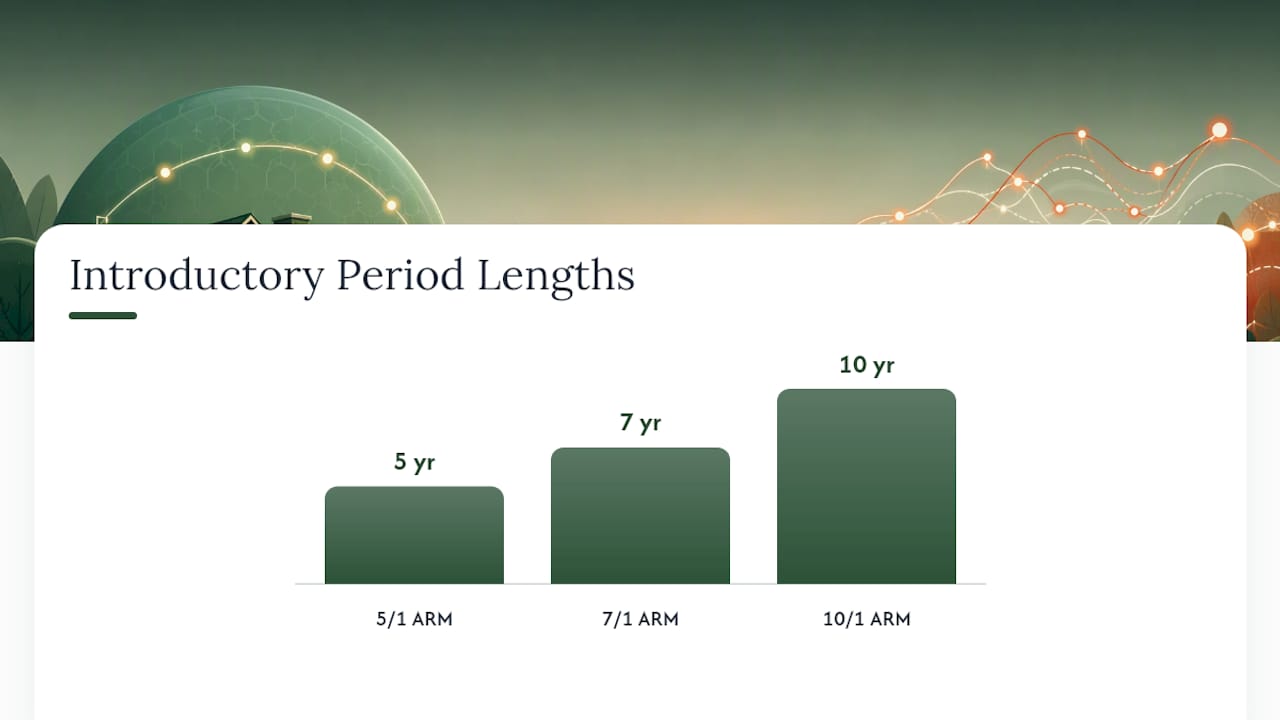
The introductory period is the number before the slash. A 7/1 ARM holds its starting rate for seven years, then adjusts once a year after that. A 5/1 adjusts starting in year five. A 10/1 buys you the longest runway before the first reset.
Caps limit how far the rate can move, and there are two kinds that matter separately:
- Periodic caps limit the change at each individual adjustment (often 1 to 2 percentage points).
- Lifetime caps limit the total change over the life of the loan (often 5 to 6 points above the start rate).
A loan that starts at 5% with a 5% lifetime cap could eventually reach 10%, even if it only gets there in small steps. Borrowers frequently underestimate this rate shock potential because the caps feel protective, when they actually just slow the climb, not cap the pain. A separate risk on some older or nontraditional ARM products is negative amortization, where a payment cap keeps the monthly bill low but unpaid interest gets added to the loan balance instead of disappearing.
Which Loan Fits Your Timeline and Risk Tolerance
Start with one question: how long do you realistically expect to keep this loan? Everything else follows from that answer.
- If you plan to stay 7+ years or you hate uncertainty, a fixed-rate mortgage is the safer default. You lock in one number and budget around it indefinitely.
- If you’re confident you’ll sell or refinance before the first adjustment, commonly within 3 to 7 years depending on the ARM type, the lower introductory rate on an ARM can be real, usable savings.
- If your income or savings can absorb a payment increase, an ARM’s risk becomes manageable. If a $300 monthly jump would break your budget, it isn’t worth the initial discount.
- First-time buyers usually lean fixed, since job changes, family growth, and unfamiliar markets make long-term certainty valuable. Investors and career movers with a known exit timeline are the more natural fit for an ARM, since down payment, credit score, and debt-to-income requirements are broadly similar across both loan types, but lenders scrutinize an ARM applicant’s ability to handle the maximum future payment, not just the introductory one.
What to Ask Lenders Before You Choose
Comparing offers means comparing more than the headline rate. Collect these from every lender quoting you a mortgage:
- APR (not just the interest rate)
- The initial rate, index, and margin for any ARM
- Periodic and lifetime caps, in writing
- Payment-cap rules, if any
- Prepayment penalties
- Closing costs and points offered
- Refinance fees, in case you plan to switch loans later
Once you have those numbers, run the stress test yourself: take the ARM’s initial rate plus its lifetime cap, calculate that maximum possible payment, and check it against your monthly budget, ideally keeping total housing costs (principal, interest, taxes, insurance) at no more than 28 to 31% of gross income. If that worst-case number would strain you, the ARM isn’t a fit no matter how good the intro rate looks.
One more caution worth repeating: refinancing out of an ARM before the rate resets is not guaranteed. Your ability to refinance depends on your credit, your home’s equity position, and where market rates sit at that future moment, none of which you control today. Comparing an ARM’s full terms against a fixed offer before closing beats hoping a refinance bails you out later.
An Agent’s View on Loan Choice and Negotiation
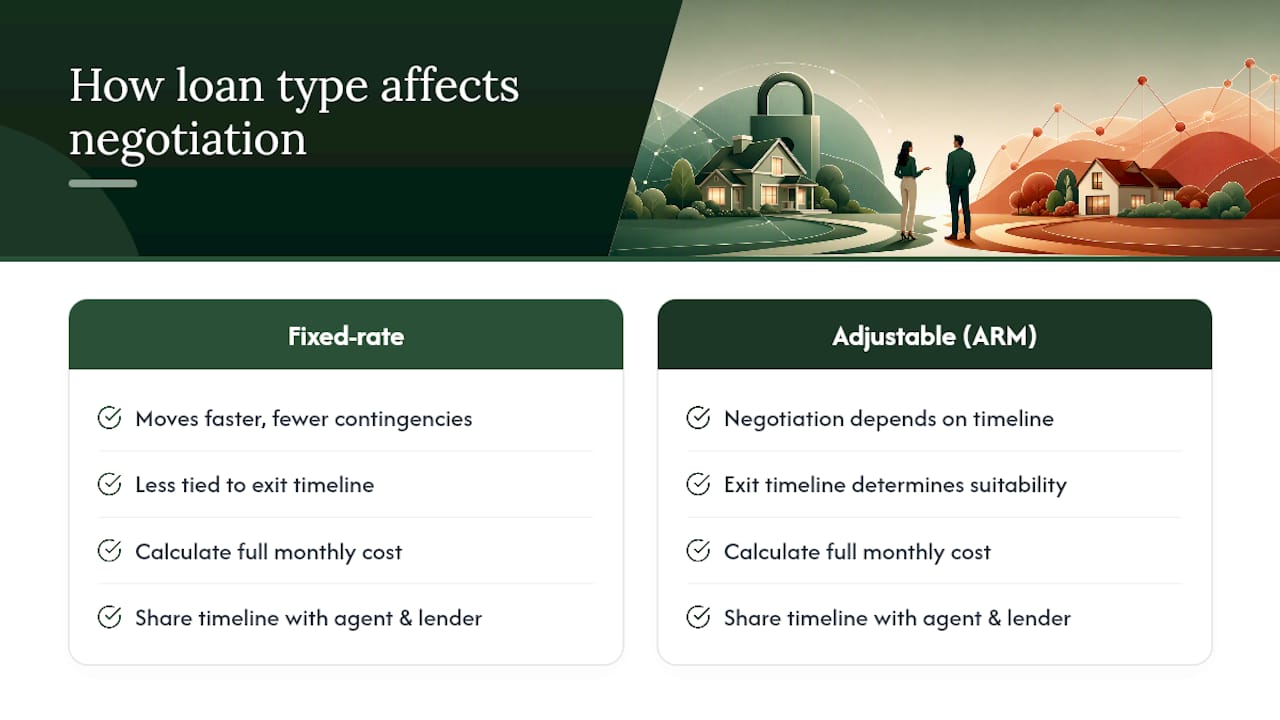
Your loan type shapes more than your payment. It shapes how you negotiate. A buyer set on a fixed-rate loan can often move faster with fewer contingencies, which matters in competitive Maine markets. A buyer leaning ARM should tell their lender and agent the exit timeline up front, since that number drives whether the ARM makes sense at all.
Early on, calculate your full monthly cost, not just principal and interest. Escrowed property taxes and homeowners insurance can add several hundred dollars a month, and skipping that math is how buyers end up house poor regardless of loan type. Write down your move or refinance timeline and share it with your agent and lender together so their advice lines up.
My Take: Skip the Guesswork, Not the Math
Fixed-rate loans win for most buyers because most buyers stay put longer than they plan to. If you’re seriously eyeing an ARM, do the worst-case math before you fall for the lower introductory payment. If your household budget still works at the loan’s maximum allowed rate, an ARM can be a smart tool. If it doesn’t, walk away from it. Reach out if you want a second set of eyes on your specific numbers.
— David
Where to Verify These Details
For definitions and consumer protections, the CFPB’s loan comparison guide is the clearest starting point. Freddie Mac’s homebuyer guide walks through payment examples. Bankrate’s ARM comparison breaks down shopping checklists, and Usa links to broader federal housing resources. These sources shaped the guidance above.
This article is general information, not a substitute for advice from a qualified financial advisor. Consult a qualified financial professional about your own circumstances before acting on anything here.
Sources
- Understand the different kinds of loans available | Consumer Financial Protection Bureau
- Fixed-Rate Mortgage Vs. ARM: What’s the Difference? | Bankrate
- Choosing Between a Fixed-Rate and an Adjustable-Rate Mortgage – My Home by Freddie Mac
FAQ
What Is the Main Difference Between Fixed and Adjustable Mortgages?
A fixed-rate mortgage keeps the same interest rate for the entire loan term, while an ARM has a rate that stays fixed for an introductory period, then adjusts periodically based on an index plus a margin.
What Do the Numbers in a 5/1 or 7/1 ARM Mean?
The first number is how many years the introductory rate lasts, and the second number is how often the rate adjusts after that, so a 7/1 ARM holds its rate for seven years, then adjusts annually.
Can My ARM Payment Increase Every Year Forever?
No. Periodic caps limit how much the rate can move at each adjustment, and lifetime caps limit the total increase over the loan’s life, though a loan can still eventually reach a much higher rate than it started with.
Is Refinancing Out of an ARM Always an Option?
Refinancing is possible but never guaranteed, since it depends on your credit, your home equity, and market rates at the time, so it shouldn’t be your only backup plan.
Should I Choose Fixed or Adjustable if I’m Buying My First Home?
Most first-time buyers benefit from a fixed-rate mortgage’s predictability, while an ARM tends to fit buyers with a clear short-term timeline who can handle a potential payment increase.