Yes: under Maine law you can form a statutory road association and collect assessments, and §3121 lets owners bring a civil claim after written demand. The statute applies mainly to private roads benefiting residential parcels, with different treatment for commercial or forest roads. The practical next steps are calling a meeting, preparing a notice, and adopting bylaws.
TL;DR:
- Forming a statutory road association requires creating an organization with at least four parcels, holding a formal meeting, and adopting bylaws to ensure enforceability.
- Owners can be held liable for unpaid assessments after a written demand, with costs typically split equally unless bylaws specify otherwise.
- Proper documentation, including recorded agreements and lien notices, is essential to enforce assessments and protect against future disputes or sales.
- Maintenance should focus on drainage, grading, and culverts, as improper water management causes road damage and environmental issues flagged by Maine DEP.
- Informal agreements are vulnerable to breakdown; escalating to a formal association offers stronger governance, assessment collection, and dispute resolution mechanisms.
Table of Contents
- What Maine’s private ways statute actually requires
- Choosing between an informal deal, a statutory association, or a nonprofit
- How to form a statutory road association, step by step
- Allocating costs, building reserves, and collecting unpaid assessments
- Building a paper trail that holds up later
- What maintenance covers, and why drainage matters
- A Maine REALTOR’s view on private roads and home sales
- Start cooperative, document carefully, escalate if needed
- Getting help with private road questions during a Maine transaction
- FAQ
- Sources
What Maine’s private ways statute actually requires
Maine’s Private Ways statute, 23 M.R.S. §§3101 through 3106, defines a “private way” and spells out what counts as repairs and maintenance: grading, graveling, snowplowing, culvert work, and ditching among them. It also governs how meetings are called, what notice must contain, and how votes get counted, generally one vote per parcel rather than per owner.
Any three or more owners, representing at least three different people, can petition a notary to call an organizational meeting. The statute requires advance written notice mailed to each owner’s tax-record address, and it sets out how a commissioner or board gets elected to manage the road going forward. Recent amendments, PL 2023, c. 387, clarified the definition of repairs and maintenance and added provisions for reserve accounts and repair contracts.
Enforcement runs through §3121: a benefited residential owner who refuses to pay a fair share can face a civil claim, but only after the association sends a written demand. Absent a separate agreement, owners split costs equally. The statute carves out exceptions for roads serving mainly commercial or forestry use, so check which category your road falls into before assuming the residential cost-sharing rule applies.
Choosing between an informal deal, a statutory association, or a nonprofit
Not every private road needs the same level of structure. The right choice depends on how many parcels share the road, how often disputes come up, and whether you expect ownership to change hands.
- An informal agreement among neighbors costs little to set up but tends to fall apart when a property sells or a new owner refuses to pay.
- A statutory road association under Maine’s Private Ways statute gives you durable, collectable assessments and a clear procedural path for meetings, voting, and enforcement.
- A nonprofit corporation suits larger subdivisions that want to own the road outright or hold easements formally; it carries more paperwork but offers stronger governance for bigger associations.
The Maine DEP’s road association guide walks through all three models and includes sample forms for each, which is worth reviewing before you pick a structure.
How to form a statutory road association, step by step
Forming an association under Maine law follows a defined sequence, and skipping a step can undercut your ability to collect later.
- Confirm eligibility: the road must serve four or more parcels, and any three or more owners (representing at least three different people) may apply to a notary to call the first meeting.
- Draft and mail the warrant at least 30 days before the meeting date, sent to each owner’s address of record for tax purposes, with the agenda and a proposed budget attached.
- Hold the meeting and vote, one vote per parcel, allowing proxies or absentee ballots where your draft bylaws permit.
- Elect a commissioner or board to manage day-to-day maintenance and collections.
- Mail the results of the vote to all owners within 30 days of the meeting, as the statute requires.
- Settle the remaining formation decisions: an assessment formula, a reserve account, easement language where needed, insurance coverage, and a recordkeeping system.
Pro Tip: Keep proof of mailing for every warrant and notice. A missing mailing record is one of the most common reasons an assessment later gets challenged.
Allocating costs, building reserves, and collecting unpaid assessments
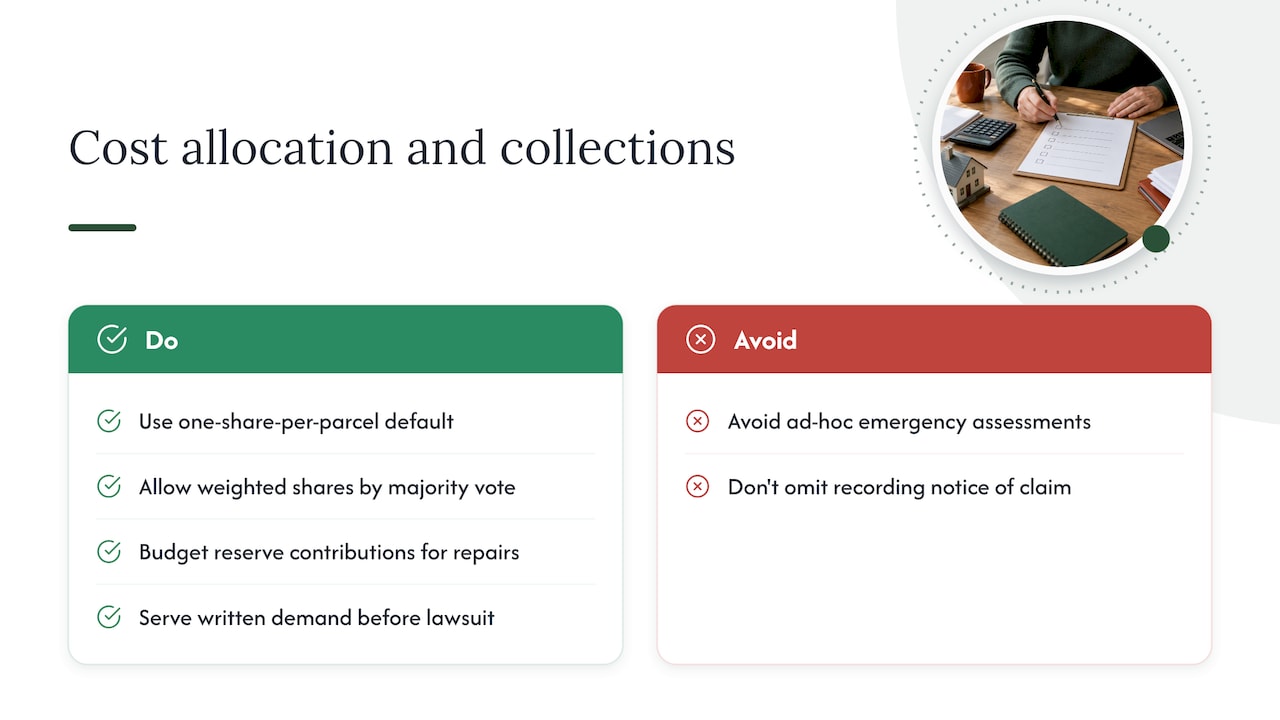
Most statutory associations assess costs on a one-share-per-residential-parcel basis, though bylaws can adopt a different formula by majority vote, weighting shares by frontage or usage instead. Acceptable line items include routine maintenance, insurance, administrative costs, and contributions to a reserve account for larger future repairs.
Emergency assessments, for a washed-out culvert or storm damage, are generally permitted outside the normal budget cycle when the bylaws allow for them, though it helps to spell out the trigger and approval process in advance rather than deciding on the fly.
When an owner does not pay, the process under §3121 starts with a written demand. If that goes unanswered, the association or an individual owner can bring a civil claim for the unpaid share. Recording a notice of claim at the county registry of deeds, as described in related statutory provisions, strengthens the association’s position against a future buyer who might otherwise claim no notice of the debt.
Building a paper trail that holds up later
A durable agreement depends less on clever wording than on keeping the right documents and recording them where successors in title will see them.
- Keep the original warrant, meeting minutes, adopted bylaws, and the assessment formula on file.
- Draft a maintenance agreement that spells out payment terms, interest on late payments, and collection costs.
- Include lien or notice-of-claim language so unpaid assessments attach to the property rather than just the individual owner.
- Set a clear threshold for amending the agreement, such as a two-thirds vote, so future disputes don’t stall every change.
- Address insurance requirements and emergency assessment procedures directly in the agreement rather than leaving them implied.
Recording the agreement, easement, or a notice of claim at the registry of deeds matters because it puts future buyers and their lenders on notice. An unrecorded handshake deal between neighbors rarely survives a property sale intact, while a recorded document tied to the deed tends to bind whoever buys the parcel next.
What maintenance covers, and why drainage matters
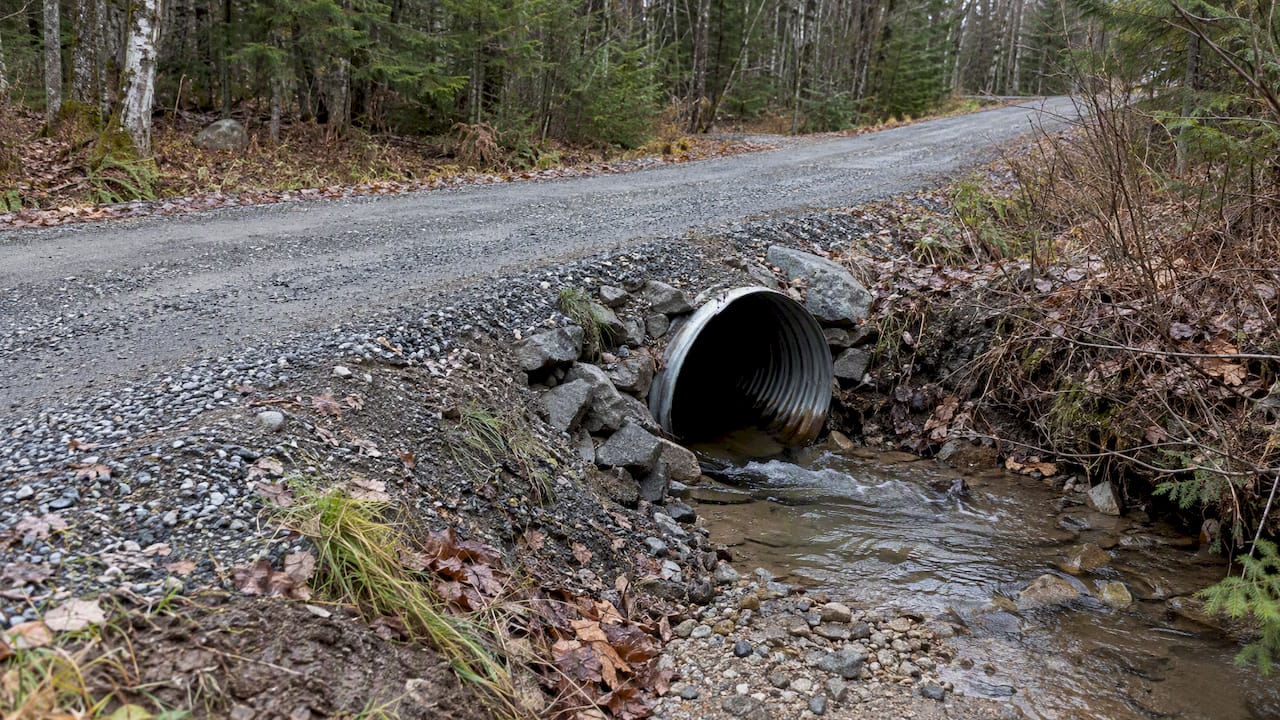
Maine’s statute treats “repairs and maintenance” broadly: snowplowing, grading, adding gravel, clearing brush, and maintaining culverts and ditches all qualify. Full repaving is treated differently and often requires a separate, larger assessment vote rather than routine budget approval.
The Maine DEP’s guidance emphasizes that proper drainage and erosion control protect more than the road surface. Culverts and ditches that are undersized or poorly maintained send sediment into nearby lakes and streams, a problem DEP flags repeatedly in its road association materials. Associations that write performance standards for drainage into their easements and maintenance plans tend to avoid both road damage and runoff violations down the line. For related drainage questions on individual properties, a closer look at drain field and grading issues can help owners understand how water management choices ripple beyond the road itself.
A Maine REALTOR’s view on private roads and home sales
We see private road issues surface frequently at closings involving camp roads or rural subdivisions. Buyers should ask for the recorded agreement, review recent meeting minutes, and find out the reserve balance and any assessments levied in the past two years. Sellers should locate and disclose the governing documents early, since an unresolved assessment or missing easement can stall a closing.
Start cooperative, document carefully, escalate if needed
Most road disputes resolve faster when neighbors start with an informal agreement, move to a written and recorded document, and only form a statutory association if nonpayment or turnover makes informal cooperation unreliable. Whichever stage you’re at, following the statute’s notice and recording steps protects your ability to enforce the agreement later.
— David
Getting help with private road questions during a Maine transaction
Private road questions rarely show up in isolation. They tend to surface alongside title review, financing conditions, and negotiation points that can shift a deal’s timeline. We help buyers and sellers track down recorded road agreements, flag outstanding assessments before they become closing-day surprises, and coordinate with title companies, lenders, and attorneys when a road issue needs more than a conversation to resolve.

This isn’t a substitute for legal advice on drafting or enforcing an agreement, but it does mean someone is looking out for the transactional side while your attorney handles the legal side.
| Situation | What we help coordinate |
|---|---|
| Buying a home on a private road | Locating recorded agreements and recent assessment history |
| Selling a home on a private road | Disclosure prep and clearing outstanding title issues |
| Investment or vacation property with shared access | Coordinating attorney referrals and title review |
Reach out through our Buying a Home, Selling My Home, or Investment Property pages to start a conversation about your specific property.
FAQ
What are the laws in Maine regarding private roads?
Maine governs private roads primarily through 23 M.R.S. §§3101 through 3106, which sets rules for forming road associations, calling meetings, and assessing maintenance costs. Section 3121 adds the cost-sharing and enforcement framework for roads that benefit residential properties.
Do private roads have right-of-way?
A private road typically exists because of an easement or recorded right-of-way granting access across someone else’s land, rather than public ownership. The terms of that easement, not a general rule, determine who can use the road and under what conditions.
What is the Romeo and Juliet law in Maine?
This phrase refers to a provision in Maine’s criminal statutes addressing age gaps in consensual relationships between young people, and it has no connection to private road law or property access rules.
What is the Maine no-touch law?
This term is sometimes used informally for Maine’s protection-from-harassment or protection-from-abuse statutes, which are separate from property and road access law. It does not relate to private road agreements, maintenance, or easements.
Sources
The statutes and state guides below cover the formation, assessment, and enforcement rules discussed throughout this guide, along with sample forms worth downloading before you draft your own agreement.