Yes. If you plan to buy in the next 60 to 90 days, get pre-approved for a mortgage now. A pre-approval letter tells sellers your financing is real, which matters in a market where competing offers can come down to who looks least risky. Start by pulling together income documents and calling a lender, ideally one approved for MaineHousing programs, since Maine-specific loans can change your down payment or paperwork requirements.
TL;DR:
- A pre-approval letter from an approved lender confirms financial reliability and significantly improves your chances with sellers in Maine’s competitive market.
- Lenders evaluate credit scores, income, assets, and debt-to-income ratios, with MaineHousing programs often requiring a minimum 640 credit score and housing costs under 33 percent of income.
- Completing all required documentation, including ID, paystubs, tax returns, bank statements, and proof of other income, helps avoid delays during the application process.
- Programs like MaineHousing First Home Loan, Advantage, and USDA loans have specific eligibility rules for down payment assistance and property location, which must be verified upfront.
- Working with local real estate professionals and MaineHousing-approved lenders improves pre-approval accuracy and ensures timely closings, reducing the risk of deal-breakers.
Table of Contents
- What Lenders Check for Mortgage Pre-Approval in Maine
- Documents You Need Before Applying for Pre-Approval
- What Maine Programs Change Your Pre-Approval Odds
- How Do You Get Pre-Approved for a Mortgage in Maine?
- How Long Does Mortgage Approval Take in Maine?
- Questions to Ask Lenders (and Red Flags to Avoid)
- What Maine Sellers Look for in a Buyer’s Pre-Approval
- Get Local Lender Referrals and Pre-Approval Help
- Where to Verify Program Details and Eligibility
- Sources
- FAQ
What Lenders Check for Mortgage Pre-Approval in Maine
Lenders look at four things: credit, income, assets, and debt-to-income ratio (DTI). MaineHousing guidance points to a 640 minimum credit score for many First Home Loan options, though conventional and FHA lenders sometimes work with lower scores under different terms.
DTI compares your monthly debts to your gross income. Lenders generally want your housing payment (the front-end ratio) under 30 to 33 percent of income, and total debts (back-end ratio) under 43 percent, though FHA and VA loans often allow more room.
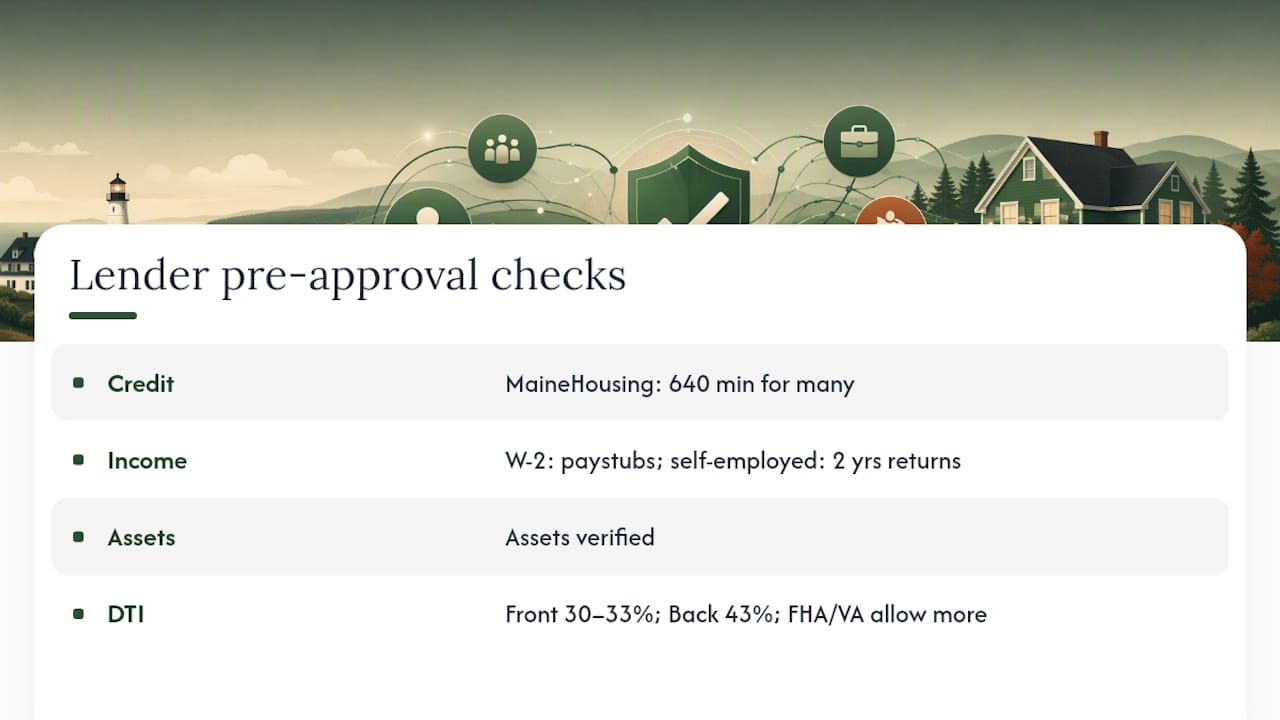
W-2 employees just need recent paystubs. Self-employed applicants need two years of tax returns since lenders average income over time. A new credit card, a car loan, or a collection account showing up mid-process can shrink your DTI room fast and stall a decision.
Pro Tip: A single late payment reported after your credit pull can force a lender to re-run numbers. Ask your loan officer exactly when they will check credit again.
Documents You Need Before Applying for Pre-Approval
Lenders move faster when your file is complete on day one. Local lender guidance on required pre-qualification documents points to a consistent list across Maine institutions:
- Government-issued ID and Social Security number
- Recent paystubs covering the last 30 days
- W-2s for the past two years, or two years of tax returns if self-employed
- Bank and asset statements, ideally the last three months
- Documentation for other income, such as child support, alimony, or rental income
- Statements for existing debts and proof of any gift funds used for a down payment
If you’re going through MaineHousing’s Advantage down payment assistance, add proof you completed a Homeworks-approved homebuyer education course.
What Maine Programs Change Your Pre-Approval Odds
Three programs shape what Maine buyers should expect during pre-approval, and each has its own eligibility quirks worth knowing before you assume you qualify.
- MaineHousing First Home Loan: Low fixed-rate mortgages with little or no down payment required. The First Home Loan Program must be applied for through an approved lender, not a random bank, and program-specific income limits apply.
- MaineHousing Advantage: Down payment and closing cost assistance, which can provide substantial help, paired with the First Home Loan. It requires the education class mentioned above and typically a 1% borrower contribution.
- USDA Single Family Housing Direct Home Loans: A federal program for eligible rural properties. USDA’s direct loan program can replace conventional down payment needs entirely for qualifying buyers, but property location and household income both have to fit strict limits.
Don’t assume you qualify for any of these based on a blog post. Verify income and property eligibility directly with an approved lender before you build a house-hunting budget around a program you haven’t confirmed.
How Do You Get Pre-Approved for a Mortgage in Maine?
Follow these steps in order, and you’ll avoid most of the delays that trip up first-time buyers.
- Check your credit report and dispute any errors before a lender pulls it. Old collections or wrong balances can knock down your score unnecessarily.
- Gather your documents from the checklist above so you’re not scrambling mid-application.
- Compare lender types. If you want MaineHousing programs, confirm the lender is approved to offer them since not every bank is.
- Submit your application with full documentation attached, not partial files you plan to follow up on later.
- Read your pre-approval letter carefully. Look for conditional language like “subject to underwriter review” or an expiration date, usually 60 to 90 days out.
Pre-qualification is a quick, informal estimate based on what you tell a lender. Pre-approval means a lender has verified your income, assets, and credit. Pursue pre-qualification early to gauge your range, but get a full pre-approval before you start touring homes seriously.
Pro Tip: If your letter says “conditional,” ask the loan officer exactly what conditions remain. A vague answer here is a warning sign you’ll want resolved before you make an offer.
How Long Does Mortgage Approval Take in Maine?
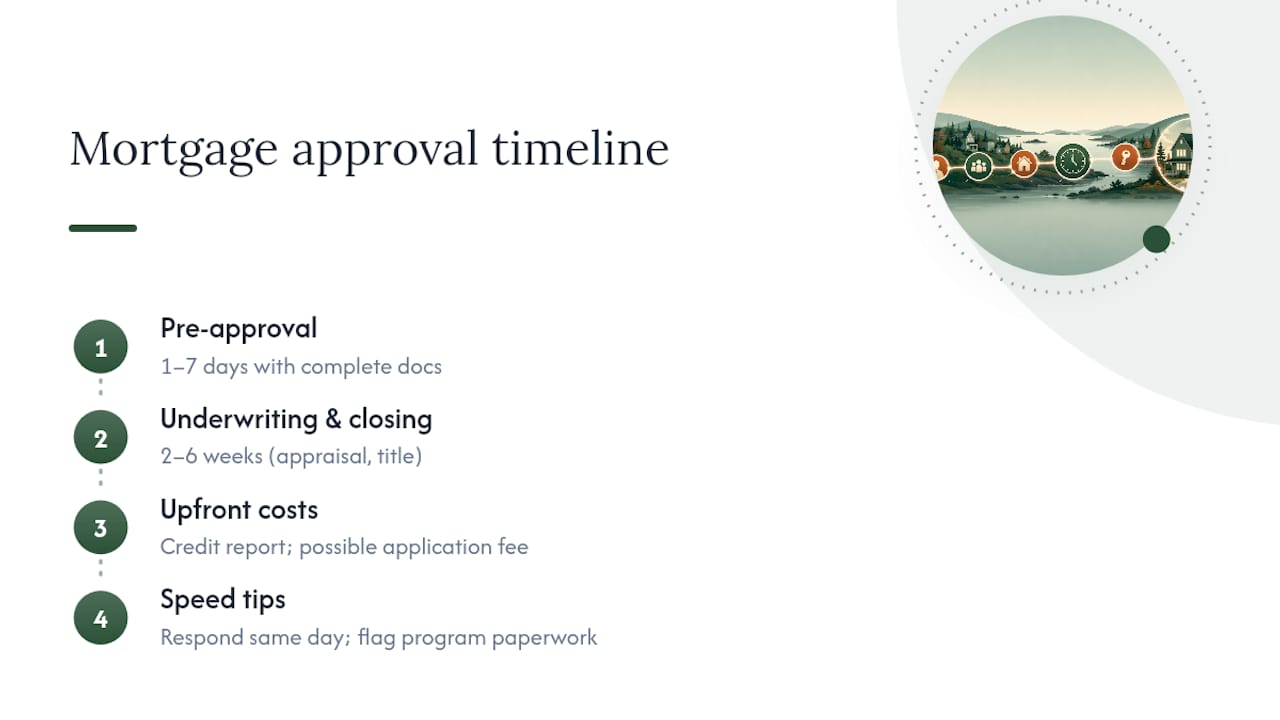
Pre-approval itself usually takes one to seven days if your documents are complete. Full underwriting and closing typically run two to six weeks, depending on appraisal scheduling and title work, according to mortgage process guidance from Maine lenders.
Expect to pay for a credit report and possibly an application fee upfront, plus an appraisal fee once you’re under contract. MaineHousing Advantage funds can sometimes offset closing costs, reducing what you pay out of pocket. The fastest path through this process is simple: respond to lender requests the same day, and work with an agent who flags Maine program paperwork before it becomes a bottleneck.
Questions to Ask Lenders (and Red Flags to Avoid)
Before you commit to a lender, ask about the APR (not just the rate), the loan program, required down payment, estimated monthly payment including mortgage insurance, all fees, and how long the pre-approval stays valid.
- Watch for lenders who won’t put fees in writing or give evasive answers about underwriting timelines.
- Be wary of pressure to lock a rate before you’ve even signed a purchase agreement.
Pro Tip: Compare effective APRs across lenders, not headline rates. A lower rate with higher fees can cost more over the life of the loan than a slightly higher rate with fewer add-ons.
What Maine Sellers Look for in a Buyer’s Pre-Approval
In central and southern Maine, sellers and their agents scan a pre-approval letter for the lender name, loan type, and whether it’s conditional. A generic pre-qualification letter from an online lender rarely carries the same weight as one from a known local lender.
Over 20 years working Maine’s residential market, I’ve watched deals fall apart because a buyer’s “approval” turned out to be a soft pull nobody verified. Coordinating with a MaineHousing-approved lender early, flagging program paperwork before it becomes a delay, and knowing which local lenders close on schedule matters more than people expect.
— David
Get Local Lender Referrals and Pre-Approval Help
Working with a local real estate agent offers benefits a generic bank call center can’t provide: guidance on which Maine lenders close on time and which MaineHousing-approved lenders understand the Advantage and First Home Loan programs. That’s the real gap between a pre-approval letter that impresses a seller and one that raises questions.

Working with an experienced local real estate professional means you get lender recommendations, help coordinating your pre-approval paperwork, and guidance on eligibility for MaineHousing or USDA programs before investing time in programs that may not fit your situation. If you’re getting ready to buy in central or southern Maine, reach out to David Haydym for a brief consult or a document checklist review before you contact a lender. It’s a fast way to walk in prepared instead of guessing.
Where to Verify Program Details and Eligibility
Confirm every program detail directly with the source before you build plans around it. Start with MaineHousing’s First Home Loan Program page and its Steps to Homeownership guide, then check USDA’s Single Family Housing Direct Home Loans page if you’re eyeing a rural property. For general market context, browse RealtorMaine’s market notes.
Sources
- First Home Loan Program
- Steps to Homeownership
- Single Family Housing Direct Home Loans
- Pre-Qualification – Machias Savings Bank
FAQ
Who Are the Best Mortgage Lenders in Maine?
The strongest choice depends on your goals: a MaineHousing-approved lender for state program access, or a conventional lender for flexibility on property type. RealtorMaine can point you toward vetted local lenders based on your specific situation.
How Much Income Do I Need to Qualify for a $300,000 Mortgage?
A loan officer can run your exact numbers in minutes.
How Do I Get Pre-Approved for a $200,000 Mortgage?
Gather your ID, paystubs, tax returns, and bank statements, then apply with a lender who checks your credit, income, and DTI. If you qualify for MaineHousing’s First Home Loan, you may need little to no down payment.
How Much Do I Need to Earn to Qualify for a $200,000 Mortgage?
There’s no fixed number since it depends on your existing debts and the loan’s interest rate. Getting pre-approved is the only way to know your exact figure.