Portland’s median sold price sits at $590,000 over the trailing six months, based on 445 tracked closings, and that figure has held firm rather than sliding. This is a competitive market with tight timelines. Buyers still face real pressure on well-priced homes, but rising inventory and a growing share of price cuts are quietly handing more negotiating room back to anyone patient enough to use it.
TL;DR:
- Portland’s median sale price remains steady at $590,000, but the broader price range from $466,000 to $825,000 indicates significant market dispersion.
- Rising inventory and more price reductions have shifted bargaining power toward patient buyers, especially in the lower and mid-range segments.
- The most competitive market activity occurs under $500,000, with faster sales and multiple offers, whereas upper-tier homes above $825,000 tend to sit longer and offer more negotiation opportunity.
- Limited new construction and strict zoning restrictions keep supply tight in entry-level and mid-range markets, maintaining price firmness despite increased listings.
- Buyers should focus on neighborhood-specific data and local expertise to avoid overpaying, particularly differentiating between high-demand and less competitive segments.
Table of Contents
- What the Portland Maine Housing Market Actually Costs Right Now
- Recent Trends: Inventory, Days on Market, and Rate Pressure
- Which Portland Neighborhoods and Price Bands Are Hottest
- Affordability, Mortgage Math, and Local Buyer Assistance
- How Long Buying or Selling Takes, and What to Do First
- A Local Realtor’s Take on Reading These Numbers
- Portland Home Prices Over the Longer Run
- How Portland’s Job Market Shapes Housing Demand
- Portland’s Rental Market and What It Means for Buyers
- New Construction and What It Means for Future Supply
- Zoning Rules That Shape What Gets Built in Portland
- Who’s Moving to Portland and Why It Matters for Housing
- What the Data Actually Tells You to Do Next
- Get a Local Read on Your Portland Home Search
- Where This Data Comes From
- Sources
- FAQ
What the Portland Maine Housing Market Actually Costs Right Now
The median sold price of $590,000 tells you where the middle of the market sits, but it hides more than it reveals. Resideline’s tracked sample of 445 closings shows a middle-half range, the interquartile spread, stretching from $466,000 to $825,000. That’s a $359,000 gap between the 25th and 75th percentile sale, which means half of all closed deals in Portland fell somewhere inside that band and half didn’t.
Price per square foot is an important measure to consider alongside median price for comparing properties of different sizes and conditions. Two homes at $590,000 can be wildly different bets depending on square footage, lot size, and condition.
- Median sold price (6 month sample): $590,000
- Median price per square foot: $387
- Middle-half sale range: $466,000 to $825,000
- Sample size: 445 closings
Statistic Callout: A median alone can mislead in a market with this much dispersion. The middle-half range matters more than the single median figure when you’re pricing one specific house, because a citywide number smooths over a broad upper tail of waterfront and newly built properties pulling the average up.
One more distinction worth flagging: listed price and closed price are not the same conversation. A home can list at $625,000 and close at $605,000, or it can list at $550,000 and close $40,000 over after a bidding war. Closings are the only number that reflects what buyers actually paid, which is why serious analysis leans on sold data, not asking prices.
Recent Trends: Inventory, Days on Market, and Rate Pressure
Active listings have been climbing in Portland even as the median listing price has stayed roughly flat, a combination that tends to shift leverage toward buyers over time. More homes to choose from, at prices that aren’t climbing, gives buyers room to negotiate that didn’t exist a year or two ago.
- Active listings trending upward while median list price holds steady
- Median time from listed to under contract: 15 days in tracked samples
- Median contract to close: 27 days
- A growing share of listings now carry at least one price reduction
Pro Tip: If a listing has already had one price cut, don’t assume the seller is desperate. Check how long it’s been on the market relative to the 15 day median. A cut after 40+ days signals real motivation; a cut after 10 days might just mean it was overpriced at launch.
Mortgage rates remain the wildcard. Every quarter-point move changes what a buyer can afford at the same monthly payment, and Portland’s tight 15-day contract timeline leaves little room to wait out a rate dip once you find the right house.
Which Portland Neighborhoods and Price Bands Are Hottest
Not every corner of Portland is competing at the same intensity. Entry-level homes under $500,000, when they exist at all, tend to draw multiple offers fast, while properties in the upper quartile above $825,000 often sit longer and see more price flexibility.
- Starter homes and condos under $500,000: highest competition, shortest days on market
- Mid-range homes ($550,000 to $700,000): steady demand, moderate negotiation room
- Upper-tier properties above $825,000: slower turnover, more room to negotiate on price
Munjoy Hill and the West End continue to command premium per-square-foot pricing thanks to walkability and historic housing stock, while outlying neighborhoods and parts of North Deering tend to offer more square footage per dollar. Flood, wind, and fire exposure also factor into neighborhood desirability now in ways they didn’t a decade ago. First Street Foundation’s risk data flags specific coastal-adjacent pockets of Portland where insurance costs are climbing, which can quietly cool demand even when the location itself is desirable.
Affordability, Mortgage Math, and Local Buyer Assistance
Mortgage rate changes significantly impact monthly payments, highlighting the importance of preapproval before shopping.
- Get preapproved with a lender who knows Maine’s tax and insurance quirks before you tour anything.
- Ask about local and state down-payment assistance programs, many of which require HUD-approved homebuyer education as a prerequisite.
- Compare FHA against conventional financing. FHA’s 3.5% down option can beat conventional in specific scenarios, detailed in this FHA versus conventional breakdown.
- Budget separately for flood or wind insurance if you’re eyeing a coastal-adjacent neighborhood.
Pro Tip: Complete your homebuyer education course before you start touring, not after you’re under contract. Some assistance programs need it finalized weeks in advance of closing.
How Long Buying or Selling Takes, and What to Do First
Expect roughly six to ten weeks from a serious search to a signed contract in this market, then another month to close. The Resideline sample shows a 15-day median from listing to under contract and 27 days from contract to closing, which means priced-right homes move fast once they hit the market.
- Get preapproved and gather your financial documents.
- Tour homes in your target neighborhoods and price band.
- Submit a competitive offer with clean contingencies.
- Schedule the inspection quickly. Sellers expect this within days, not weeks.
- Clear underwriting conditions and confirm your clear-to-close date.
- Ask any Realtor you interview: how many local closings this year, average days on market for their listings, and how they price against comps in your specific neighborhood.
A Local Realtor’s Take on Reading These Numbers
Twenty years of closing deals across central and southern Maine has taught me one thing above all: citywide medians are a starting point, never the answer. When I price a listing above Portland’s $590,000 median, I pull comps from the upper quartile of that $466,000 to $825,000 range, not from the middle, because a house in the upper band competes against a completely different buyer pool.
Three tactics consistently work in this market. Price at or just below recent comparable closings to trigger competitive offers in that 15-day window. Negotiate repair credits instead of price cuts when an inspection turns up issues, since sellers often protect their number harder than they protect their repair budget. And on any coastal-adjacent property, order a flood and insurance quote before you write the offer, not after.
I’ve watched buyers lose leverage in Munjoy Hill by skipping that last step and discovering a $4,000 annual insurance bill after they were already under contract.
— David
Portland Home Prices Over the Longer Run
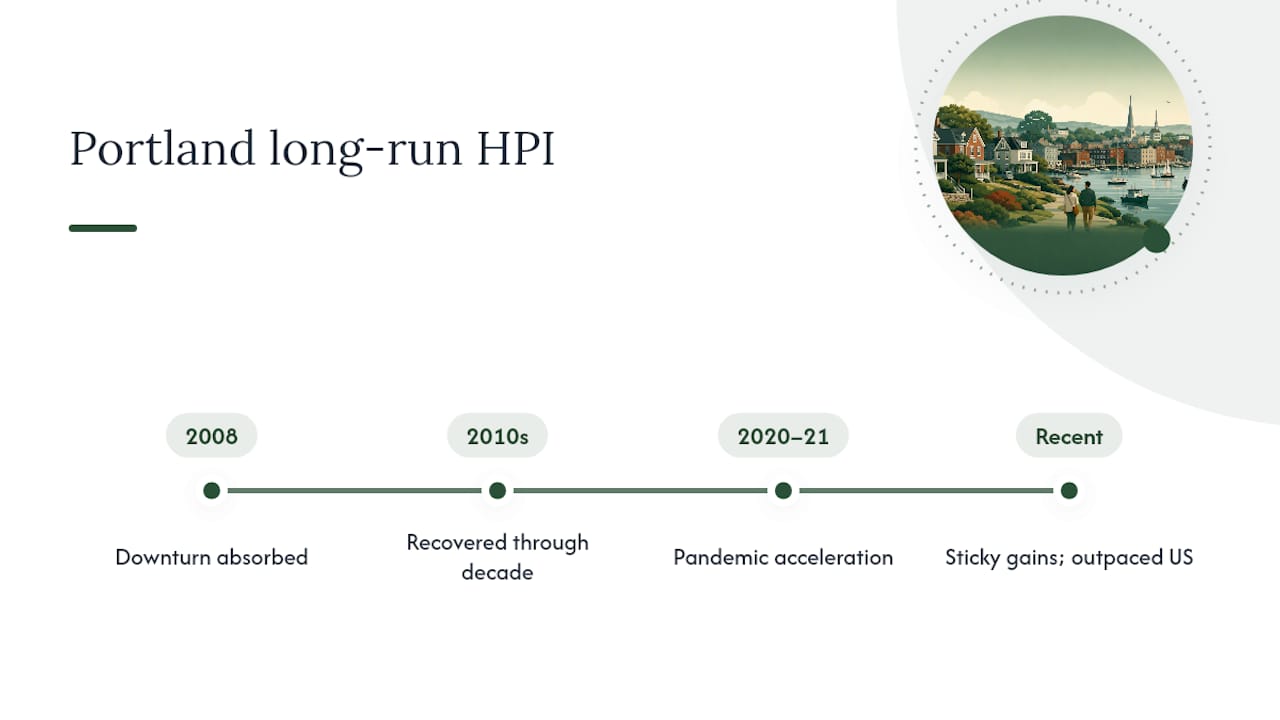
The six-month snapshot only tells part of the story. Portland’s prices have climbed steadily for more than a decade, tracked over the long run by the All-Transactions House Price Index for the Portland-South Portland metro area, maintained by the Federal Reserve Bank of St. Louis. That index strips out some of the noise in month-to-month sold data and shows the broader arc: a market that absorbed the 2008 downturn, recovered through the 2010s, then accelerated sharply during the pandemic years as remote work pulled buyers north from Boston and beyond.
What makes Portland’s long-term curve different from many comparable New England cities is how little it has given back. Markets that spike hard in a short window often correct hard too. Portland’s gains have proven stickier, likely because the supply constraints driving prices up (limited land, a historic building stock, strict preservation rules in older neighborhoods) haven’t eased. That’s a structural story, not a cyclical one.
For sellers, this history is reassuring: a home bought even at a local peak has rarely lost value over a five-year hold. For buyers, it’s a caution against waiting for a crash that the longer index simply doesn’t support as likely. If you want to see how Portland’s line compares to the national HPI trend, the FHFA’s House Price Index datasets let you benchmark regional appreciation against the country as a whole, and Portland has consistently outpaced the national average over the past several years.
How Portland’s Job Market Shapes Housing Demand
Portland’s economy runs on a mix that insulates it from single-industry shocks: healthcare systems, higher education, tourism, and a growing tech and remote-work sector all draw steady employment. MaineHealth and its affiliated hospital network is one of the region’s largest employers, and that kind of stable, recession-resistant payroll base tends to support housing demand even when national headlines turn gloomy.
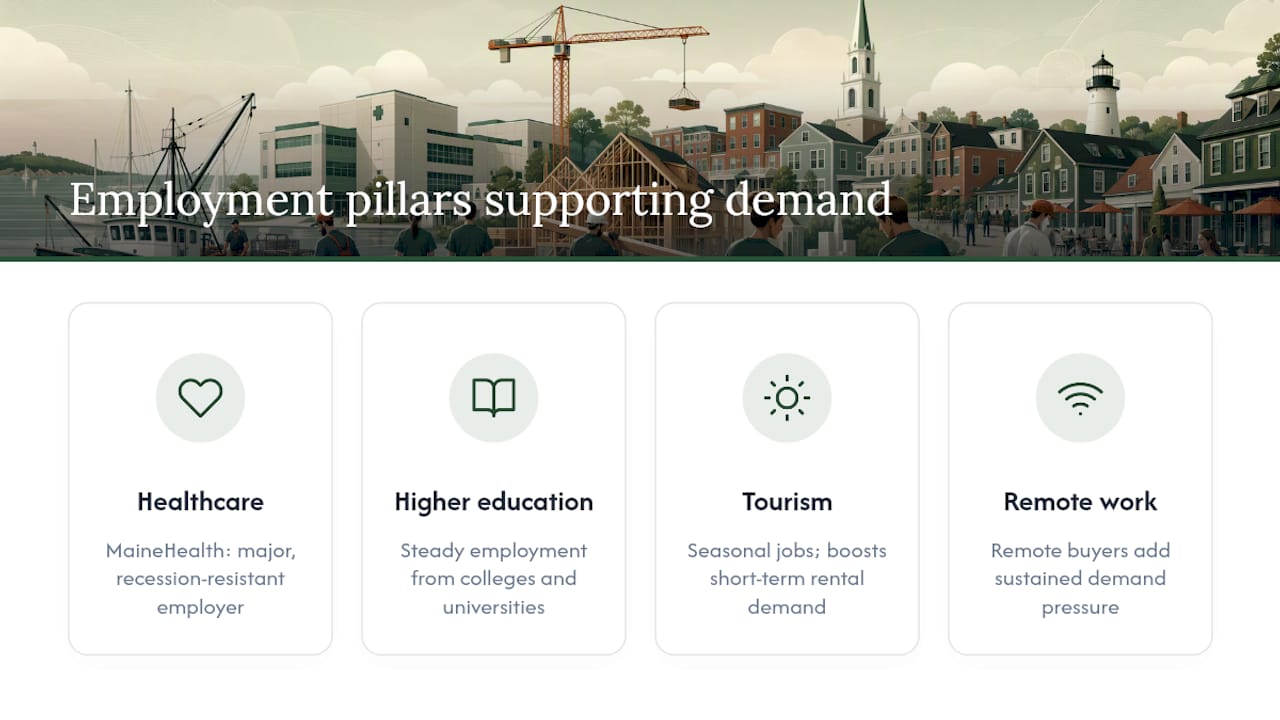
Tourism adds a seasonal wrinkle unique to Portland. Summer visitor traffic supports restaurant, hospitality, and retail jobs, but it also fuels short-term rental demand that competes with long-term housing stock in certain neighborhoods, particularly closer to the waterfront and Old Port.
The remote-work shift hasn’t reversed either. Buyers who can work from anywhere continue to choose Portland for the combination of coastal lifestyle, walkable downtown, and proximity to Boston without Boston’s price tag. That inflow adds real demand pressure on a housing supply that isn’t growing nearly as fast as the interest in living here. When a local economy diversifies across healthcare, education, tourism, and remote-capable knowledge work, housing demand tends to stay more resilient through downturns than in a single-employer town, and Portland’s price history over the last decade reflects exactly that pattern.
Portland’s Rental Market and What It Means for Buyers
Rents in Portland have climbed alongside sale prices, and the two markets feed each other more than most buyers realize. When rents rise faster than incomes, more renters get pushed toward buying sooner than they planned, even at today’s mortgage rates, simply to lock in a fixed housing cost instead of an annual rent increase.
That dynamic adds fuel to the entry-level and starter-home competition described earlier. A renter facing another lease renewal at a higher rate does the math and often decides a $500,000 condo with a fixed payment beats an open-ended rent trajectory, even with rates where they are.
The reverse is also true. When mortgage rates spike and buying becomes less attainable, would-be buyers stay in the rental pool longer, which tightens rental vacancy and pushes rents up further. This feedback loop is a big part of why Portland’s rental vacancy rate has stayed low for years. Investors watching this cycle have leaned into small multifamily purchases, duplexes and triplexes, specifically because steady rental demand provides a hedge against any softening in the owner-occupied market. For anyone considering an investment property in Portland, that rental tightness is arguably a stronger signal than the sale-price data alone.
New Construction and What It Means for Future Supply
New construction in Portland has not kept pace with demand, and that gap is a core reason prices have stayed firm despite rising active listings. Land within city limits is scarce, much of the buildable land near downtown is already developed, and construction costs for labor and materials have climbed enough that many projects only make financial sense at the higher end of the price spectrum.
That produces a supply mix skewed away from the entry-level segment where competition is fiercest. Builders are more likely to construct $700,000-plus homes or higher-end condo conversions than $400,000 starter homes, because the margins pencil out better at the top of the market. This is a big part of why the price bands under $500,000 stay so competitive: new supply simply isn’t arriving there in meaningful volume.
Some relief is coming from infill projects and adaptive reuse of older commercial buildings, particularly near the waterfront and in transitional neighborhoods bordering the peninsula. These projects add density without requiring new greenfield land, which is nearly impossible to find within Portland’s city limits at this point. But the pace remains slow relative to demand, and anyone hoping new construction will meaningfully soften prices in the next year or two is likely to be disappointed. Supply-side fixes in a land-constrained coastal city move on a timeline measured in years, not quarters.
Zoning Rules That Shape What Gets Built in Portland
Portland’s zoning code plays a direct role in how tight the entry-level and mid-range supply stays. Much of the peninsula and older residential neighborhoods carry single-family and low-density zoning that restricts how many units can go on a given lot, even where demand for multifamily housing is obvious.
The city has taken steps toward reform, including efforts to allow more accessory dwelling units and denser infill in select districts, but these changes move through a public process that takes years to translate into actual permits and completed units. Height restrictions in historic districts like Munjoy Hill and the West End also limit how much new density can be added without altering the character that makes those neighborhoods desirable in the first place, which creates a real tension between preservation and supply.
For buyers, this means don’t expect zoning reform to meaningfully change the competitive landscape in the next buying season. For anyone considering a small multifamily purchase or an ADU addition, checking current zoning designations before making an offer is not optional. A lot’s zoning can determine whether you can add a rental unit, and that possibility can materially change the math on an investment property purchase in Portland.
Who’s Moving to Portland and Why It Matters for Housing
Portland’s population has grown steadily, driven less by young families and more by a mix of remote workers, retirees, and professionals in their 30s and 40s relocating from larger, pricier metros. That age mix shapes what kind of housing sees the most demand: walkable condos and smaller single-family homes near downtown draw the remote-work and younger professional crowd, while single-level homes and properties with in-law potential draw retirees looking to downsize without leaving the region.
This demographic blend also explains some of the neighborhood-level price divergence discussed earlier. Munjoy Hill and the West End skew toward buyers prioritizing walkability and lifestyle, often willing to pay a premium for less square footage. Areas farther from the peninsula draw buyers, often families or retirees, who want more space and are more price-sensitive.
An aging population statewide adds another layer. As more longtime Maine homeowners look to downsize out of larger family homes, that could gradually add inventory in the mid-size single-family segment over the next several years, though the pace of that shift remains slow and uneven across neighborhoods. For now, in-migration from outside Maine remains the stronger force shaping demand, and it shows no clear sign of reversing.
What the Data Actually Tells You to Do Next
The conventional advice you’ll hear about the Portland Maine housing market boils down to “prices are up, act fast.” That’s not wrong, but it’s incomplete, and it leads plenty of buyers to overpay on the wrong property while ignoring genuine opportunity elsewhere in the market.
The real story is dispersion. A $590,000 median sits inside a $466,000 to $825,000 range, and treating every listing as if it competes against that single median number is a mistake. Entry-level homes are genuinely in a fast, competitive market. Upper-tier properties are not, and buyers who assume otherwise leave negotiating room on the table.
My priority for any reader right now: figure out which segment your target property actually falls into before you assume anything about competition or timeline. A $450,000 condo and a $900,000 single-family home in Portland are, functionally, two different markets wearing the same city name.
— David
Get a Local Read on Your Portland Home Search
National data and citywide medians only take you so far. What actually determines whether you overpay, underprice, or miss a window entirely is neighborhood-level knowledge, the kind that comes from closing deals in Portland year after year, not from reading a spreadsheet.

A local Realtor with extensive experience in central and southern Maine’s residential market, with a track record built on transparent pricing and no-pressure negotiation. Whether you need a comparative market analysis on a specific Munjoy Hill listing, guidance on FHA versus conventional financing, or a straight answer about whether a Portland price is fair, that local read is what separates a good decision from a lucky one. Reach out through RealtorMaine to request a consultation or a comparative market analysis tailored to your target neighborhood and price band, and if you’re weighing a condo purchase with shared building amenities, this overview of building access systems is worth a look before you tour.
Where This Data Comes From
- Resideline: sample-based closing data behind the median price, distribution, and days-on-market figures.
- FRED (ATNHPIUS38860Q): the standardized long-term price index for the Portland-South Portland metro area.
- FHFA House Price Index: national and regional benchmarking data.
- First Street Foundation: neighborhood-level flood and hazard risk indicators.
Sources
- Portland, ME Housing Market 2026: Median Price & Trends — Resideline
- All-Transactions House Price Index for Portland-South Portland, ME (FRED)
- First Street Foundation — Portland, ME flood risk
- FHFA — House Price Index data and downloads
FAQ
Is Housing More Expensive in Oregon or Maine?
Portland, Oregon’s median home price runs higher than Portland, Maine’s $590,000 figure, though overall cost of living comparisons depend heavily on taxes, insurance, and local wages rather than home price alone.
Is Portland, Maine a Very Liberal City?
Portland is widely regarded as one of Maine’s more politically liberal cities, and that civic character shows up in local housing policy debates, including ongoing zoning reform discussions.
Are Portland Housing Prices Dropping?
No. The median sold price has held around $590,000 rather than declining, though rising active listings and a growing share of price reductions are giving buyers more negotiating room than in recent years.
What’s the Best Town to Live in Near Portland, Maine?
It depends on priorities. Munjoy Hill and the West End suit buyers who want walkability and historic character, while towns just outside Portland proper often offer more square footage per dollar for buyers willing to commute. A local Realtor like RealtorMaine can match your budget and lifestyle to the right specific neighborhood.