Most home sales in the United States close through a title company, but that answer flips entirely depending on which state the property sits in. In a number of states, only a licensed attorney can legally conduct the closing. Check your state’s rule first, and if the title has any complications, talk to a real estate attorney before signing day, since every lender-backed deal still runs through the same Closing Disclosure under TRID.
TL;DR:
- In attorney states, only licensed lawyers can conduct closings, while title states rely on title companies unless specific complications arise.
- Title companies act as neutral parties handling title searches, insurance, and escrow, whereas attorneys can provide legal advice, draft contracts, and resolve disputes.
- Fees are typically itemized on the Closing Disclosure, with title search and insurance usually handled by the title company, and legal fees varying based on complexity and state rules.
- Hiring a legal professional is advised for complex liens, estate sales, commercial deals, or if the title commitment shows unresolved issues, even in title states.
- Verify your state’s closing laws directly through official sources, as the rules and practices can vary significantly by county and shift over time.
Table of Contents
- Title Company vs Attorney Closing: A Side-by-Side Look
- Attorney States vs Title States: How to Tell Which Applies
- Who Handles What During Closing, Step by Step
- What Title Company and Attorney Fees Look Like on Your Closing Disclosure
- When You Should Hire a Closing Attorney Anyway
- How to Choose the Right Closing Professional
- How a Local Realtor Coordinates the Closing Team
- Getting Local Help Coordinating Your Closing
- Where to Verify These Rules Yourself
- Sources
- FAQ
Title Company vs Attorney Closing: A Side-by-Side Look
The core split comes down to authority. A title company (often working through an escrow officer) searches the property’s title history, issues title insurance, and holds funds in escrow until every condition of the sale is met. A closing attorney does all of that in states that require it, plus something a title company legally cannot: give either party legal advice or represent their interests in a dispute.
That neutrality versus advocacy distinction matters more than most buyers realize going in.
- Title company: neutral third party, handles paperwork and fund transfer, cannot advise either side legally
- Closing attorney: can represent a client’s interests, draft or modify legal language, resolve title disputes on the spot
- Cost: title company fees are often flat and bundled into settlement charges; attorney fees run flat or hourly depending on the state and complexity
- Timing: title-only closings tend to move faster on routine deals; attorney closings can take longer when legal review is involved but often resolve title snags without a separate referral
Neither model is universally cheaper or faster. It depends entirely on what your specific transaction needs.
Attorney States vs Title States: How to Tell Which Applies
An “attorney state” is one where state law or bar rules require a licensed attorney to conduct or supervise the closing, even for a routine sale. A “title/escrow state” allows a title or escrow company to run the closing without an attorney present, though either party can still hire one voluntarily.
Georgia, South Carolina, and New York are commonly cited as attorney states, among others, while Texas and California typically rely on title and escrow companies to close residential deals. But these lists shift, and county-level practice sometimes differs from the state norm.
Don’t rely on a static list you find online, including this one. Verify directly:
- Check your state bar association’s real estate practice guidance
- Search ALTA (American Land Title Association) state summaries for licensing requirements
- Ask your lender, since their closing instructions often specify the required model
- Call the county recording office where the property sits
Who Handles What During Closing, Step by Step
The closing process follows a predictable sequence, and where legal authority kicks in depends on the state.
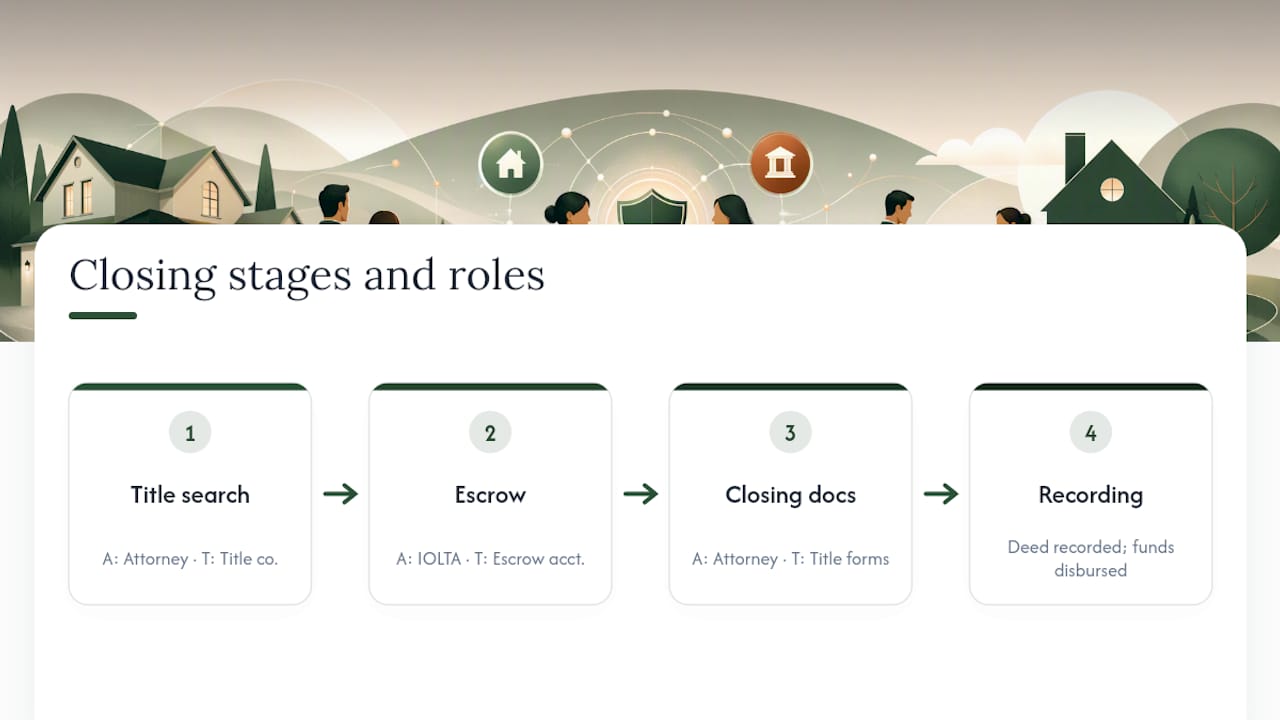
First, the title company or attorney orders a title search and issues a title commitment, often called Schedule A and Schedule B. Schedule A lists the basic terms of the insurance policy; Schedule B lists exceptions, like liens or easements, that need clearing before closing. In attorney states, the attorney typically prepares and reviews this commitment directly. In title states, the title company prepares it, though a buyer’s attorney can still review it.
Second comes escrow. Title companies hold buyer and seller funds in state-regulated escrow or trust accounts. Attorneys typically hold funds in an IOLTA account, a specific trust account regulated by state bar rules rather than insurance departments.
Third, someone drafts or finalizes the closing documents. Only an attorney can legally draft custom contract language or resolve a title defect that requires legal judgment; a title company can prepare standard forms but cannot practice law.
Finally, the deed gets recorded with the county, and funds get disbursed to the seller, lender, and any lienholders.
What Title Company and Attorney Fees Look Like on Your Closing Disclosure
RESPA and the CFPB’s TRID rule require lenders to give buyers a standardized Closing Disclosure that itemizes every settlement charge, which makes it far easier to compare a title company’s fees against an attorney’s line by line.
Look for these typical line items:
- Title search and title insurance premium: almost always title-company charges, even in attorney states
- Settlement or closing fee: can be billed by either the title company or the attorney, depending on who’s running the closing
- Attorney fees: usually itemized separately, either flat-rate or hourly, and often bundled with title work in attorney states
In states where attorneys customarily handle closings, bundling title search, drafting, and closing services into one fee can bring the total surprisingly close to what a separate title company and settlement agent would charge in a title state, according to industry comparisons. Don’t assume attorney involvement automatically means a higher bill. Read the disclosure line by line before you compare offers.
When You Should Hire a Closing Attorney Anyway
Even in a title state where you’re not required to hire one, certain situations make legal representation worth the extra line item on your Closing Disclosure.
- Complex title defects: unresolved liens, boundary disputes, or a chain-of-title gap that a title company flags but can’t fix on its own
- Probate or estate sales: transferring property through an estate almost always benefits from legal review of the deed and heirship documents
- Commercial transactions: these involve contract terms and zoning issues that go well beyond what standard residential closing forms cover
- For sale by owner (FSBO) deals: without an agent managing the paperwork, a buyer or seller benefits from an attorney checking the purchase agreement
- Lender or investor mandates: some lenders, particularly on investment or commercial loans, require attorney review regardless of state norm
Pro Tip: If your title commitment comes back with a Schedule B exception you don’t understand, that’s the exact moment to call an attorney, not sign anyway and hope it’s minor.
Weigh the added cost against what a title defect could cost you later. A few hundred dollars in legal fees now is cheap compared to a quiet-title lawsuit two years after closing.
How to Choose the Right Closing Professional
Vetting your title company or attorney takes the same rigor as vetting a lender.
Start with the basics: confirm the professional is licensed in your state and has closed transactions in your specific county, since local recording quirks trip up out-of-area providers.
- Ask who holds escrow funds and where the account sits
- Ask how they’ve historically handled title exceptions similar to yours
- Request a sample Closing Disclosure or fee sheet before you commit
- Ask their typical turnaround time from contract to closing table
- Confirm exactly who you’ll communicate with on signing day
Watch for red flags: vague answers about escrow location, reluctance to provide a written fee estimate, or a closing timeline that keeps slipping without explanation. If a title company can’t clearly explain a title exception on your Schedule B, or an attorney won’t quote a flat fee for a routine residential closing, keep looking.
How a Local Realtor Coordinates the Closing Team
After 20 years and more than 50 homes sold across central and southern Maine, I’ve coordinated closings under both models more times than I can count. A good Realtor doesn’t replace your title company or attorney. They keep the calendar honest, flag missing documents before they become last-minute fire drills, and know which local providers actually answer the phone during closing week. My advice to clients is simple: tell me your questions early, and I’ll help you find someone who can answer them properly.
— David
Getting Local Help Coordinating Your Closing
Choosing between a title company and an attorney is only half the battle. Someone still has to keep the appraisal, inspection, lender documents, and closing schedule moving in sync, and that’s where a lot of transactions lose weeks they didn’t need to lose. We work with vetted title companies and closing attorneys across central and southern Maine, and can walk you through your Closing Disclosure line by line before you sign anything.

David will point you toward legal counsel the moment a transaction shows signs of needing it, whether that’s a messy title history, an FSBO deal, or lender-mandated attorney review. Short of that, expect a Realtor who answers outside normal business hours and pushes for smart, data-backed pricing rather than a rushed close. If you’re buying or selling in Maine and want a coordinated closing without the guesswork, reach out to David directly to talk through your specific timeline and property.
Where to Verify These Rules Yourself
State closing rules shift, so verify them directly rather than trusting a static list. The Real Estate Transaction Authority guide breaks down the attorney-versus-title-state split and TRID’s role in the Closing Disclosure. Guida Law Firm explains the legal authority gap between attorneys and title companies. Deal Run’s comparison covers the three closing models and representative state examples, with a reminder to confirm your state’s current practice before relying on any list.
Sources
- Title Company vs. Closing Attorney: Who Handles Your Closing | Real Estate Transaction Authority
- Escrow vs Title Company vs Closing Attorney | Deal Run
- Real Estate Closings: Attorney vs. Title Company – What’s the Difference? – Guida Law Firm
FAQ
Should I use a title company or an attorney for my closing?
It depends on your state. In attorney states, you don’t have a choice; in title states, you can use either, though a title company alone is usually sufficient for a routine sale without title complications.
Is a closing attorney the same thing as a title company?
No. A title company issues title insurance and handles escrow as a neutral party, while a closing attorney can also give legal advice, draft documents, and represent a client’s interests directly.
Does Florida use title companies or closing attorneys?
Florida allows either title companies or attorneys to conduct closings, making it a title/escrow state rather than a mandatory attorney state, though many Florida buyers still hire an attorney for extra protection.
Which states require attorneys for real estate closings?
States commonly cited as requiring attorney involvement include Georgia, South Carolina, and New York, but this list can shift by county and transaction type, so confirm current practice with your state bar or ALTA’s summaries before assuming.
Can a Realtor recommend a title company or attorney?
Yes. RealtorMaine regularly connects Maine buyers and sellers with vetted local title companies and closing attorneys, and flags when a transaction’s complexity calls for legal representation.