
Pay points when your months-to-break-even is shorter than how long you plan to keep the loan. Otherwise, take the no-points option or a lender credit and keep the cash. Everything else in this decision, your closing budget, your tax situation, how long you’ll actually hold the mortgage, feeds into that one comparison, and the math behind it is simpler than most lenders make it sound.
TL;DR:
- Paying points makes financial sense only if you plan to hold the loan longer than the break-even period, which varies with loan type and rates.
- Each point costs 1% of the loan amount and typically reduces your interest rate by about 0.25%, but the benefit depends on how long you stay in the home.
- Borrowers should compare the upfront cost of points against monthly payment savings, especially if expecting to refinance or sell within a few years.
- Points on a home purchase are usually tax-deductible in the year paid, while refinance points are amortized over the loan’s life, affecting the break-even calculation.
- Lenders must clearly differentiate between discount points and origination fees; ask for detailed disclosures to avoid hidden costs or misleading quotes.
Table of Contents
- Points vs No Points: What Discount Points Actually Cost
- When Paying Points Makes Sense
- Why No Points or Lender Credits Might Win Instead
- How to Calculate Your Break-Even Point
- Are Mortgage Points Tax Deductible?
- How to Compare Lender Offers Without Getting Burned
- A Maine Realtor’s View on Points vs No Points
- How RealtorMaine Helps You Model the Real Tradeoff
- Where to Read More
- Sources
Points vs No Points: What Discount Points Actually Cost
On a mortgage, one point costs about 1% of your loan amount, paid upfront at closing, in exchange for a lower interest rate. Typically, one point reduces the interest rate by about a quarter of a percentage point, though that ratio shifts with the lender and the rate environment, and the CFPB has tracked how discount point pricing moves as rates rise.
A few terms get mixed up constantly during rate shopping:
- Discount points buy down your interest rate. This is the “points vs no points” decision this article covers.
- Origination points are a lender fee for processing the loan. They don’t touch your rate at all, and Bankrate notes lenders sometimes blur this distinction in quotes, so ask directly which type you’re being charged.
- Fractional points (0.5, 0.125) let you fine-tune the buydown instead of committing to a full percentage point.
- Some advertised rates already bake in an assumed point or two, which is why two “competing” quotes can look identical until you check what each one assumes you’re paying upfront.
When Paying Points Makes Sense
Points work in your favor when you’ll hold the loan long enough to recoup the upfront cost through lower monthly payments. A few scenarios make that recovery likely:
- You plan to stay in the home for a long time, generally longer than typical break-even periods.
- You have a fixed-rate loan, so the lower rate holds for the full term instead of resetting.
- You have cash left over after your down payment and reserves, and it isn’t better used elsewhere.
- The seller or builder is covering the points as part of a concession, which removes your upfront cost entirely while you still keep the lower rate.
Pro Tip: If a seller offers a closing-cost concession, ask your agent to steer it toward points instead of a generic credit. A seller-paid point still buys down your rate for the life of the loan, while a vague “closing cost credit” often just covers fees that don’t save you anything long-term.
Long-term fixed-rate buyers get the most mileage here. A 15 year term compounds the monthly savings faster than a 30 year term, so the same point cost breaks even sooner.
Why No Points or Lender Credits Might Win Instead
Buying points isn’t free money, it’s a bet that you’ll stay put long enough to win it. Several real drawbacks argue for skipping points:
- Points add directly to your closing costs, which can shrink your down payment cushion or drain your reserve funds right when you need them most.
- If you sell or refinance before reaching break-even, you lose the difference outright. There’s no partial refund on unused rate reduction.
- Lender credits work as the mirror image of points: the lender pays part of your closing costs in exchange for you accepting a higher rate, as the CFPB explains in its guidance on credits and points. That raises your monthly payment for as long as you hold the loan.
For buyers who expect to refinance within a few years, or who are stretching to make the down payment work, a lender credit often makes more sense than a discount point, even though it runs against the instinct to “buy down” the rate.
How to Calculate Your Break-Even Point
The formula is simple: cost of points ÷ monthly payment savings = months to break-even. Once you have that number, compare it to how long you realistically expect to keep the loan.
Here’s a worked example using a mortgage at a 30-year fixed term:
- Baseline rate, no points: a certain interest rate, with a standard monthly principal and interest payment.
- Cost of one point: 1% of your loan amount.
- Rate after one point: typically about 0.25 percentage points lower, reducing monthly payment.
- Monthly savings: the difference between the original and reduced payment.
- Break-even: the cost of the point divided by the monthly savings, resulting in the number of months needed to recoup the upfront cost.
If you plan to stay in that home past year five, the point pays for itself and then keeps paying you for the rest of the term. Stay only three years, and you’re out $1,200 net. Buying two points doubles the upfront cost but doesn’t always double the savings, since rate reductions per point can flatten out, so run the math on each point separately rather than assuming it scales evenly. The CFPB also points out that break-even shifts with the broader rate environment, and a 15-year term reaches break-even faster than a 30-year term because more of each payment goes toward principal and interest savings compound sooner. National tenure data on how long owners typically stay in a home is a useful gut check when you’re estimating your own timeline, since the National Association of Realtors tracks homeownership duration trends that many buyers underestimate.
Are Mortgage Points Tax Deductible?
Points on a home purchase are often deductible in the year you pay them, while points on a refinance usually have to be amortized over the life of the loan instead of deducted all at once. The IRS lays out the specific requirements in Topic 504, including different treatment when a seller pays points on your behalf.
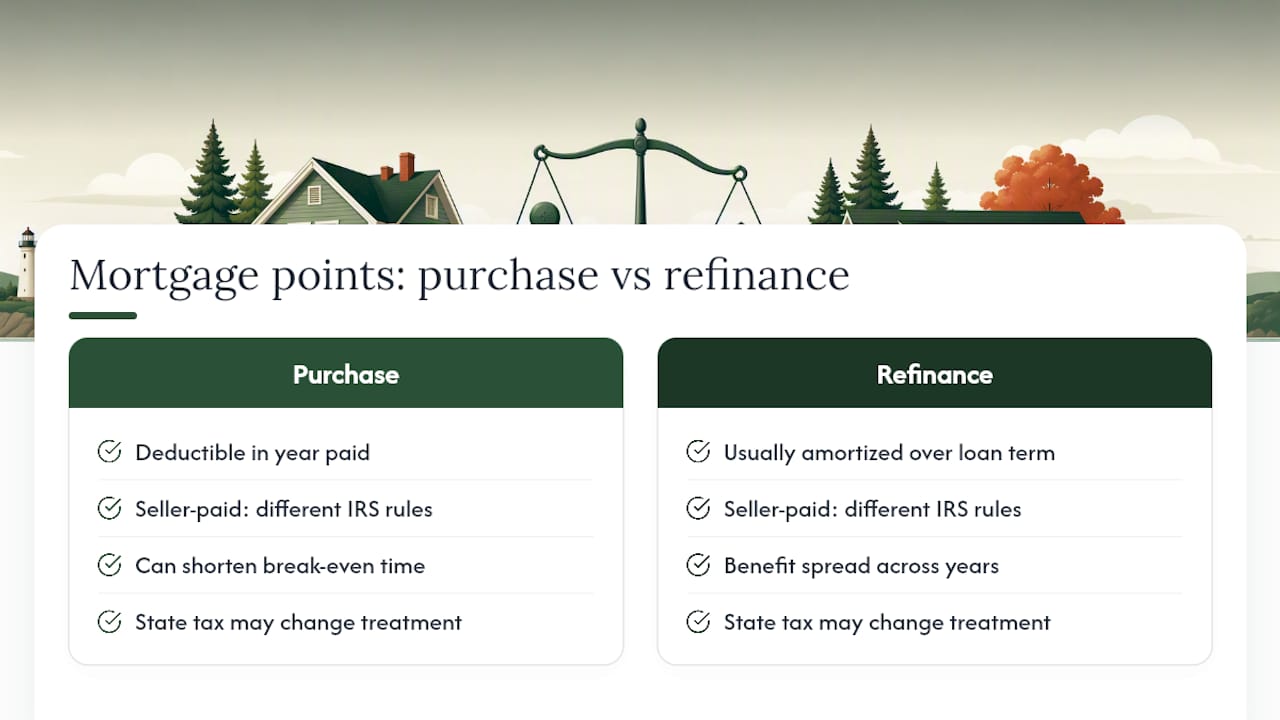
Quick fact: The deductibility rule is one of the few places where the purchase-vs-refinance distinction changes your break-even math directly, since a same-year deduction can effectively shorten how long it takes points to pay off.
State tax treatment and unusual loan structures can complicate this further. A quick call with a tax professional, or a look at broader tax planning resources for homeowners, is worth it before you commit to a strategy based on assumed deductions.
How to Compare Lender Offers Without Getting Burned
Rate shopping only works if you’re comparing apples to apples. Use this checklist when you’re collecting quotes:
- Ask every lender for the same two scenarios: rate with zero points, and rate with a specific dollar amount of points.
- Request the Closing Disclosure early, not just a rough estimate, so you can see the actual point cost line by line.
- Compare APR and total upfront cash needed, not just the headline interest rate.
- Confirm whether a fee labeled “points” is a discount point or an origination point. Only one of them buys down your rate.
Pro Tip: If a loan estimate bundles points into an unclear “prepaid finance charges” line, or a lender won’t separate credits from rate quotes when you ask, treat that as a red flag. Clear lenders show the tradeoff plainly because it’s not something they need to hide.
A Maine Realtor’s View on Points vs No Points
Most first-time buyers I work with are cash-constrained at closing, so I usually steer them toward no points or a lender credit unless they’ve got a clear reason to stay put long-term. Long-term holders and move-up buyers with room in their budget are the better candidates for buying down the rate.
Seller concessions can affect the calculations around break-even points. Local variations in closing costs also influence how much cash buyers have available to allocate toward points versus reserves.
— David
How RealtorMaine Helps You Model the Real Tradeoff
Lenders can quote you rates all day, but nobody’s running the break-even numbers against your actual timeline, your local market, or the concessions a seller might be willing to offer. That’s where RealtorMaine fits in.

David isn’t a lender, so he won’t be the one setting your rate or your point structure. What he does is coordinate: pulling seller concessions into the negotiation when a deal allows for it, helping you read a Closing Disclosure line by line, and connecting you with lenders who’ll actually walk through the zero-points-versus-points scenarios side by side instead of burying the comparison. For buyers weighing FHA against conventional financing, that same guidance on loan types and down payments often shapes how much cash is even left over to consider points in the first place. If you’re working through this decision on a home in central or southern Maine, reach out to David directly to talk through your specific numbers before you lock anything in.
Where to Read More
For the official rules and deeper detail, start with the CFPB’s guide to lender credits and points, the IRS rules on deducting points, and NerdWallet’s break-even walkthrough.
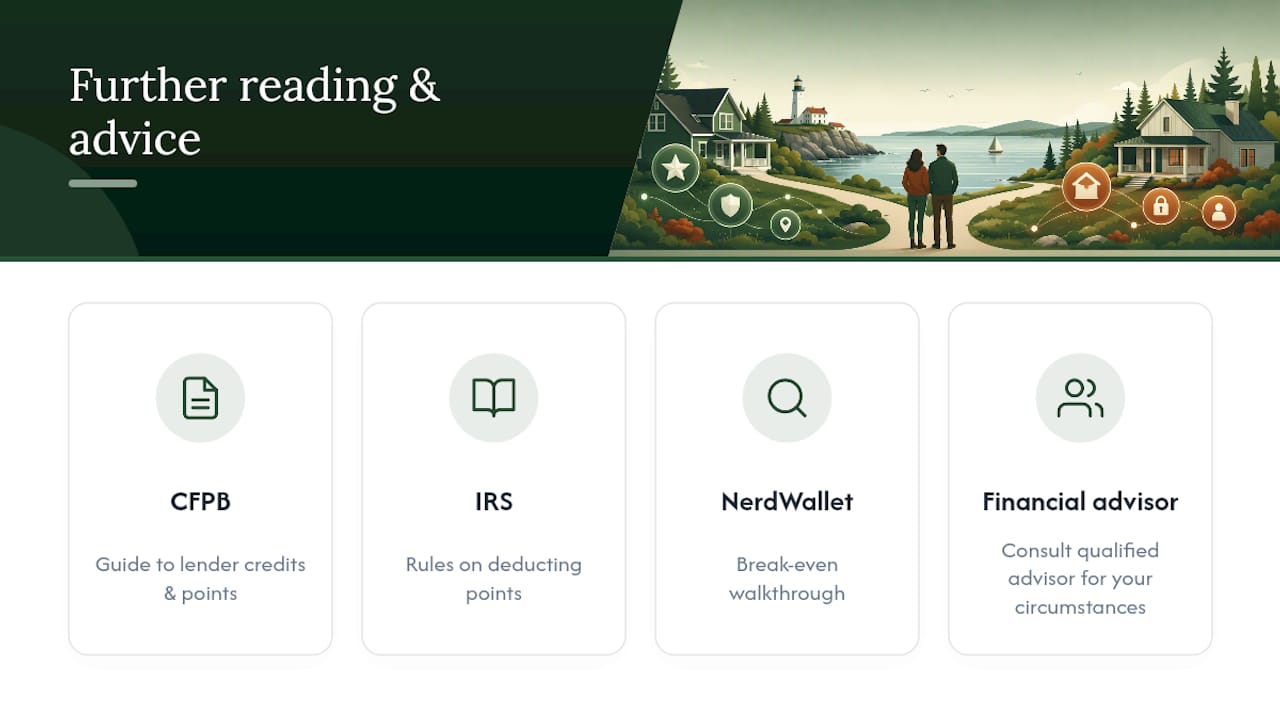
This article is general information, not a substitute for advice from a qualified financial advisor. Consult a qualified financial professional about your own circumstances before acting on anything here.
Sources
- Trends in discount points amid rising interest rates — Consumer Financial Protection Bureau
- IRS Topic 504 — Points
- Mortgage points: Are they worth it? — NerdWallet