
Maine’s homestead exemption reduces the just value of an eligible primary residence by up to $25,000, which lowers your property tax bill proportionally once your town’s certified ratio is applied. You qualify by being a permanent Maine resident who has owned the home for at least 12 months before April 1 and uses it as your primary residence, not a camp or second home. File the application with your local municipal assessor by April 1, or you’ll wait until next year’s tax bill to see the savings.
TL;DR:
- The exemption reduces your home’s assessed value by up to $25,000, multiplied by your town’s certified ratio, affecting your property tax bill proportionally.
- Eligibility requires permanent residence in Maine for at least 12 months before April 1 and ownership of the home for the same period, with proof needed at the assessor’s office.
- The exemption only applies to primary residences; camps, second homes, or hunting cabins do not qualify, even if owned and visited regularly.
- Filing must occur by April 1 to qualify for the current tax year; late applications do not receive retroactive benefits, and additional proof can expedite approval.
- Combining the homestead exemption with other local or state programs is possible if eligibility criteria are met and separate applications are filed.
Table of Contents
- Who Qualifies for the Maine Homestead Exemption
- How Is the Homestead Exemption Calculated?
- How Do You Apply for the Homestead Exemption?
- What If Your Homestead Exemption Application Is Denied?
- Can You Combine the Homestead Exemption With Other Tax Credits?
- What Would You Actually Save? Two Quick Scenarios
- What a Maine Realtor® Wishes Every Homeowner Knew About Filing
- Why This Exemption Deserves More Attention Than It Gets
- Need Help Sorting Out Title, Trust, or Ownership Questions?
- Sources
Who Qualifies for the Maine Homestead Exemption
Municipal assessors are looking for two things: proof you actually live in Maine year round, and proof you’ve owned this specific home long enough to qualify. “Permanent residence” means the home is where you actually live, not a place you visit a few weekends a year. Assessors typically accept a Maine driver’s license, voter registration, a filed Maine income tax return, or recent utility bills showing your name and the property address as evidence.
The 12-month ownership rule is calculated backward from April 1 of the tax year you’re claiming. If you closed on your house in May of last year, you won’t hit the 12-month mark until this coming May, meaning you’d need to wait for next year’s application cycle. Homes held in revocable trusts or through deeded life estates generally qualify, but Bulletin No. 35 notes assessors may ask for documentation proving the beneficiary or life tenant actually occupies the property.
Camps, hunting cabins, and second homes don’t qualify, even if you own them outright and visit often. If a property has joint owners, only one signature is typically required on the application, though some towns request all owners sign. Active-duty military members stationed elsewhere often retain eligibility on their Maine homestead under specific exceptions worth confirming with your assessor.
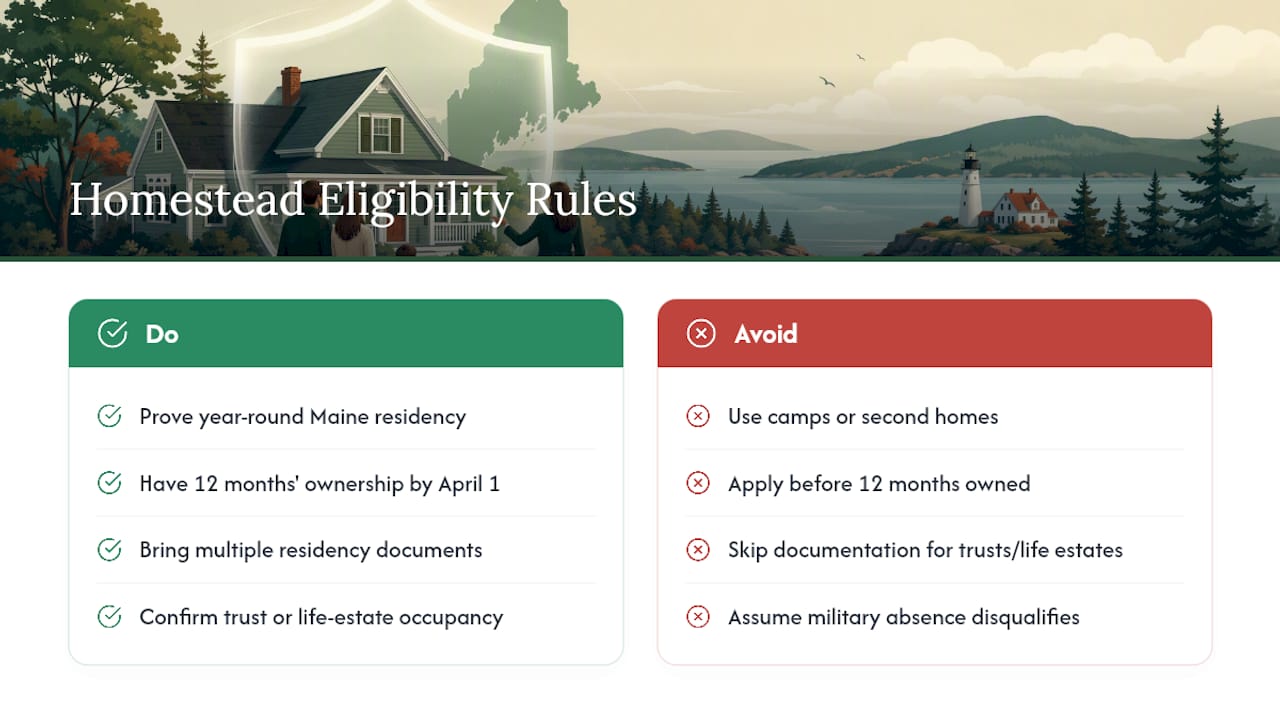
Pro Tip: Bring more than one proof of residency to your assessor appointment. A driver’s license plus a voter registration card or insurance binder resolves most eligibility questions on the spot and avoids a follow-up request that delays approval.
How Is the Homestead Exemption Calculated?
The exemption doesn’t simply subtract $25,000 from your tax bill. It reduces the just value of your home by up to $25,000, then your municipality applies its certified ratio to determine the actual assessed-value reduction.
The math: Exemption applied = $25,000 × certified ratio. A town assessing at 90% of just value would apply a $22,500 reduction to your assessed value, not the full $25,000.
Here’s how that plays out:
- Your home has a just value of $250,000, and your town’s certified ratio is 90%.
- The exemption reduces your assessed value by $25,000 × 0.90, or $22,500.
- Your taxable assessed value drops from $225,000 (250,000 × 0.90) to $202,500.
- Your town then applies its mill rate to that lower number, cutting your bill proportionally.
If your home’s just value is below $25,000, which is rare but does happen with some rural land parcels or mobile homes, you get a partial exemption capped at the property’s actual just value rather than the full $25,000. Cooperative housing units follow separate proration rules under Bulletin No. 35, since ownership is structured differently than a standard deed.
How Do You Apply for the Homestead Exemption?
You can get the official application form from your town’s assessor office or download it directly from the Maine Revenue Services website. The form asks you to check boxes confirming permanent residency, 12 months of ownership, and primary-residence use, then sign under penalty of perjury.
Filing steps to follow:
- Complete Section 1, checking every box that applies to your situation honestly and accurately.
- Sign the form. If you own the property jointly, check whether your town requires every owner’s signature.
- File with your local municipal assessor by April 1, or with Maine Revenue Services directly if you live in an unorganized territory.
- Bring supporting documents such as your deed, driver’s license, or a recent tax return in case the assessor asks.
Miss the April 1 deadline and your application rolls to the following tax year automatically. There’s no retroactive credit for a late filing. Once approved, the exemption stays noted on your property record and continues each year unless you sell, move, or change how the property is used.
Pro Tip: Ask the assessor for a written receipt or email confirmation when you drop off your application. It’s the easiest way to prove you filed on time if there’s ever a dispute about your deadline.
What If Your Homestead Exemption Application Is Denied?
Denials usually trace back to one of three things: incomplete proof of residency, a late filing, or a records mismatch showing you claimed a homestead exemption on a different property somewhere else in Maine. You can only claim one homestead exemption at a time, statewide.
If your application is denied, here’s the path forward:
- Request the specific reason for denial in writing from your municipal assessor.
- Gather the missing documentation, whether that’s a lease showing you vacated a prior homestead or a corrected deed.
- File an abatement appeal, generally within 185 days of the municipality’s tax commitment date.
- Consult a real estate attorney or your assessor’s office directly if the ownership structure involves a trust or unclear title.
The commitment date, not your filing date, starts the abatement clock, so confirm it directly with your town.
Can You Combine the Homestead Exemption With Other Tax Credits?
You can stack the homestead exemption with Maine’s Veteran’s Exemption or Blind Person’s Exemption, as long as you separately meet each program’s eligibility rules and file the required paperwork for each one. Maine Revenue Services treats these as independent programs that can apply to the same property simultaneously.
The homestead exemption is fundamentally different from the Property Tax Fairness Credit, which is income-based and claimed on your state income tax return rather than filed with your town. One reduces your assessed value regardless of income; the other refunds a portion of taxes paid based on how much you earn.
- Homestead exemption: ownership and residency based, filed locally.
- Veteran’s or Blind exemptions: separate applications, same local assessor.
- Property Tax Fairness Credit: income based, filed with your state tax return.
Talk to your assessor about local exemptions and Maine Revenue Services about anything tied to your income tax filing.
What Would You Actually Save? Two Quick Scenarios
Scenario 1: You own a home in a town with a certified ratio of 80% and a just value of $300,000. The exemption knocks $20,000 off your assessed value (25,000 × 0.80). At a mill rate of $18 per $1,000, that’s roughly $360 in annual savings.
Scenario 2: You own a small camp-turned-year-round cottage with a just value of only $18,000. Since that’s below $25,000, you get a partial exemption capped at the full just value, effectively zeroing out that portion of your assessed value.
- Find your town’s certified ratio (ask your assessor or check the town website).
- Multiply $25,000 by that ratio.
- Subtract the result from your current assessed value to estimate your new tax basis.
Remember, the exemption changes your assessed value, not your mill rate. A high mill rate town and a low mill rate town with identical just values will see different dollar savings from the same exemption.
What a Maine Realtor® Wishes Every Homeowner Knew About Filing
After watching clients navigate this process for years, the applications that sail through share a pattern: they bring more proof than the bare minimum. Don’t just bring your deed. Bring your driver’s license, a recent property tax bill, and a utility statement, too.
- File in February or March, not the last week before April 1.
- Confirm your assessor received the form and ask for the town’s commitment date.
- If your deed shows a trust, life estate, or unclear ownership history, loop in a title company or real estate attorney before your appointment.
Pro Tip: If you recently inherited a home or hold title through a trust, get a title search done before you file. It saves you a second trip to the assessor’s office.
Why This Exemption Deserves More Attention Than It Gets
Most homeowners I talk to treat the homestead exemption as an afterthought buried in closing paperwork, and that’s a mistake. A few hundred dollars a year sounds modest until you multiply it across a 20 or 30 year hold, and it adds up to real money over the life of ownership. I’ve seen buyers move into a new home, forget to file by that first April 1, and lose a full year of savings simply because nobody mentioned the deadline. If you’ve recently bought a home in central or southern Maine and aren’t sure whether your paperwork or trust structure qualifies, reach out. It’s a five-minute conversation that can save you a filing headache.
— David
Need Help Sorting Out Title, Trust, or Ownership Questions?
Filing the homestead exemption itself doesn’t require an agent, but the ownership paperwork behind it sometimes gets messy, especially with inherited property, trusts, or deeds that changed hands more than once. That’s where a local Realtor® earns their keep: sorting out title history, tracking down the right documents, and knowing which assessor’s office wants what before you show up.

Local Realtors® often help buyers and sellers untangle ownership documentation before it becomes a filing problem. Some homeowners file the exemption themselves without any trouble. But if your deed history is unclear, or you’re not sure whether a trust or life estate affects your eligibility, David Haydym can walk through your specific situation and point you toward the right next step, whether that’s a quick call with your assessor or a title company referral. Reach out through the site to get a straight answer on where you stand.
Sources
- Property tax exemptions | Maine Revenue Services
- Homestead Exemption Program FAQ | Maine Revenue Services