
Central Maine rewards people who pick a town on purpose. Plan for four real seasons and a car-based lifestyle, and expect home prices that differ a lot from county to county. The Kennebec Valley around Augusta and Waterville, the Lewiston-Auburn area, and the lake towns near Oakland and Skowhegan each suit a different kind of buyer. This guide covers the towns, what homes cost, how to prepare for winter, and the steps to take before you make an offer.
TL;DR
- Central Maine is a collection of distinct communities. Waterville, Augusta, Hallowell, Gardiner, Skowhegan and Auburn offer very different mixes of price, services and walkability.
- Median sale prices for June to August 2026 ran from $251,250 in Somerset County to $365,000 in Kennebec County, so your county choice shapes your budget.
- Winter is the main thing to plan for: heating, tires, a generator and a reliable vehicle. Many newcomers enjoy the seasonal rhythm once they are prepared.
- Maine’s homestead exemption can reduce taxable value by up to $25,000 if you own and live in the home as your permanent residence.
- Visit in more than one season, then work with a local agent who knows the specific town.
Table of Contents
- What Central Maine is like to live in
- Comparing Central Maine towns
- What homes cost in Central Maine
- Jobs and the local economy
- Healthcare and services
- A practical relocation plan
- Our perspective
- Work with a local agent
- FAQ
- Sources
What Central Maine is like to live in
Maine is a big state, and a Down East Magazine guide for newcomers makes the point that Aroostook County is different from York County, and the coast is different from the mountains. Pick a region or two that fit your life before you start touring houses. Central Maine sits in the middle: a few hours from the coast, close to lakes and hills, and anchored by small cities rather than one big one.
Most people who move here do it for the lifestyle: nature, community and room to breathe. The same guide notes that distances here are measured in time rather than miles, and that moose on roads are a real consideration for drivers.
Seasons and weather
The numbers help set expectations. According to NOAA climate data, the Southern Interior division averages 60 to 90 inches of snow per winter, an average annual temperature of 43°F, and about 20 days a year below 0°F. Frost can occur eight to 10 months of the year in most of the state, and the Southern Interior growing season runs 120 to 180 days.
Summers are pleasant. The Maine Tourism Association notes that summer nights are usually comfortably cool, though a very warm summer can bring as many as 25 days near 90°F in the Southern Interior.
The seasons are also shifting. The Maine Climate Plan reports that Central Maine winters are shorter and summers longer by about two weeks compared with a century ago, and that the statewide growing season has grown by 16 days on average since 1950.
Day to day, that means:
- Winter: snow, ice and short days. Good tire tread and practical cold-weather clothing matter.
- Spring: gradual and muddy, so mud boots earn their place by the door.
- Summer: warm, sometimes humid, with mosquitoes near water.
- Fall: the colorful season that draws many people here in the first place.
These seasonal tips come from a newcomer’s guide to Maine’s seasons, which also suggests preparing winter equipment and generators in advance.
Lifestyle trade-offs worth planning for
A Maine living guide describes a slower pace, a job market concentrated in a few hubs (Portland, Bangor, Lewiston-Auburn and Augusta), and a car as a necessity almost everywhere outside the Portland area. It also notes that many homes heat with oil, so winter heating costs are worth budgeting for. Maine suits people who want nature and community and are ready for winter and driving. It is a different fit if you need dense transit or a big-city social scene.
Comparing Central Maine towns
The Central Maine Growth Council describes Waterville as the heart of regional economic growth, Fairfield as a mix of commercial and rural spaces, Winslow as a suburban town, and Oakland as a gateway to the Belgrade Lakes. Waterville has roughly 16,000 residents, Colby College and Thomas College, the Waterville Opera House and the Colby College Museum of Art.
A regional town overview adds that Augusta is the state capital with jobs anchored by state government, Hallowell is a walkable historic town with a food scene, Gardiner is a more affordable riverfront community, and Skowhegan has some of the region’s lowest-priced housing and serves as a gateway to the western mountains.
| Town | Character | Good fit for |
|---|---|---|
| Waterville | Regional hub with two colleges, arts and a major hospital campus | Buyers who want services and culture close by |
| Augusta | State capital, government employment | Commuters and anyone who works for the state |
| Hallowell | Walkable, historic, food scene | Buyers who want a small-town walkable core |
| Gardiner | Riverfront, more affordable | First-time buyers watching the budget |
| Skowhegan | Lower housing costs, mountain gateway | Outdoor lovers and value seekers |
| Oakland and Winslow | Lakes access and suburban feel | Families who want space near Waterville |
| Auburn | Lewiston-Auburn area, interstate access | Families and commuters toward Portland |
If you want a closer look at specific places, we have written town guides on moving to Augusta and moving to Auburn, plus a look at the Augusta housing market.
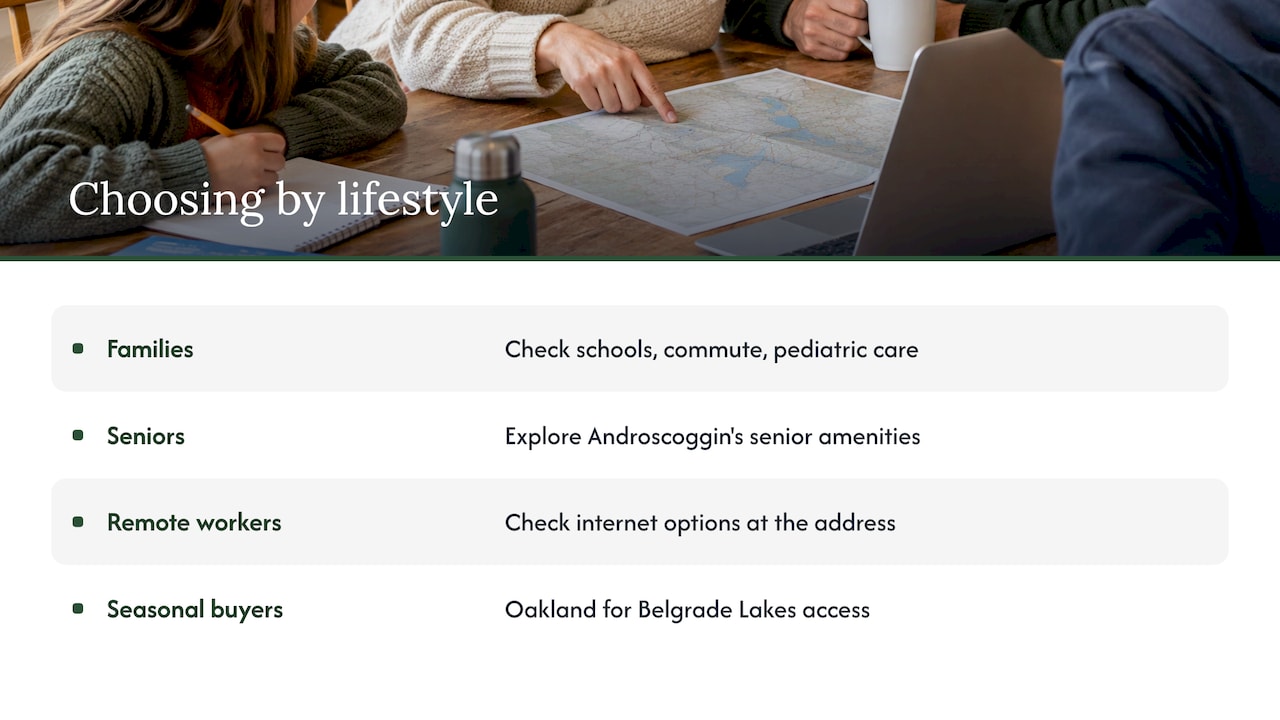
Choosing by the way you live
Families: look at the school district, the commute and how far you are from pediatric care. Suburban towns near Waterville and the Auburn area give more yard for the money.
Seniors downsizing: the Androscoggin area stands out. A Sun Journal feature points to affordable real estate, senior living communities, first-class medical care and easy drives to popular destinations. It also reports that home sale prices in Androscoggin County hover 15 to 20 percent below the rest of the state, with a boom in all-ages and 55+ construction expected to keep prices and rents steady.
Remote workers: the same regional overview says remote work has filled much of the gap for professionals in a job market narrower than Greater Portland. Check internet options at the specific address before you commit.
Vacation and seasonal buyers: the Belgrade Lakes area through Oakland is the lake-side option within Central Maine. If you want the coast, we also help buyers across southern Maine.
What homes cost in Central Maine
Prices vary by county, and they are moving. The Central Maine newspaper’s summer 2026 report gives median sale prices for June to August 2026:
| County | Median sale price, June to August 2026 |
|---|---|
| Kennebec | $365,000 (up 10.36%) |
| Androscoggin | $360,000 (steady) |
| Oxford | $342,500 (up 4.62%) |
| Franklin | $337,700 (up 8.06%) |
| Somerset | $251,250 |
The statewide median in the same report reached $429,000, up 2.75% from a year earlier.
For a longer view, the Mainebiz Fact Book lists 2025 median sales prices of $349,999 in Androscoggin, $325,000 in Kennebec, $300,000 in Franklin, $339,950 in Oxford, $285,000 in Penobscot and $240,000 in Somerset. It also lists two-bedroom fair market rents effective October 1, 2025: $1,586 in Androscoggin County (Lewiston-Auburn), $1,416 in Kennebec County and $1,392 in Penobscot County.
Two takeaways. First, a county median hides big differences between towns, so a county figure is a starting point, not a target price. Second, renting for a season while you learn the area is a common way to test a town before buying.
Property taxes and the homestead exemption
Maine’s homestead exemption is one of the most useful things to know before closing. Maine Revenue Services Bulletin No. 35, dated February 11, 2026, says it reduces just value by up to $25,000. Eligibility requires that you own the home and have been a Maine permanent resident for the 12 months before April 1. The reduction is adjusted by the municipality’s certified ratio, and applications go to the local assessor by April 1.
Because of that residency timing, plan your move date with the April 1 deadline in mind. We explain the steps in our homestead exemption guide and in our Maine property tax overview.
Jobs and the local economy
The Maine Center for Economic Policy’s 2024 report found payroll employment 19,000 above the pre-pandemic level, unemployment at or below 3%, and roughly two job openings per unemployed worker. It also found that 82% of Mainers aged 16 to 64 worked at some point in 2023, the highest rate since 2006.
Its 2025 edition adds that unemployment is higher outside the Portland metro region and that rural jobs are more likely to be part-time or seasonal. So ask early how your own income will work in the town you pick.
In Central Maine, the main employers are state government in Augusta, MaineGeneral, Colby and Thomas Colleges in Waterville, and the trades, according to the regional overview.
If you are selling a home elsewhere first
Many people relocating here are selling a house in another state at the same time. Timing the sale against your purchase deserves attention, and this overview of selling a home after a job relocation walks through the questions relocating owners face. Build in margin between your closing dates so you are not carrying two homes or scrambling for temporary housing.
Healthcare and services
Healthcare is a practical question for families and seniors alike. MaineGeneral Health operates the Alfond Center for Health in Augusta and the Thayer Center for Health in Waterville, which has a 24/7 emergency department. Its emergency care page lists 24-hour emergency care at both centers, with Express Care sites in Augusta, Waterville and Gardiner.
For everyday care, MaineGeneral’s primary care listings cover family, pediatric, geriatric and internal medicine across the Kennebec Valley, including Augusta, Waterville, Oakland, Gardiner and Winthrop, with virtual visits for some appointments. Confirm that a given practice is accepting new patients and takes your insurance before you settle on a town.
A practical relocation plan
- Choose two or three towns. Use the comparison above and narrow by commute, schools and services.
- Visit in more than one season. A January visit tells you things a July visit cannot.
- Set your budget by town, not county. Ask for comparative market analyses on the specific neighborhoods you like.
- Get your financing lined up. Talk with lenders about FHA and conventional options before you tour seriously.
- Plan the homestead timing. Residency before April 1 matters for the exemption.
- Prepare the house for winter. Check the heating system and fuel type, insulation, the roof, a generator and snow removal.
- Handle the move itself. Our 30-day checklist for movers to Maine covers the DMV, regions and winter prep.
For condos and townhouses, read the association documents closely: fees, rules, reserves and what the fee covers. We review those documents with our buyers.
Our perspective
Relocation goes best when the buyer starts with how they want to live, then chooses the town, then the house. Too many people do it in the reverse order and end up with a good house in the wrong place.
In 20 years of working Central and Southern Maine, we have seen how much the details matter: which road gets plowed first, which town has the walkable downtown, which neighborhood fits a family and which suits a downsizer. Local knowledge and data work together. We use comparative market analyses to price accurately and negotiate with confidence, and we explain every step without pressure.
We also know a move is not a nine-to-five event. Out-of-state buyers often have questions in the evening or on weekends, so we make ourselves available beyond standard hours. Whether you are a first-time buyer, a family relocating, a senior downsizing, an investor or someone looking for a lake or coastal getaway, our job is to give you clear, unbiased advice so you can make the decision yourself.
David
Work with a local agent
If you are ready to turn this research into a plan, we can help. We represent buyers and sellers across central and southern Maine, including home search, listing, pricing strategy, negotiation, comparative market analyses and guidance on FHA and conventional financing. We also support first-time buyers, relocators, investors, seniors and vacation property seekers. See our buying, selling, investment and seasonal property services to get started.

Tell us which towns you are considering and your timeline, and we will help you compare them in practical terms.
FAQ
What is the best town in Central Maine for newcomers?
It depends on what you value. Waterville suits buyers who want services, colleges and culture, Hallowell offers a walkable historic core, and Gardiner and Skowhegan are often chosen for value. Visit a few, and ask for neighborhood-level price data before deciding.
How much snow should I expect in Central Maine?
NOAA data shows the Southern Interior division averaging 60 to 90 inches of snow per winter. Winters are getting shorter, but you should still plan for snow removal, good tires, winter heating and backup power.
Can I move to Central Maine without a job?
Yes, many people do, particularly remote workers. Maine’s job market is concentrated in a few hubs and rural jobs are more often part-time or seasonal, so confirm how your income will work before you buy.
Do I qualify for the Maine homestead exemption right away?
Not necessarily. Per Maine Revenue Services, you must own the home and have been a Maine permanent resident for the 12 months before April 1, then apply to the local assessor by that date. Check your town assessor’s office for your specific situation.
Sources
- Climate of Maine, NOAA
- Central Zone, Maine Climate Plan
- Maine Weather, Maine Tourism Association
- Moving to Maine: What to Know, Down East Magazine
- Living in Maine: Honest Pros, Cons and Where to Live
- Moving to Maine? What to Expect in Every Season
- Communities, Central Maine Growth Council
- Moving to Central Maine: Best Towns, Cost and Pros
- Ready to retire? Central Maine, Sun Journal
- Summer home prices rose across much of Central Maine
- Mainebiz Fact Book: Doing Business in Maine 2026
- Maine Revenue Services Bulletin No. 35
- State of Working Maine 2024
- State of Working Maine 2025
- About MaineGeneral Health
- Emergency Care, MaineGeneral
- Primary Care, MaineGeneral