A comparative market analysis (CMA) is a Realtor’s written estimate of what your home, or the home you want to buy, should sell for, based on similar Maine homes that sold recently. It gives you a price range, not a single number. A careful agent builds that range from close comparisons and explains every adjustment. We build CMAs for buyers and sellers across central and southern Maine, and the sections below show what goes into a good one and how to use it.
TL;DR
- A CMA is an informal estimate of value drawn from similar sold, pending and active properties. Sellers use it to choose a list price. Buyers use it to choose an offer.
- It is not an appraisal. Maine lenders order a separate appraisal from a licensed appraiser before they fund a mortgage.
- Quality depends on the comparables chosen and the adjustments made. Local knowledge matters more than software.
- Maine prices vary sharply by town. A Portland comp tells you almost nothing about a Bangor or Augusta home.
- Ask your agent to walk you through each comp. A range you understand is worth more than a number you were handed.
Table of Contents
- What a CMA tells you, and what it doesn’t
- CMA, appraisal and broker price opinion: the Maine differences
- How a Maine agent builds a CMA
- Why Maine’s local market changes everything
- Using a CMA if you are selling
- Using a CMA if you are buying
- A worked example
- What makes one CMA better than another
- How we approach CMAs
- Our perspective
- Get your own CMA
- FAQ
- Sources
What a CMA tells you, and what it doesn’t
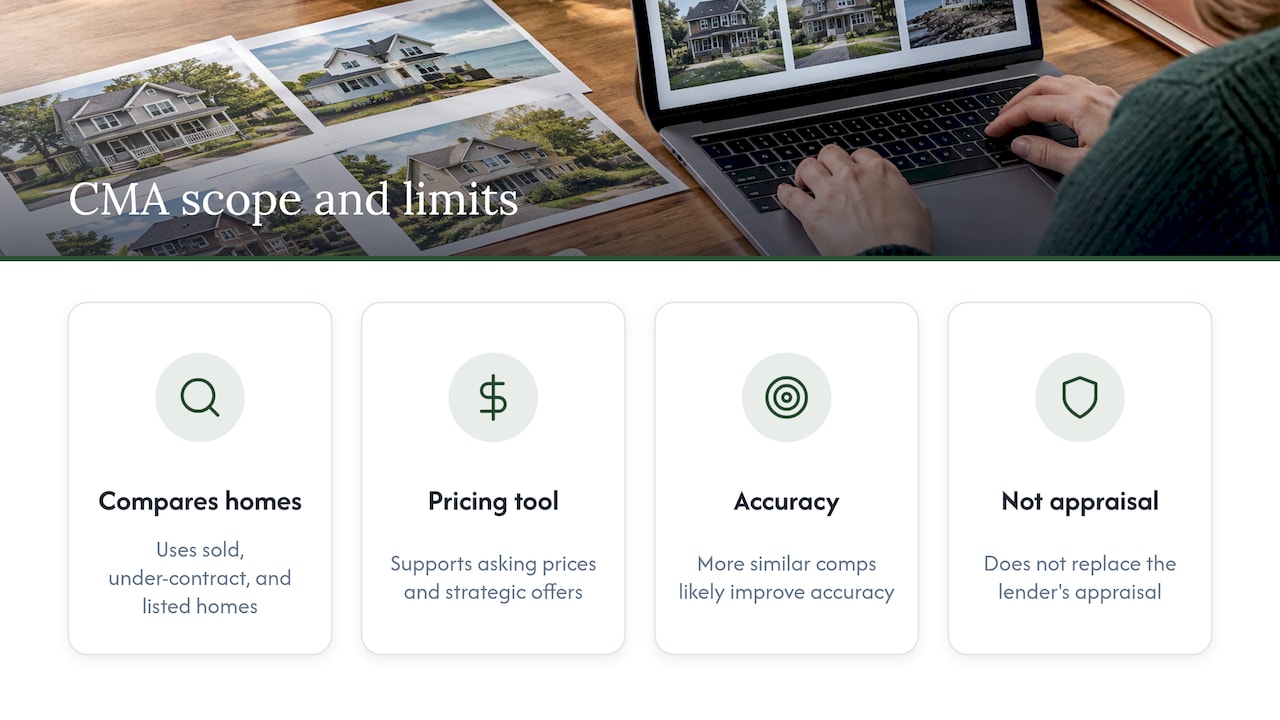
A CMA answers one question: what are buyers actually paying for homes like this one, right now? The agent looks at properties in the same area that have sold, are under contract or are currently listed. The National Association of Realtors describes the CMA as the research an agent uses to suggest a listing price.
For a seller, it supports the asking price. For a buyer, it supports a strategic offer. The CRMLS guide to CMAs describes both uses.
The output is a range. The Massachusetts Division of Professional Licensure, in its guidance for licensees, says the more alike the subject home and the comparables are, the more accurate the CMA is likely to be. Maine’s rules differ in detail, but that principle is the same everywhere.
A CMA is a pricing tool. It is not a valuation a lender will accept. It does not replace the appraisal that happens after you have a signed contract.
CMA, appraisal and broker price opinion: the Maine differences
Three documents get confused, and they have different jobs.
| CMA | Appraisal | Broker price opinion (BPO) | |
|---|---|---|---|
| Who prepares it | A licensed real estate agent | A licensed or certified appraiser | A broker or associate broker |
| Main use | Choosing a list price or an offer | Mortgage underwriting | Opinions of value outside a sale, such as for lenders or servicers |
| Accepted by lenders | No | Yes | Not for a standard purchase loan |
Maine’s Office of Professional and Occupational Regulation explains in its licensing newsletter that only broker and associate broker licensees may render opinions of value outside federally related transactions. Sales agents may not. Those opinions must state that they were not prepared by a licensed or certified appraiser. A BPO also cannot be given on a property where the licensee or someone in the same company will receive a fee from the transaction.
The practical takeaway: a CMA is part of the service a Realtor gives you when you are deciding whether to list or buy. It is not a stand-in for an appraisal. If you are financing a purchase, plan for the lender’s appraisal and use the CMA to understand how your price relates to it.
How a Maine agent builds a CMA
There is no single required method, so the steps below are what a careful agent does.
1. Define the subject home
The agent records location, lot, square footage, bedrooms, baths, age, style, condition, updates and anything unusual: a shared driveway, a septic system, waterfront, a condo association. For condos and townhouses, we also review the association documents, because fees and rules affect what buyers will pay.
2. Pick comparables that really compare
The Massachusetts Association of Realtors pricing course advises choosing comps that are as close as possible to the subject in location, size, sale date, style, age, improvements and amenities. For rural areas, its guideline is a search radius of up to five miles, with sales in the last 90 days, stretched to six months in slow markets.
That guideline fits much of central Maine, where the nearest similar home may be in the next town. It also shows why a CMA gets harder in thinly traded areas such as small coastal towns and islands, where good comps are scarce and judgment counts for more.
3. Use sold data as the anchor
Active listings show what sellers hope for. Pending sales show where buyers and sellers are agreeing. Sold sales show what buyers paid. The guidance above treats sold properties as the anchor, and a CMA built on asking prices alone tends to overshoot.
4. Adjust the comps, not your home
No two houses match exactly. The agent adjusts each comparable’s sale price up or down for differences: a finished basement, a third bathroom, a newer roof, a bigger garage. If the comp has a feature yours lacks, its value comes off the comp’s price. If yours has a feature the comp lacks, the value is added. Each adjustment should be explainable in a sentence.
5. Reach a range and a recommendation
The adjusted prices form a range. The MAAR manual says agents should walk clients through the data and the reasoning behind the range, with the aim of agreeing on a list or offer price within it. The NAR consumer guide adds that the seller has the final say on the asking price. The agent weighs your goals and timeline: a seller who needs a quick close may price more sharply than one with time to wait.
Why Maine’s local market changes everything
Statewide averages hide huge differences. The Federal Reserve Bank of St. Louis publishes monthly inventory metrics by Maine geography. For October 2026, it shows a statewide median listing price of $449,000, 66 median days on market and 6,528 active listings. In the Portland-South Portland area the median listing price was $600,000, with 50 median days on market. In Bangor it was $314,450, with 70 days. These figures are updated monthly, so check the live table for the latest month.
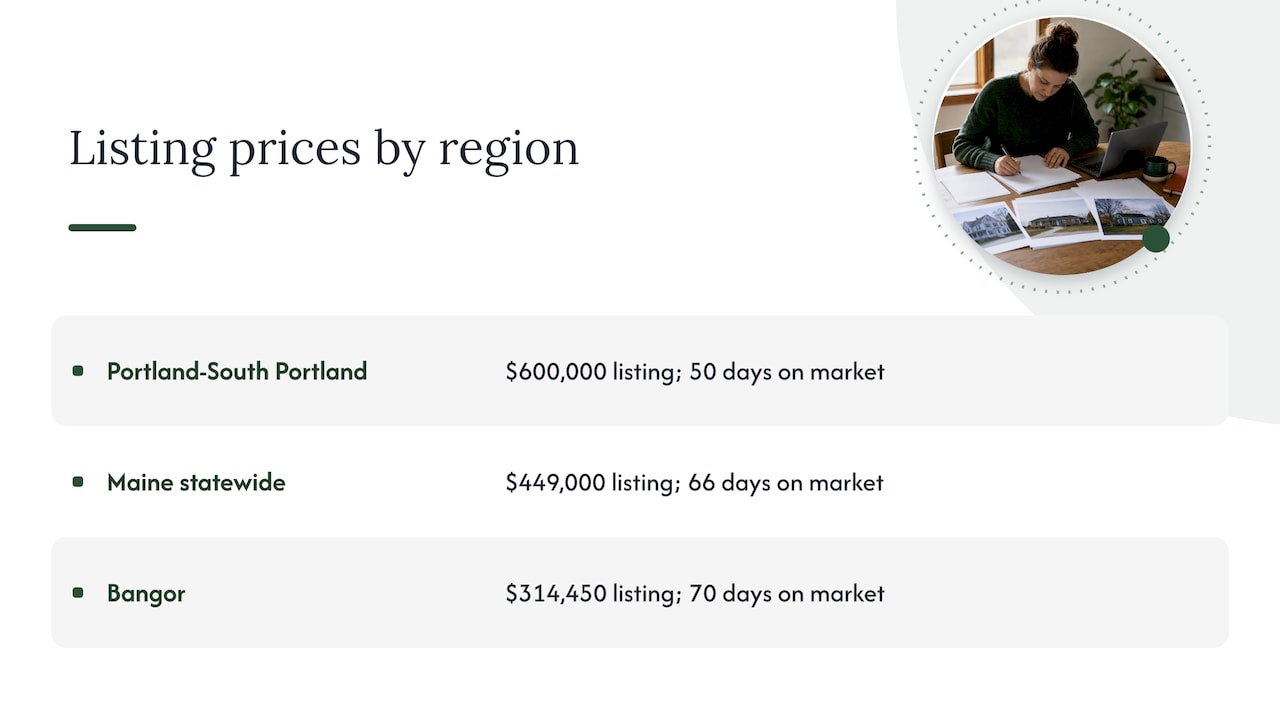
A CMA that mixes those markets would be useless. The point is that the comps must come from the same kind of place as your home.
Sales data tells a similar story over time. The Maine Association of Realtors reported that Maine closed 15,133 single-family existing home sales in 2025, up 4.78% from the year before, with a median sales price of $405,000. In its September 2025 report, the association said sellers and buyers were on more equal footing in many Maine markets. It also noted that with more homes for sale, a seller’s listing price should reflect today’s market to generate demand.
The association’s April 2026 report showed the spring market in motion: a median sales price of $410,865 and for-sale inventory up 18% since March. Seasonality matters. A CMA run in a busy spring can look different from one run in a quiet winter, and a good agent says which season the comps come from.
For town-level context, our market notes cover Portland and Augusta, and our Market Notes collect more.
Using a CMA if you are selling
Pricing is the biggest decision you make as a seller, and the CMA is your evidence.
- Look at the range, not the top. A price at the top of the range needs a reason, such as a recent renovation or an unusually good lot. Otherwise buyers compare your home to the sold homes and move on.
- Match price to your timeline. If you want a quick sale, price toward the middle or lower end. If you can wait, you can test the higher end.
- Read the comps yourself. Ask what each sold home had that yours lacks, and the reverse. Disagreement is useful. It usually means a missing detail about your home.
- Revisit the price when the market moves. If inventory climbs, as the Maine Association of Realtors noted in 2025, an old number can go stale.
We wrote a longer piece on this, Maine home pricing and why a single number is only a starting point. If you expect competing bids, our guide to multiple offers in Maine explains how pricing and strategy interact.
Using a CMA if you are buying
Buyers get less from CMAs than they could, because many think of them as a seller’s tool.
- Anchor your offer to sold prices. If similar homes closed between $385,000 and $410,000, a $450,000 list price is a conversation, not a fact.
- Know how the home differs. Condition, mechanical systems, a septic system or a shared well all move the price.
- Plan for the appraisal. If you are using FHA or conventional financing, the lender’s appraiser will look at comps too. A price far above the CMA range can leave you covering a gap in cash.
- Think about the next sale. Investors and seniors downsizing in particular should ask what the same comps say about resale and rental potential.
First-time buyers who want to know what a budget really buys can start with our cost of living and regional budget guide and our mortgage rate trends in Maine.
A worked example
Say you are selling a three-bedroom ranch of 1,500 square feet with one and a half baths in a central Maine town. The agent finds five sold homes within five miles over the last three months, each within roughly 10% of your square footage. The figures below are illustrative, not real sales.
| Comp | Sold price | Difference from your home | Adjustment | Adjusted price |
|---|---|---|---|---|
| A | $372,000 | Has a finished basement you lack | −$15,000 | $357,000 |
| B | $355,000 | Same size, older roof | +$8,000 | $363,000 |
| C | $381,000 | Has an extra full bath | −$10,000 | $371,000 |
| D | $349,000 | Smaller lot | +$6,000 | $355,000 |
| E | $368,000 | Similar, newer kitchen | −$7,000 | $361,000 |
The adjusted prices run from $355,000 to $371,000. A sensible recommendation is a list price in that band, with the exact figure set by your timeline. Listing at $399,000 would put your home well above every adjusted comp.
The adjustment amounts are the agent’s judgment, which is why they should be explained. This is the part software cannot replace.
What makes one CMA better than another
Because no required methodology governs CMAs, quality varies from agent to agent. Look for these signs:
- Enough sold comps. A common MLS guideline is to use at least five, ideally ten, sold properties unless the comps are very close matches, as one MLS knowledge base explains. In thin markets, fewer will exist, and the agent should say so.
- Comps within about 10% of your size. The same guide treats homes within plus or minus 10% of the subject’s square footage as comparable when other factors also match.
- A mix of larger and smaller comps. Balancing both sides keeps the range honest.
- Clear adjustments. Each line should say what changed and by how much.
- Local explanation. Waterfront, school district, commute, road type and town taxes are the reasons two similar houses sell for different prices in Maine.
How we approach CMAs
The route to a trustworthy price is the same for every reader here, whether you are a first-time buyer, an investor, a family relocating to central Maine, a senior downsizing or someone looking for a coastal vacation home. It starts with a Realtor who knows the town.
We prepare comparative market analyses as part of our buying and selling work. Our process is transparent and without pressure, and we use data to guide pricing and negotiation. David has 20 years in the Maine market and has sold over 50 homes across central and southern Maine.
Our perspective
A CMA is only as good as the person who builds it. Two agents can pull the same sold data and hand you very different numbers, and the difference is local knowledge: which road floods in April, which neighborhood buyers quietly prefer, which renovation actually gets paid for.
We would rather show you the work than hand you a number. When you list with us, we walk through every comp and every adjustment so you can see how we reached the range. When you buy with us, we use the same comps to decide how firmly to negotiate.
Maine is not one market. A lakefront camp, a Portland condo and an Augusta cape all price differently, and what works in one will mislead you in another. That is why we put time into the local detail and stay reachable beyond standard hours when a decision cannot wait.
If you are thinking of buying or selling in central or southern Maine, a conversation about the numbers costs you nothing to start.
David
Get your own CMA
If you are planning to sell, buy, invest or find a seasonal home in Maine, we can build a comparative market analysis around your situation. Our services cover buying a home, selling your home, investment property and vacation property, including guidance on FHA and conventional financing and a document review for condos and townhouses.

Tell us the address or the town you are considering, and we will walk you through the comps and what they mean for your price.
FAQ
Is a CMA the same as an appraisal in Maine?
No. A CMA is a Realtor’s informal estimate of value used for pricing and offers. An appraisal is prepared by a licensed or certified appraiser and is what a mortgage lender relies on. In Maine, licensees giving opinions of value must state that the opinion was not prepared by a licensed or certified appraiser.
How accurate is a CMA?
Accuracy depends on how closely the comparables match your home. The more similar they are, the more reliable the estimate, as Massachusetts licensing guidance notes. In small towns with few recent sales, the range will be wider, and your agent should explain why.
How recent should the comparable sales be?
A widely used course guideline is within 90 days for most markets, stretching to six months when sales are slow. The MAAR pricing manual also suggests a radius of up to five miles in rural areas. Maine’s seasonal swings mean the agent should note the time of year the comps sold.
Do buyers get a CMA too?
Yes. Buyers can use a CMA to decide how much to offer, based on what similar homes actually sold for rather than on the list price. It also helps you anticipate how the lender’s appraisal may come in.
Sources
- NAR: What goes into pricing your home
- CRMLS: What is a CMA?
- Mass.gov: Comparative market analysis guidance
- Maine Professional Licensing: Opinions of value and BPOs
- MAAR: Pricing Strategies, Mastering the CMA
- FRED: Inventory metrics by geography, Maine
- Maine Association of Realtors: 2025 state housing report
- Maine Association of Realtors: September 2025 housing report
- Maine Association of Realtors: April 2026 housing report
- MLS knowledge base: CMA comparables selection