
A good Maine home inspection checklist has two halves. The first covers what a general inspector examines: structure, roof, exterior, electrical, plumbing, heating and cooling, interior, insulation, chimneys and appliances. The second covers what Maine homes often need on top of that: radon testing, private well water testing and septic evaluation. Most first-time buyers only plan for the first half. This guide gives you both, with the Maine rules that decide your timing.
TL;DR
- Maine does not require a home inspection, and it does not license home inspectors, so hiring a qualified one is your job. Expect roughly $300 to $600 for a general inspection, depending on size, age and location.
- A general inspection covers about 10 major systems. Radon, well water and septic usually need separate, specifically ordered tests.
- In Maine, only a registered radon tester can collect radon samples on a home for sale. You, your agent and the seller cannot.
- Seller disclosures are a starting point, not a warranty. After you receive the water and waste disposal disclosures, a 72-hour clock starts.
- Book the inspector and the specialty testers the day your offer is accepted.
Table of Contents
- What a general home inspection covers
- What the general inspection usually leaves out
- Maine’s rules that shape your inspection timeline
- How to choose a Maine home inspector
- What a Maine home inspection costs
- Our perspective: use the inspection to negotiate, not to panic
- Working with a Realtor through the inspection
- Printable checklist: before, during and after
- FAQ
- Sources
What a general home inspection covers
A home inspection is a visual, non-invasive evaluation of a building’s structure and systems, from the foundation to the roof. The Maine inspector’s FAQ describes it that way, and it is a useful way to think about the limits: the inspector looks at what can be seen and operated without opening walls or digging.
The ASHI Standards of Practice frame the scope around the major residential systems. Use the list below to follow along on inspection day.
Structure and foundation
- Foundation walls: look for cracks, bowing, efflorescence (white mineral deposits) and signs of past water entry.
- Basement or crawl space: ask where water has come in during spring melt or heavy rain, and look at the floor and the bottom of the walls.
- Framing you can see: sagging floors, notched or cut joists, and sills near the ground.
- Doors and windows that stick or won’t latch can point to settling.
Roof, gutters and exterior
- Roofing material age, missing or curling shingles, flashing at chimneys and valleys.
- Ice dam evidence: stained ceilings below eaves, water marks in attic sheathing.
- Siding, trim and paint condition, especially at the bottom edge where snow sits.
- Grading and drainage: does the ground slope away from the house?
- Decks, porches, railings and steps: attachment to the house is where failures start.
Electrical
- Panel brand, capacity and labeling, and any signs of overheating.
- Outlets: grounding, GFCI protection near water, and anything added by a past owner without a clear permit trail.
- Old wiring types or open junction boxes in basements and attics.
Plumbing
- Supply and drain pipe materials, visible leaks, water pressure.
- Water heater age and venting.
- Under-sink cabinets, around toilets and tubs for soft or stained areas.
Heating, cooling and fuel
Heating matters more in Maine than almost anywhere. Ask about the system type, age and service history, and look at the oil tank if there is one: its location, age, condition and the piping that leads to it. Check the chimney and any fireplace or wood stove, including clearances and the liner. If you plan to rely on a wood stove, ask the inspector what they can and cannot evaluate.
Interior, insulation and ventilation
- Ceilings and walls: stains, patched areas, cracks.
- Floors, stairs and handrails.
- Attic insulation depth, ventilation and bath fan venting (fans that exhaust into the attic cause moisture problems).
- Smoke and carbon monoxide alarms: present, working, placed on each level.
Appliances
The inspector will typically run built-in appliances such as the range, dishwasher and disposal. Ask what is included in the sale, since appliances may or may not convey.
What the general inspection usually leaves out
Here is the misconception that costs buyers the most. A general inspection does not cover every possible problem. The Maine CDC notes that private wells are not tested by public authorities, and that testing for radon, well water quality and septic systems generally has to be requested and contracted separately.
Add these to your checklist when they apply:
| Test or evaluation | When it applies | Who does it |
|---|---|---|
| Radon in air | Nearly any home with a basement or slab | Maine-registered radon tester |
| Radon in water | Homes on private wells | Maine-registered tester, certified lab |
| Well water quality | Any private well | State-certified lab |
| Septic system evaluation | Any home not on public sewer | Septic professional |
| Lead paint review | Homes built before 1978 | See our lead paint guide |
| Lakefront or shoreland checks | Waterfront properties | See our lakefront checklist |
Radon: the rule that surprises buyers
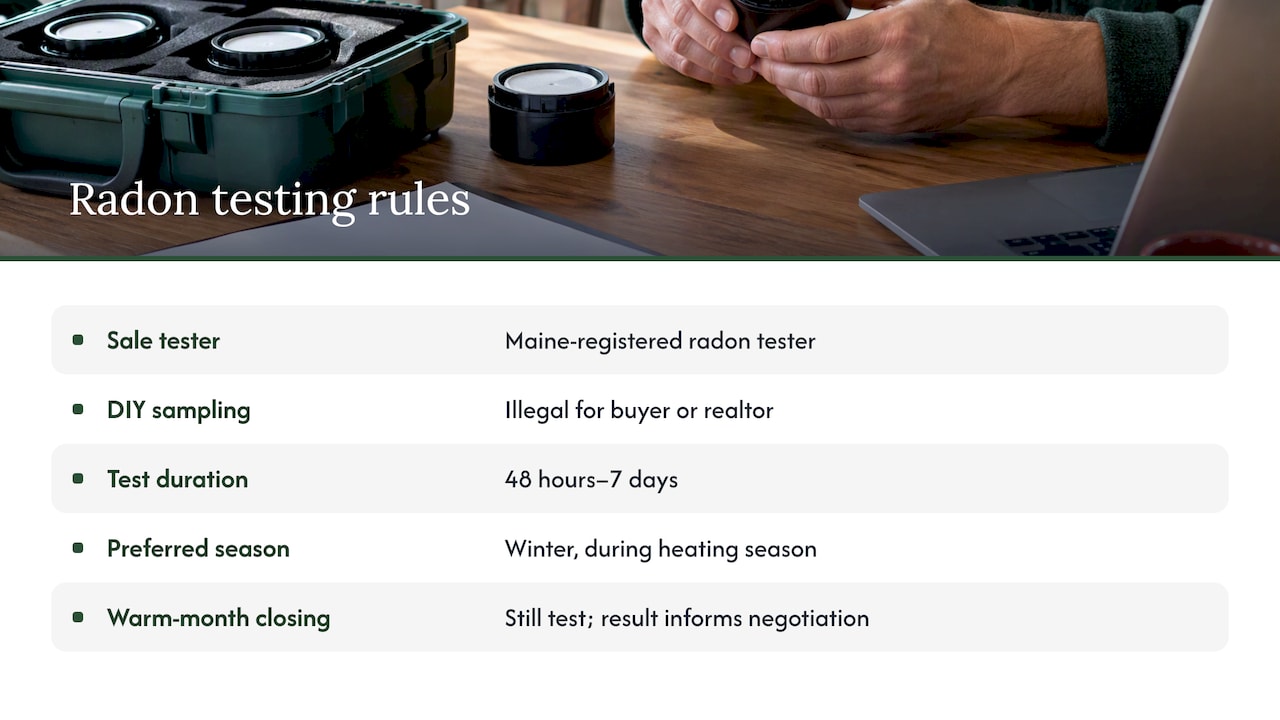
The Maine CDC’s radon FAQ says the Maine Radon Registration Act requires a Maine registered radon tester to conduct the test, and that it is illegal for a realtor or home buyer to collect radon samples for a property being sold. The same applies to radon in water. So the do-it-yourself kit from the hardware store is not the route during a sale. Hire a registered tester and put it in your calendar early.
The same page explains that short-term tests of 48 hours to 7 days are the standard for real estate transactions, and that winter, the heating season, is the preferred time to test because levels are typically highest and most representative. If your closing falls in a warm month, still test: the result is information you can negotiate with. The Maine CDC’s radon and home sales page is worth reading before you sign anything. For our own take on timing and closing risk, see our radon guide.
Investors eyeing small multifamily buildings should know radon testing is not just a single-family issue. One radon testing company explains how radon affects apartment buildings and underwriting, which is useful background even though it is written for another region.
Private wells
Maine sellers are not required to investigate their own water before filling out disclosures, so you should not rely on the seller’s word alone. The Maine CDC recommends independent testing from a state-certified lab, covering bacteria, nitrates, nitrites, arsenic and radon, even when the water looks and tastes fine. Ask the lab how to collect the sample and how long results take, then work backward from your deadlines. We cover the process in our well testing guide.
Septic systems
If the house is not on public sewer, ask for the disclosure on the waste disposal system and any pumping or repair records, then have the system evaluated by a septic professional. A general inspector looking at drains inside the house is not evaluating the tank and field outside. Ask the seller how old the system is, where the tank lies, and when it was last pumped.
Maine’s rules that shape your inspection timeline
Two pieces of Maine law and practice drive your schedule.
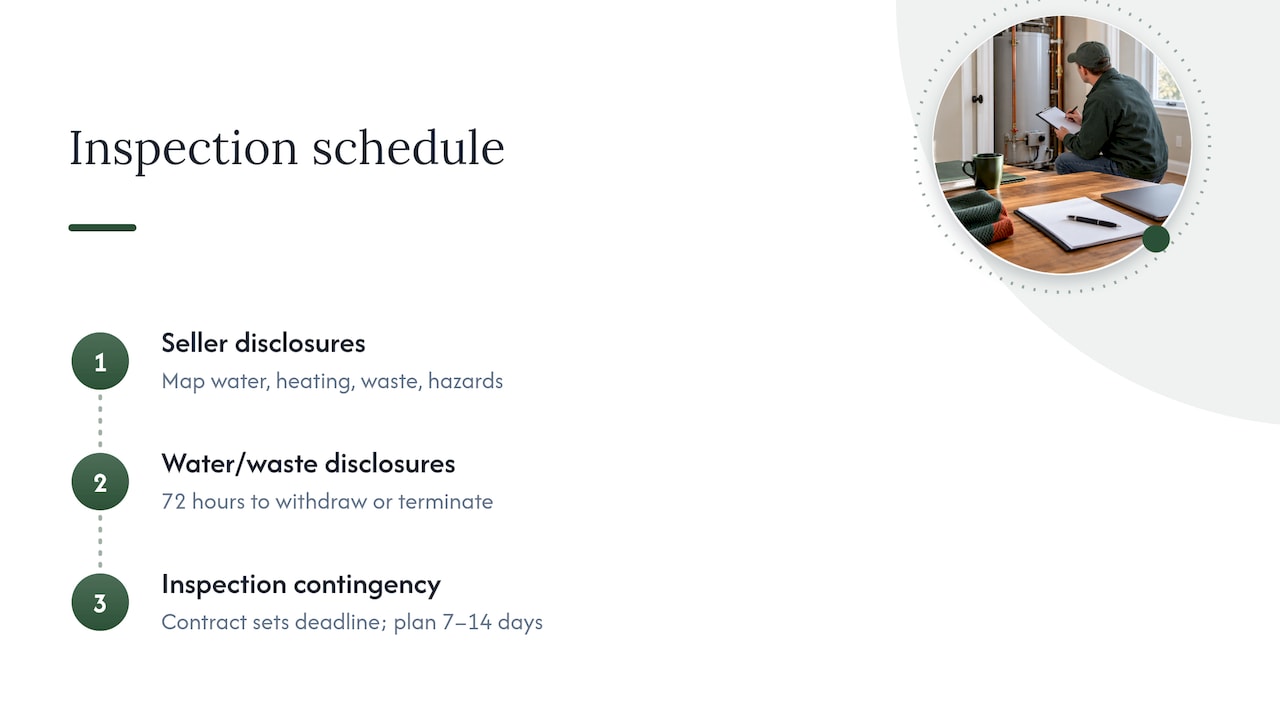
Seller disclosures. Under Title 33, §173, the seller of residential real property must give the purchaser a property disclosure statement, unless the transaction is exempt. The Maine Attorney General’s buying guide says these disclosures cover items such as the water supply, heating system, waste disposal system and hazardous materials, are limited to the seller’s knowledge, and are not warranties. Treat them as a map of where to look.
The 72-hour window. The same Attorney General page explains that buyers have 72 hours after receiving the water supply and waste disposal disclosures to withdraw an offer or terminate a contract. Read the disclosures the moment you get them and line up your well and septic questions right away. Our article on mapping disclosures to Title 33 walks through it.
Your contract’s inspection contingency. The deadline for inspections is written into your purchase and sale agreement, not set by law for every deal. Our guide to Maine inspection contingencies covers why you should book fast and plan for roughly 7 to 14 days. Read your own contract for the exact dates.
How to choose a Maine home inspector
Maine does not license home inspectors, so the title alone tells you little. State guidance as summarized in our research points buyers toward inspectors with recognized professional credentials such as ASHI or InterNACHI, and toward ones who know Maine’s particular issues: radon, arsenic in wells, oil heat, old basements. Local familiarity often matters more than shaving $50 off the fee.
Questions to ask before you book:
- Which professional association do you belong to, and which standards of practice do you follow?
- How many Maine homes of this age and type have you inspected?
- Do you carry insurance, and what does your report look like? Ask for a sample.
- Can I attend the inspection? (You should.)
- How fast do I get the report?
- Which tests do you not perform, and who do you recommend for them?
We built a longer list in 6 questions to vet Maine home inspectors.
What a Maine home inspection costs
A Maine inspector’s published FAQ puts typical general inspections between $300 and $600, varying with property size, age and location. Radon, water, and septic work are billed separately, so quotes from the individual professionals matter. Get a quote for your specific property rather than budgeting from a statewide average. For the rest of your cash needs at closing, see Maine closing costs for buyers and sellers.
Note that this is a home inspection. Searches for Maine inspections also bring up the annual vehicle safety inspection and restaurant health inspections, which are different things entirely.
Our perspective: use the inspection to negotiate, not to panic
After 20 years in Maine real estate, we have seen the same pattern: buyers walk into an inspection hoping for a clean report, then get a 60-page document and feel their stomach drop. Almost every home, new or old, produces a long list. The skill is sorting it.
We sort findings into three buckets. First, safety and health items: radon above the action level, bad well water results, active leaks, electrical hazards. These deserve a firm response. Second, big-ticket systems near the end of their life: roof, furnace, septic. These are good for price discussions or credits, informed by what comparable homes sold for. Third, ordinary maintenance. Those you simply plan for.
We also encourage buyers to be at the inspection. An hour with the inspector, walking the basement and attic, teaches you more than the report. And because we answer calls and texts beyond standard hours, clients can send us a photo from the crawl space at 7 p.m. and get a straight answer.
We keep the process transparent and pressure-free. If the inspection tells you this is the wrong house, we’d rather you walk away than stretch. Our approach to pricing and negotiation is data-driven, so repair requests are backed by facts, not emotion. For the other side of the table, see how pricing a home in Maine reflects condition.
— David
Working with a Realtor through the inspection
If you are buying in central or southern Maine, we help you line up inspectors and specialty testers, track the disclosure and contingency deadlines, and turn the report into a negotiation strategy. We work with first-time buyers, relocating families, investors, downsizing seniors and vacation property seekers. Start at RealtorMaine to talk through your search.
Printable checklist: before, during and after
Before the inspection
- Review seller disclosures the day you get them and note the 72-hour deadline.
- Book the general inspector, a registered radon tester, a certified water lab and a septic professional if needed.
- Ask for utilities to be on, and for access to attic, crawl space, panel and outbuildings.
During the inspection
- Attend, bring a flashlight and a notebook, and photograph issues.
- Ask what is urgent versus routine.
- Ask about the age of the roof, furnace, water heater and septic.
After the inspection
- Read the full report within a day, not just the summary.
- Get quotes from licensed trades for major findings.
- Decide with your Realtor whether to request repairs, a credit, a price change, or to walk away, within your contingency dates.
FAQ
Is a home inspection required in Maine?
No. Maine does not mandate home inspections; it is the buyer’s choice. We strongly recommend one, plus the specialty tests that fit the property, because disclosures are not warranties.
Can I test for radon myself during a purchase?
Not for a property being sold. The Maine CDC states it is illegal for a realtor or home buyer to collect radon samples, so you need a Maine registered radon tester. Short-term tests of 48 hours to 7 days are the usual choice.
Does the home inspector test the well and septic?
Usually not. Well water quality and septic systems are typically separate services you must request. Order well testing through a state-certified lab and have septic evaluated by a septic professional.
How much is a home inspection in Maine?
One Maine inspector quotes $300 to $600 for typical cases, depending on size, age and location. Specialty tests cost extra, so ask each provider for a quote.
Can I back out after a bad inspection?
That depends on your contract’s inspection contingency and its dates. Separately, Maine gives buyers 72 hours after receiving the water and waste disposal disclosures to withdraw an offer or terminate a contract. Review both with your Realtor, and with an attorney for legal questions.
Sources
- Breakwater Home Inspections: Home Inspection FAQ
- ASHI Standards of Practice 2026
- Maine CDC: Radon Frequently Asked Questions
- Maine CDC: Hydrogeology and Wells
- Maine Attorney General: Buying a Home
- Maine Statutes, Title 33, §173: Required disclosures
- Radon in Apartments for Multifamily Owners