Start your search through a local Maine broker’s MLS access and statewide lakefront specialty sites, then verify any listing you find on a national portal against the actual MLS number and listing agent. Before writing an offer, run three checks: shoreland zoning limits on the parcel, the age and replaceability of the septic system and well, and the property’s flood exposure and insurance requirements. A lakefront-specialist REALTOR® can run all three in parallel while you keep looking.
TL;DR:
- Confirm the shoreline zoning limits, vegetation restrictions, and permit requirements with local authorities before making an offer.
- Verify water access details, boat rights, and lot frontage length to differentiate actual lakefront parcels from views or rights-of-way.
- Review long-term water quality data for signs of algae, sediment, or pollution issues that could impact property value and usage.
- Obtain septic, well, and flood insurance information early, ensuring systems are replaceable and flood risks are clear before committing.
- Use a knowledgeable local agent to coordinate inspections and documentation in parallel, reducing the time required for a smooth transaction.
Table of Contents
- Where to find current Maine lakefront listings
- Maine shoreland zoning explained for lakefront buyers
- Vegetation and view-clearing rules you cannot assume away
- What lake water quality data tells a buyer
- Inspecting septic, wells, flood exposure, and insurance needs
- How waterfront pricing and comparables actually work
- Common maintenance challenges on Maine lakefront homes
- Wildlife and conservation issues that shape lakefront living
- How a changing climate affects lake levels and value
- Typical property taxes and fees on Maine lakefront homes
- Why certain Maine lakes carry lasting cultural value
- What a Maine lakefront REALTOR® actually does for buyers
- Your due-diligence checklist from search to closing
- Working with RealtorMaine on your lakefront search
- Sources
- FAQ
Where to find current Maine lakefront listings
The most reliable Maine lakefront listings come through a local broker’s MLS access, since that database updates in real time and includes details national portals often miss or mislabel. Statewide lakefront specialty brokers who focus on waterfront transactions maintain their own curated inventories and often hear about pocket listings before they hit the open market. National portals are worth browsing for a sense of scale and price range, but treat every listing there as a lead to confirm, not a final source, since photos and descriptions sometimes lag behind a property’s actual status.
When you search, use specific terms rather than generic ones:
- Search by the exact waterbody name rather than a general region, since Maine has thousands of ponds and lakes with overlapping names.
- Add “direct waterfront” or “true frontage” to filter out properties with only a deeded right-of-way or a distant water view.
- Note the lot frontage in feet, since a 50-foot lot and a 300-foot lot face very different shoreland restrictions.
- Check whether the listing specifies year-round road access or seasonal-only access, which changes financing and insurance options.
- Confirm boat launch, dock, and mooring rights separately, since these are sometimes shared or restricted even on deeded frontage.
A listing that says “water view” or “near the lake” is not the same as direct frontage. Call the listing broker and ask for the parcel’s legal description and tax map number before you schedule a showing, as that single question separates genuine lakefront parcels from adjacent land that merely overlooks one.
Maine shoreland zoning explained for lakefront buyers
Maine’s Shoreland Zoning rules require municipalities to adopt land use ordinances covering areas within 250 feet of great ponds and many freshwater wetlands, and within 75 feet of certain streams. The law exists to limit water pollution, protect wildlife habitat, guard buildings from flooding and erosion, and preserve shore cover and public access to the water.
Municipalities can adopt standards stricter than the state minimum, which means the rules on one lake can differ meaningfully from the rules on the next town over. Never assume your realtor’s summary of shoreland rules from a past sale applies to your target parcel.
- Get written confirmation from the local code-enforcement officer or planning office before you rely on any verbal answer about setbacks or permitted uses.
- Ask specifically about dock permits, new construction setbacks, additions to existing structures, and the status of any nonconforming buildings already on the lot.
- Request the district designation for the parcel, since shoreland zones are often split into subcategories with different rules within the same town.
Maine’s shoreland law sets a 250-foot regulated zone around most great ponds and many wetlands, per Maine DEP, and a narrower 75-foot zone around certain streams. That distance defines where municipal permitting authority reaches, and it is the first number every lakefront buyer needs before making an offer.
Vegetation and view-clearing rules you cannot assume away
Buyers often picture clearing brush for a better view the way they would on inland property, and that assumption causes problems on lakefront lots. Within the first 75 feet of the shoreline, Maine DEP guidance permits removing up to 40% of tree volume over a rolling 10-year period, and it prohibits any new clear-cut opening larger than 250 square feet. Adjacent to some great ponds, the protected buffer extends to 100 feet rather than 75.
- Footpaths to the water must meander rather than run in a straight line, and they cannot exceed the width allowances set in the local ordinance.
- Buffer strips are sometimes scored under a municipal rating system, and a low score can trigger required restoration plantings before you clear anything further.
- Cutting trees before closing, or before getting a permit, can create a violation the seller passes on to you along with the deed.
Pro Tip: Ask the code-enforcement officer for a written buffer-strip rating and a list of what has already been removed on the parcel before you factor a lake view into your offer price.
What lake water quality data tells a buyer
Maine DEP’s lake monitoring program covers water quality trends built from decades of sampling, with baseline readings taken each year between August 1 and September 15, the window when many lakes show their worst seasonal conditions. Judge a lake by that long-term record, not by a single glowing description in a listing.
- Secchi transparency measures how far down light penetrates, and a shrinking number over several years often signals rising algae or sediment.
- Total phosphorus feeds algae growth, and elevated or rising levels are an early warning for future bloom problems.
- Chlorophyll-a tracks algae concentration directly, while dissolved oxygen readings reveal whether the lake can support fish and other aquatic life through the season.
A lake that appears on the Integrated Report’s impaired-waters list carries added weight for buyers, since impaired status can mean use restrictions or higher long-term management costs tied to the watershed. Maine’s monitoring network tracks a large number of lakes using consistent methods, according to Maine DEP, enabling buyers to find several years of trend data before visiting the property.
Inspecting septic, wells, flood exposure, and insurance needs
Treat the septic system and the private well as two separate specialized inspections, not a single line item on a general home inspection. Maine DEP guidance on septic systems notes that an older system on a constrained shore lot may not be replaceable in its current footprint under today’s setback rules, which can cap how the property gets used long after closing.
- Request the septic system’s design plans, installation date, and pump-out maintenance history, and confirm whether the reserve area for a future system actually exists on the lot.
- Pull FEMA flood maps for the parcel and ask whether the lender or a prior owner has filed a flood insurance claim on the property.
- Ask your insurance agent for a flood insurance quote before you remove financing contingencies, since waterfront premiums vary widely by elevation and floodplain designation.
- Confirm in writing whether a private road, seasonal-only access, or a nonconforming structure affects mortgage underwriting or insurability.
Pro Tip: Order the septic and well inspections early in the contract period, since a failed system can take weeks to permit for repair or replacement under shoreland rules.
How waterfront pricing and comparables actually work
Waterfront value moves on a different set of levers than a typical inland home. Frontage length usually matters more than square footage, since a 40-foot lot and a 200-foot lot on the same lake can carry very different price tags. Deeded dock and mooring rights, the shoreline type (sandy versus rocky or marshy), road access quality, and whether the home supports year-round living versus seasonal use all shift the number meaningfully.
- Waterfront comparables must come from the same lake or a genuinely similar one, since inland comps and even comps from a lake two towns away rarely hold up.
- A good agent documents frontage, dock rights, and any known shoreland restrictions in the comp package submitted to the appraiser, which helps the valuation land closer to actual market behavior.
- Build in a conservative offer contingency and a plan for an appraisal gap, since waterfront appraisals swing more than typical residential ones and a specialized valuation is sometimes worth paying for on a unique parcel.
You can find current pricing patterns and town-by-town notes on market notes covering central and southern Maine.
Common maintenance challenges on Maine lakefront homes
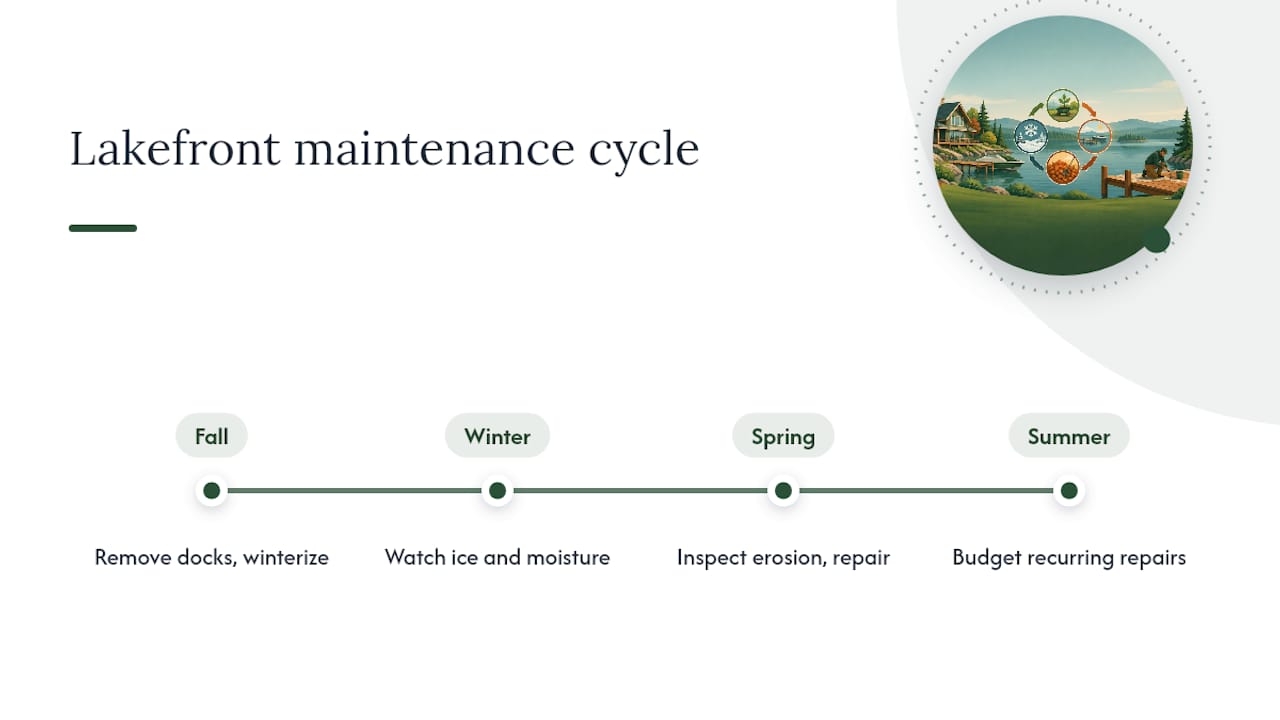
Lakefront homes in Maine carry maintenance demands that inland properties simply do not face. Winterizing a seasonal camp means draining water lines, pipes, and often the entire plumbing system before the first hard freeze, and skipping a step can mean a burst pipe discovered the following spring. Docks and boat lifts typically need to come out of the water each fall, both to prevent ice damage and because many municipal ordinances require seasonal structures removed during the off-season.
Erosion along the shoreline is an ongoing concern, particularly on sandy or lightly vegetated banks exposed to wave action from wind or boat traffic. The buffer strip rules that limit vegetation removal exist partly to control this, since root systems hold soil in place far better than lawn does. A property with visible bank erosion may need a permitted stabilization project, and that work falls under the same shoreland permitting process as any other shoreline alteration.
Roofs, siding, and foundations near water also face more moisture exposure than a typical inland home, which shortens the practical lifespan of some materials. Ice dams are common on camps with older or minimal insulation, and heaving from freeze-thaw cycles affects docks, retaining walls, and any structure built close to the waterline. Buyers should budget for these recurring costs rather than treating them as one-time repairs, since a lakefront property’s maintenance calendar runs on a different schedule than a standard suburban home.
Wildlife and conservation issues that shape lakefront living
Living on a Maine lake means sharing the shoreline with an active ecosystem, and that reality affects both daily life and what you can legally do to the land. Loons, eagles, herons, and other nesting birds use undisturbed shoreline vegetation, which is part of why the buffer strip rules restrict clearing in the first place. Beavers, muskrats, and other wildlife can also affect water levels and shoreline structures in ways a buyer should ask a local agent or code officer about before assuming a dock placement will stay put.
Invasive aquatic plants such as milfoil have become a management issue on a number of Maine lakes, and some lake associations run boat-inspection programs at public launches to slow their spread. A lake with an active invasive species problem may carry higher association dues or usage restrictions tied to that management effort, so ask whether the lake has a local lake association and what it currently manages.

Conservation easements are also common on Maine lakefront parcels, sometimes covering a portion of the shoreline or the entire lot. An easement can permanently restrict development rights even though it does not always show up clearly in a basic listing description, which is another reason to review the deed and any recorded restrictions during title work rather than after closing.
How a changing climate affects lake levels and value
Lake levels in Maine fluctuate with seasonal precipitation and, on many lakes, with dam or water-control structure management rather than climate alone. Buyers evaluating a shoreline lot should still ask how the specific lake’s water level has behaved over recent years, since a lot with a long, gently sloping beach at typical summer levels can look very different during a low-water year or a high-water spring melt.

Insurance costs and flood mapping tend to respond faster than sale prices do when weather patterns shift, so a buyer should treat current flood insurance quotes as a snapshot rather than a fixed number for the life of ownership. Properties on lakes with a documented history of water-level swings may face higher long-term insurance costs or stricter lender requirements over time, even if the current listing price does not yet reflect that.
None of this should replace a direct check of the parcel’s flood zone status and the lake’s own monitoring history described earlier. A buyer who reviews several years of DEP data and asks pointed questions about past high-water events gets a far more useful answer than one relying on general assumptions about a changing climate.
Typical property taxes and fees on Maine lakefront homes
Maine assesses property tax at the municipal level, and waterfront parcels are typically assessed at a premium compared to inland lots in the same town because frontage and lake access carry independent value in the town’s assessment model. The exact rate and assessment method vary by municipality, so ask the town assessor’s office for the current mill rate and how it treats waterfront frontage before finalizing a budget.
Beyond the standard property tax bill, lakefront owners often face additional costs that inland buyers do not budget for. Lake association dues are common where a local association manages invasive species monitoring, water testing, or shared access points, and these fees vary lake by lake. Septic pump-out and inspection costs recur on a schedule set by system size and use, and towns near great ponds sometimes require periodic system certifications tied to shoreland compliance.
Homestead exemptions and other Maine property tax relief programs may apply depending on residency status and how the property is used, so ask the assessor’s office directly rather than assuming a seasonal camp qualifies the same way a primary residence does. Building these recurring costs into your annual budget from the start avoids an unpleasant surprise after the first tax bill arrives.
Why certain Maine lakes carry lasting cultural value
Some Maine lakes carry a weight in the local market that goes beyond water quality or frontage length. Sebago Lake, Moosehead Lake, and Rangeley Lake each have long histories as summer retreats, tied to more than a century of camp culture, sporting traditions, and, in some cases, notable summer residents. That history shapes buyer demand in ways a spreadsheet of comparable sales does not fully capture.
A lake with a strong multi-generational camp tradition often has tighter supply, since families hold properties for decades and listings appear less frequently than on newer or less established lakes. That scarcity itself supports pricing, independent of any single home’s condition or square footage. Buyers drawn to a specific lake for its history or reputation should expect to compete for the limited inventory that does turn over, and should factor patience into the search timeline rather than expecting a quick transaction on a lake with strong name recognition.
What a Maine lakefront REALTOR® actually does for buyers
A lakefront transaction involves more moving pieces than a standard home purchase, and a specialist agent’s job is to run those pieces in parallel rather than sequentially. An experienced agent shapes how he structures a waterfront offer from the first showing.
- Confirming shoreland zoning status and municipal permit rules with the code-enforcement office before you write an offer, not after.
- Coordinating septic and well inspections with qualified local inspectors and interpreting the results in the context of shoreland replacement rules.
- Assembling waterfront-specific comparables and documenting frontage, dock rights, and known restrictions for the appraiser.
- Drafting contingency language that protects you if a municipal ruling, inspection, or appraisal comes back unfavorable.
A specialist who checks zoning, septic, and comparables in parallel, rather than waiting on each step in sequence, can shave real time off a waterfront closing.
— David
Your due-diligence checklist from search to closing
Work through this order once you have a specific parcel in mind, and do not skip ahead to an offer before the early items are confirmed.
- Confirm the listing source, pull the MLS number, and request the parcel’s legal description and tax map from the listing broker.
- Check shoreland zoning district rules and vegetation clearing limits with the municipal code-enforcement office in writing.
- Request septic and well documentation, including design plans, age, and maintenance history.
- Pull the FEMA flood map for the parcel and get a flood insurance quote before removing financing contingencies.
- Confirm any municipal permit requirements or nonconforming structure status in writing before closing.
| Checklist stage | What to confirm |
|---|---|
| Listing validation | MLS number, listing broker, legal description |
| Zoning and vegetation | Shoreland district, buffer rules, permit requirements |
| Utilities | Septic age and reserve area, well test results |
| Flood and insurance | FEMA zone, insurance quote, claim history |
Working with RealtorMaine on your lakefront search
Every check in this guide takes time: a call to the code-enforcement office, a septic inspector’s schedule, a flood insurance quote that takes a day to come back. A local agent can handle multiple calls in parallel while you keep evaluating properties, so a shoreland zoning question does not sit on your desk for a week while another buyer moves faster on the same lot.

An agent working central and southern Maine specifically coordinates with municipal contacts, lake associations, and local inspectors who are familiar with the area, not names pulled from a directory. Whether you are searching for a year-round lake home, a seasonal camp, or a lakefront investment property, that local familiarity tends to move a transaction faster than working with an agent unfamiliar with the specific town’s shoreland ordinance.
If you are ready to start a focused search or want a specific parcel checked against shoreland and septic requirements before you make an offer, visit RealtorMaine’s services page to get started.
Sources
- Shoreland Zoning, Bureau of Land & Water Quality, Maine DEP
- Clearing Vegetation in the Shoreland Zone (Issue Profile), Maine DEP
- Lakes, Monitoring and Assessment-Data Page, Maine DEP
FAQ
What are some of the best lakeside communities in Maine?
Sebago Lake, Moosehead Lake, and Rangeley Lake are among Maine’s most established lakefront communities, each with a long history of summer camps and year-round homes. Central and southern Maine also offer smaller lakes with strong local demand and easier commuting distance to Portland or Bangor.
Which state has the cheapest lakefront property?
Lakefront pricing varies enormously by state and by lake, and no single state holds a fixed rank for affordability. Within Maine, price depends heavily on frontage length, lake reputation, and access, so comparing specific lakes rather than the state as a whole gives a more useful answer.
What is the cheapest coastal town in Maine?
Coastal and lakefront markets in Maine differ significantly, and pricing shifts town by town based on frontage, access, and local demand rather than following one statewide pattern. A local agent can pull current comparable sales for a specific town to answer this accurately for your target area.
Where can I find waterfront cottages in Maine?
Local broker MLS access and statewide lakefront specialty sites are the most reliable sources for current waterfront cottage listings in Maine. National portals can help with browsing, but confirm any listing you find there against the MLS number and listing broker before scheduling a showing.
How do I check if a Maine lake has water quality problems?
Maine DEP’s lake monitoring data tracks long-term trends in transparency, phosphorus, and chlorophyll-a for lakes across the state. Check whether the lake also appears on the Integrated Report’s impaired-waters list, which flags waters not currently meeting their designated uses.