
Eligible first-time buyers in Maine can typically use MaineHousing’s First Home Loan Program, paired with the Advantage grant (commonly $5,000) or the First Generation grant (commonly $10,000) toward a down payment and closing costs. The next move is straightforward: contact a MaineHousing-approved lender for pre-approval and, if grant eligible, enroll in a MaineHousing-approved homebuyer education course.
TL;DR:
- Most first-time buyers in Maine can receive up to $10,000 in combined down payment and closing cost assistance through MaineHousing’s Advantage and First Generation grants, contingent on meeting specific eligibility criteria.
- A credit score around 640 and household income aligning with county-specific limits are typically required, along with completing an 8-hour HUD-approved homebuyer education course, before funds are disbursed.
- Property types eligible include single-family homes, condominiums, manufactured homes, and two-to-four unit properties, with some rural areas offering options to eliminate down payments via USDA loans.
- Pre-approval from an approved lender takes about one to two weeks, and buyers should schedule inspections promptly after an offer to prevent closing delays.
- Working with an experienced MaineHousing agent can streamline the process, ensuring document accuracy and quick coordination with lenders for faster closings.
Table of Contents
- MaineHousing First Home Loan: What It Covers and Who Qualifies
- Down Payment and Closing Cost Assistance: Advantage vs. First Generation
- What Does Homebuyer Education Actually Involve?
- Finding a Lender and Getting Pre-Approved
- A Practical Checklist and Timeline to Closing
- Why Working With an Experienced MaineHousing Agent Matters
- How RealtorMaine Helps First-Time Buyers Navigate These Programs
- Where to Verify Program Details
- Sources
MaineHousing First Home Loan: What It Covers and Who Qualifies
The First Home Loan Program is MaineHousing’s flagship mortgage product, built specifically for people who haven’t owned a primary residence recently. The state defines a first-time buyer as someone who hasn’t held ownership interest in their principal home during the past 3 years. That’s a rolling window, not a lifetime ban. If you owned a home a decade ago and have rented since, you likely still qualify.
There are real exceptions to this rule. Active-duty military members and veterans generally aren’t held to the 3-year restriction at all, as long as they sell any current primary residence by closing. First Generation applicants have their own separate criteria tied to family homeownership history rather than the standard 3-year test.
On the numbers side, lenders commonly look for a credit score around 640, with monthly housing payments landing near 30 to 33 percent of gross household income. Income and purchase-price limits shift depending on household size and which county or town you’re buying in, so a number that works in Aroostook County won’t necessarily apply in Cumberland County. An approved lender can run your specific numbers in minutes.
Property type flexibility is one of the program’s underrated strengths:
- Single-family homes
- Two-to-four unit properties (you can live in one unit and rent the others)
- Condominiums
- Qualifying manufactured homes on owned or leased land
Because down payments can run low, many First Home Loans layer in FHA, VA, or USDA Rural Development guarantees, or require private mortgage insurance, depending on how much you put down and which loan type your lender pairs with the state program. USDA Rural Development financing is worth asking about if you’re looking outside Maine’s denser corridors, since it can eliminate the down payment requirement entirely in eligible rural areas.
Down Payment and Closing Cost Assistance: Advantage vs. First Generation
Coming up with cash for closing is usually the biggest obstacle for Maine buyers, and this is where MaineHousing’s two grant programs earn their keep.
Advantage provides down payment and closing cost help, commonly $5,000, layered on top of a First Home Loan. It requires completion of the state’s homebuyer education course and generally works for any qualifying first-time buyer who meets income and credit guidelines.
First Generation goes further: a $10,000 grant aimed at buyers whose parents never owned a home, or who meet specific foster-care related criteria. It carries stricter documentation requirements than Advantage, and in some cases pairs with a modest interest-rate benefit on the underlying loan.
Between the two programs, a buyer combining a First Home Loan with First Generation assistance could see up to $10,000 applied directly toward upfront costs, according to MaineHousing’s own FAQ page.
A few practical distinctions matter here:
- Both grants require the required homebuyer education course before funds are applied.
- First Generation typically demands more documentation to verify family homeownership history.
- Grant funds are applied directly at the closing table by your lender, not reimbursed after the fact.
Grant amounts and local add-on programs change periodically, so confirm current figures with your lender or directly through MaineHousing’s program page before you build your budget around a specific number.
What Does Homebuyer Education Actually Involve?
MaineHousing ties grant eligibility to a specific requirement: completing an 8-hour, HUD-approved homebuyer education course, most commonly through Maine hoMEworks. Skip this step and Advantage or First Generation funds simply won’t release at closing.
Here’s how the sequence typically works:
- Register for a hoMEworks class, offered both in person and online through participating agencies statewide.
- Complete coursework covering budgeting, mortgage mechanics, how to spot predatory lending, and what actually happens during closing.
- For First Generation applicants, complete any additional financial literacy component before the standard 8-hour course, per program sequencing.
- Receive a completion certificate, which your lender submits as part of your loan file.
Time this around your house-hunting timeline. Many buyers complete the course before they’ve even found a property, since it doesn’t require a signed contract to enroll. MaineHousing frames this requirement as more than paperwork. It’s meant to help buyers avoid predatory lending and manage debt before they’re locked into a 30-year commitment, not just check a box.
Finding a Lender and Getting Pre-Approved
MaineHousing loans only come through participating approved lenders, so your first real step is finding one who actively closes these loans, not just one who’s heard of the program.
Pre-qualification and pre-approval sound similar but aren’t. Pre-qualification is a quick, informal estimate based on what you tell a lender. Pre-approval means the lender has verified your income, credit, and assets, and it’s what sellers and program administrators actually take seriously. Understanding this difference early saves buyers from disappointment mid-negotiation.
Expect to gather:
- Government-issued ID
- Recent pay stubs and W-2s or tax returns
- Two to three months of bank statements
- Documentation of any other debts or assets
Realistically, pre-approval takes one to two weeks once documents are submitted. Delays usually trace back to missing bank statements or undisclosed debts surfacing during underwriting, so get organized before you apply rather than during it.
A Practical Checklist and Timeline to Closing
A typical MaineHousing purchase, start to finish, runs roughly two to four months. Here’s the rough order:
- Check credit and complete hoMEworks education (1 to 3 weeks, can overlap with house hunting).
- Get pre-approved with an approved lender (1 to 2 weeks).
- Search for a home and make an offer (timeline varies widely by market).
- Schedule inspections promptly after an accepted offer (within days, not weeks).
- Move through underwriting (2 to 4 weeks).
- Close (typically 30 to 45 days after contract signing).
Pro Tip: Book your home inspection the same week your offer is accepted. Inspection delays are one of the most common reasons closings slip past their target date, and lenders can’t finalize underwriting until repairs or negotiations are resolved.
Why Working With an Experienced MaineHousing Agent Matters
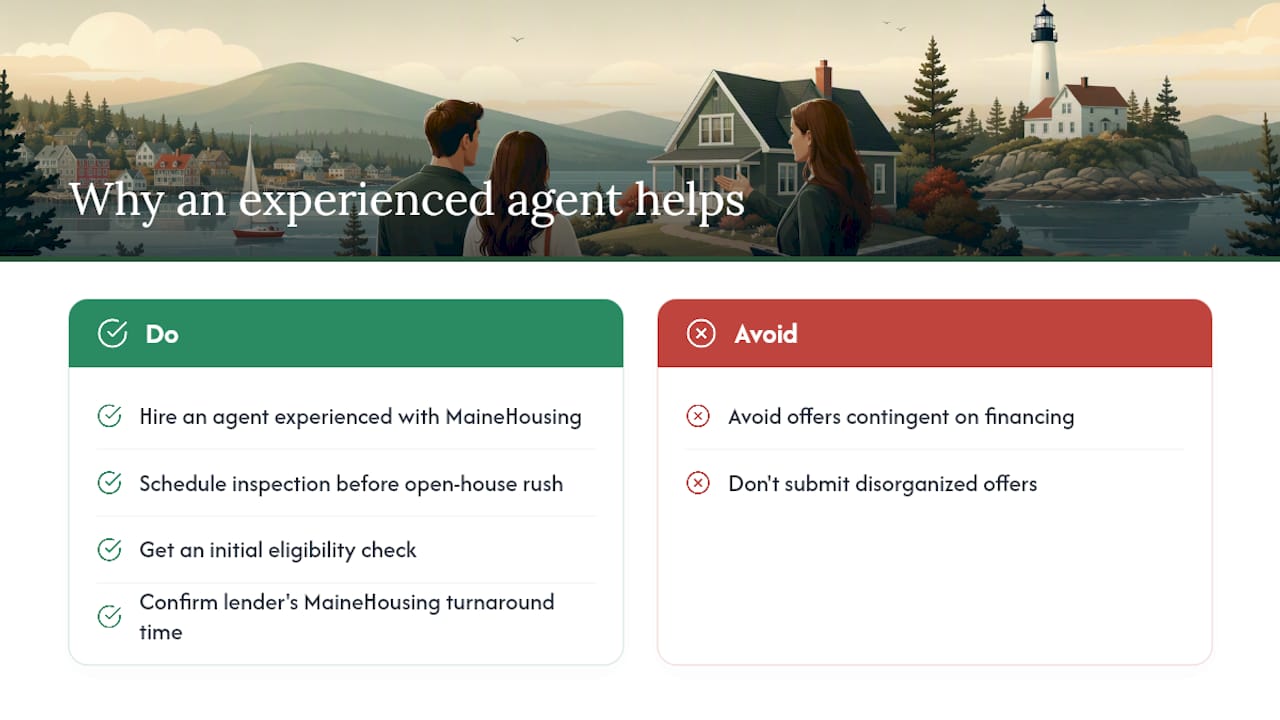
A Realtor who’s closed multiple MaineHousing-financed deals in the past year, often called a First Home Finder, knows which documents each approved lender actually wants first, and which underwriting questions tend to stall a file. That familiarity shortens the gap between offer and closing.
Two things I tell every first-time buyer: schedule your inspection before your first weekend open house rush hits, and never write an offer contingent on financing without confirming your lender’s specific MaineHousing turnaround time first. Local sellers notice when an offer looks organized. If you want a quick read on where you stand, reach out for an initial eligibility check.
— David
How RealtorMaine Helps First-Time Buyers Navigate These Programs
RealtorMaine is the local alternative to figuring out MaineHousing paperwork alone: instead of piecing together lender referrals and grant rules from scattered PDFs, you get one point of contact who’s coordinated First Home Loan closings before and knows which approved lenders move fastest on Advantage and First Generation files.

David Haydym works directly with first-time buyers across central and southern Maine, from an initial eligibility check through lender introductions and paperwork coordination all the way to closing day. If you’re wondering whether you qualify for First Generation, whether a condo you’re eyeing fits MaineHousing’s property rules, or simply want a second set of eyes before you sign anything, schedule a consultation with RealtorMaine and get a straight answer on where you stand.
Where to Verify Program Details
Confirm current limits and lender lists directly: First Home Loan Program, Maine hoMEworks for classes, and HUD’s Maine page for federal context.