
Neither source is universally better. Public water gives you regulated oversight, published testing, and no maintenance burden; a private well gives you independence and often lower long-term costs, but the safety job falls entirely on you. The right call depends on your budget, your appetite for hands-on maintenance, and what’s actually in the ground where you’re buying. Before signing anything, get the well tested or pull the seller’s Consumer Confidence Report.
TL;DR:
- Private wells more often contain potential contaminants like arsenic, radon, and nitrates, which require regular testing and monitoring.
- Public water systems are regulated and tested annually, but can still have issues such as lead from old pipes or disinfection byproducts.
- The upfront cost of drilling a well can exceed ten thousand dollars, while public hookup fees and ongoing bills typically range from $500 to $1,500 annually.
- Well owners must perform routine tests at least once a year for bacteria and nitrates, and every few years for arsenic and radon, to ensure water safety.
- Buyers should request recent well testing results, verify the well’s flow capacity, and include water-testing contingencies in their purchase to avoid surprises.
Table of Contents
- Well Vs Public Water: A Side-By-Side Look
- Well Water: Pros, Cons, and What You’re Signing Up For
- Public Water: Pros, Cons, and How to Verify It
- What Does Well Vs City Water Actually Cost Over Time?
- What Should You Test For and How Often?
- How Do Outages and Emergencies Compare?
- Does Water Source Affect Resale Value and Insurance?
- What Should Buyers and Owners Actually Check Before Deciding?
- A Realtor’s View on Well Vs City Water in Real Deals
- How RealtorMaine Helps You Navigate Water Questions During a Sale
- Where to Verify Water Quality Facts Yourself
- Sources
Well Vs Public Water: A Side-By-Side Look
The core difference comes down to who’s watching the water. Municipal systems serving 25 or more people fall under the federal Safe Drinking Water Act, which forces utilities to meet EPA Maximum Contaminant Levels and publish results every year. Private wells sit entirely outside that system. Nobody is checking your water unless you check it yourself.
That gap shows up in the kinds of problems each source tends to have. Wells more often carry naturally occurring issues tied to local geology, like arsenic, uranium, radon, and hard water from dissolved minerals, plus whatever runs off nearby farms or septic systems. Public water’s issues run differently: chlorine or chloramine taste, disinfection byproducts formed during treatment, and occasionally lead picked up from old service lines on the way to your tap, all of which utilities are required to monitor and report.
Here’s how the two stack up on the factors that matter most to a buyer or owner:
- Oversight: public systems are regulated and audited; wells are not, full stop.
- Typical annual cost: wells run roughly $200 to $500 for testing and upkeep; combined public water and sewer bills typically land between $500 and $1,500 depending on location.
- Contaminant profile: wells skew toward arsenic, nitrates, and radon; public water skews toward disinfection byproducts and aging-infrastructure issues.
- Reliability: wells depend on electricity to run the pump; public systems depend on mains and treatment plants that usually have backup power.
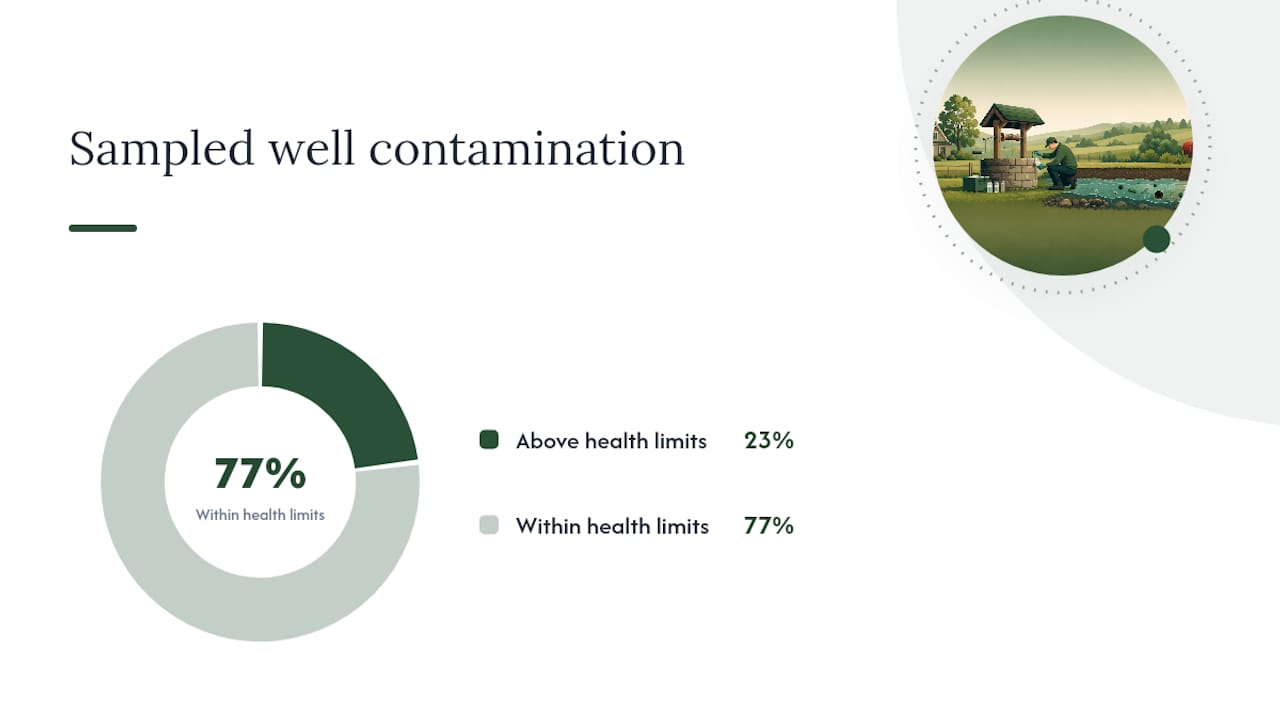
Roughly 43 million Americans get their water from a private well, and USGS testing has found that about 23% of sampled wells contained at least one contaminant above health-based safety limits. That’s not a reason to panic if you’re buying a home with a well. It’s a reason to test it before you close, not after.
Well Water: Pros, Cons, and What You’re Signing Up For
A well pulls water from an underground aquifer, and what’s in that water depends heavily on the rock and soil it passed through. Granite bedrock areas tend toward higher arsenic and radon; agricultural areas raise nitrate risk; older properties near old orchards or industrial sites carry their own baggage.
Owning a well means owning the testing schedule too:
- Every year: test for coliform bacteria and nitrate, per CDC guidance for private well owners.
- Every 3 to 5 years: run a broader panel covering arsenic, radon, and hardness.
- Immediately after: flooding, nearby construction, or any change in taste, smell, or color.
Routine maintenance covers pump checks, the pressure tank, the well cap, and the sanitary seal, usually a few hundred dollars a year unless a pump fails, which can run into the thousands.
Pro Tip: If your well sits near a military base, landfill, or industrial corridor, order a PFAS or VOC panel specifically. Groundwater plumes from these sites don’t always show up in a standard test.
Public Water: Pros, Cons, and How to Verify It
Municipal water gets treated, tested, and reported on your behalf. Every year, the utility publishes a Consumer Confidence Report showing what it found and whether it stayed under EPA Maximum Contaminant Levels for dozens of regulated substances.
That doesn’t mean city water is flawless. Common gripes include:
- Chlorine or chloramine taste, especially right after treatment.
- Disinfection byproducts like THMs and HAAs, formed as a side effect of keeping the water sanitized.
- Lead leaching from old service lines, particularly in homes built before the 1980s.
- Trace PFAS detections, which regulators are still catching up to with proposed limits.
Read your CCR before you worry, and if the home is older, request a first-draw lead test specifically since standard panels can miss it. Many owners layer on point-of-use treatment anyway: activated carbon filters for taste, a softener for hardness, or reverse osmosis under the kitchen sink for extra peace of mind.
What Does Well Vs City Water Actually Cost Over Time?
Upfront, drilling and installing a new well commonly runs several thousand dollars to well over $10,000 depending on depth and geology. Connecting to a municipal line involves a tap-in fee that varies widely by town, plus whatever it costs to trench a line to the street.
Ongoing costs split differently:
- Well: electricity for the pump, annual testing ($200 to $500), occasional treatment equipment, and eventually a pump or pressure tank replacement.
- Public water: a combined water and sewer bill, typically $500 to $1,500 a year, with no testing costs since the utility handles that.
- Catastrophic risk: a full well replacement can run $10,000 or more; spread over a 20 to 30 year well lifespan, that’s a modest annual reserve worth building into your budget.
If you’re buying a home with an older well, negotiate a credit or repair contingency rather than assuming the cost yourself.
What Should You Test For and How Often?
Start with the basics and expand based on what your area is known for. Bacteria and nitrate get tested annually; arsenic, radon, and PFAS deserve a baseline test at least once, then a repeat every few years or after any red flag.
- Collect a first-draw sample for lead (water that’s sat in the pipe overnight) and a flushed sample for general quality.
- Send samples to a state-certified lab, not a big-box store test kit, for anything beyond a basic bacteria check.
- Layer treatment based on results: sediment filter first, then iron removal, a softener for hardness, UV for bacterial control, and reverse osmosis last for anything RO catches that earlier stages miss.
- Call a licensed well contractor for pump, casing, or pressure tank issues. DIY fixes on the water itself, like adding a filter, are fine; DIY fixes on the mechanical system usually aren’t.
Pro Tip: Ask the lab specifically whether their nitrate and arsenic tests meet your state’s certification standard. Some cheaper mail-in kits don’t, and a lender may not accept the results.
How Do Outages and Emergencies Compare?
A well pump needs electricity, so a power outage means no water at all unless you’ve got a generator or battery backup. Public water systems can suffer main breaks or contamination events that trigger boil-water advisories, but treatment plants typically run on backup power, so outages tend to be localized and shorter.
Either way, keep a few practical steps in mind:
- Store at least a few gallons of drinking water per person for emergencies.
- If you’re on a well, consider a small generator sized to run the pump.
- If a boil-water advisory hits, boil tap water for at least one minute before drinking or cooking with it.
Does Water Source Affect Resale Value and Insurance?
Buyers evaluating a well property commonly ask for a flow test, recent lab results, and the well log showing depth and pump age. Sellers who can hand over clean, dated paperwork tend to face fewer objections at the negotiating table.
- Homeowners insurance rarely changes based on well versus public water directly, but proximity to a fire hydrant on municipal systems can affect fire-coverage premiums.
- A well with documented annual testing and a recent pump inspection reads as low risk to a buyer’s agent and appraiser alike.
- Pairing water documentation with other maintenance records that boost resale value gives buyers one less reason to negotiate down.
What Should Buyers and Owners Actually Check Before Deciding?
Whether you’re buying or already own the property, work through this in order:
- Request the seller’s most recent lab results for bacteria, nitrate, and any regional contaminant of concern.
- Ask for a flow and pressure test to confirm the well can supply the household’s actual demand.
- Add a water-quality contingency to your purchase offer so results come back before you’re locked in.
- Set a testing calendar the day you close: annual bacteria and nitrate, broader panels every few years.
- Budget for a pump replacement over the life of ownership rather than treating it as a surprise expense.
As a rough heuristic: if treatment or remediation costs on a well start rivaling what a municipal connection would cost, connecting to public water usually wins, especially if resale to buyers who prefer city water matters to you.
Pro Tip: Keep every lab report and maintenance receipt in one folder from day one. When you sell, that folder does more to reassure a buyer than any verbal assurance ever will.
A Realtor’s View on Well Vs City Water in Real Deals
In experience closing homes, water questions often cause more deal delays than many other inspection items. Rural listings with older wells and no recent test results make buyers nervous, and rightly so.
Three things I push every buyer to do: request lab results before the inspection deadline, get a flow test if the well is more than 15 years old, and negotiate a credit rather than walking away over a fixable issue. Sellers who test proactively close faster.
— David
How RealtorMaine Helps You Navigate Water Questions During a Sale
Buying or selling a home with a private well adds a layer most buyers haven’t dealt with before, and it’s easy to either overreact to a single test result or overlook something that matters. You can get a local advantage through working with an experienced agent who knows how well and water issues affect closings and can help coordinate with local labs and contractors to get answers promptly.

An experienced agent can advise on certified local labs, responsive contractors, and how to write effective water-quality contingencies to protect your interests. That’s the kind of detail that keeps a good house from turning into a bad surprise. If you’re evaluating a property with a well, or trying to negotiate repairs on one, reach out through RealtorMaine and get a straight answer before you’re locked into a contract.
Where to Verify Water Quality Facts Yourself
- CDC guidance on private wells covers testing and disinfection after emergencies.
- EPA’s private well and PFAS resource lists emerging contaminants to watch.
- EPA Consumer Confidence Reports explain how to read your utility’s annual water report.
This article is general information, not a substitute for advice from a qualified doctor. Consult a qualified healthcare professional about your own circumstances before acting on anything here.
Sources
- CDC — Private Wells and Safe Drinking Water
- EPA/State fact sheet comparing private well and public water (New Hampshire example)
- EPA — Drinking water regulations
- USGS — Domestic private supply wells