
If you are a senior selling a longtime home in Maine, the process comes down to five things: decide your timeline, price the house for its condition, complete the state’s seller disclosure, understand the tax and benefits rules, and line up your next place before you close. Each step is manageable when you take it in order. This guide walks through all five with the official Maine and federal rules that apply.
TL;DR
- Maine sellers of one- to four-unit homes must deliver the property disclosure statement no later than when an offer is made. If it arrives late, the buyer gets 72 hours to walk away.
- The IRS lets many sellers exclude up to $250,000 of gain from income, or $500,000 for a married couple filing jointly, if they meet the ownership and residence tests.
- Selling at fair market value is different from giving a home away. Transfers for less than market value can affect MaineCare eligibility, so talk to an elder law attorney first.
- Start decluttering and downsizing about 8 to 12 weeks before you list, and match your closing date to your move.
- Price from recent comparable sales and the home’s real condition, not from what you hope to net.
Table of Contents
- Before you decide to sell
- Set a timeline that fits your move
- Prepare the house without overspending
- Price the home for its condition
- Maine seller disclosure: what you must hand over
- Offers, contingencies and closing
- Taxes when a senior sells a Maine home
- Protect your MaineCare options
- Coordinating the sale with a move to senior living
- Our perspective
- Talk to us about your sale
- FAQ
- Sources
Before you decide to sell
Most seniors who call a Realtor about selling are not asking “how much is my house worth?” first. They are asking whether it is time. A few questions help:
- Can you manage the house? Stairs, snow removal, a wood stove, a long driveway and a well or septic system all take effort that grows with age.
- Where would you go? A condo, a single-level home, a family member’s home, a 55+ community or assisted living each has a different timeline and cost.
- What do the carrying costs look like? Property taxes, heating oil, insurance and repairs add up. Maine’s homestead exemption currently reduces assessed value by $25,000 for owners who have had a Maine primary residence for 12 months before the preceding April 1. Our own notes on Maine property taxes and the homestead exemption explain how it works in practice.
If you are weighing a move, our guide to seniors downsizing in Maine covers selling, moving and staying put side by side.
Set a timeline that fits your move
The sale and the move are two projects that have to end on the same day. Work backward from where you are going.
- 12 weeks out: Choose your next home or community and ask about its move-in date. Senior communities often have their own availability windows.
- 8 to 12 weeks out: Begin sorting rooms. A senior downsizing checklist that goes room by room helps you decide what moves, what goes to family, what gets donated and what gets hauled away.
- 4 to 6 weeks out: Make repairs, stage, photograph and set the list price.
- List and negotiate: Choose a closing date that leaves you a few days of cushion after the move.
- Closing: Maine closings are handled by an attorney, so confirm early who will represent you.
A financed sale commonly takes 30 to 90 days from accepted offer to closing, so build in room rather than promising a family member a fixed date.
Prepare the house without overspending
Buyers in Maine often shop older homes, and they respond to a clean, cared-for property. You do not need a renovation. Focus on what a buyer’s inspector will notice:
- Roof condition and any past leaks
- The heating system and its service records
- Basement moisture
- Septic and well systems
- Windows and insulation
Declutter and take down family photos so buyers can picture their own lives there. Small cosmetic fixes make a visible difference, and our Maine home staging guide lays out $200 to $500 fixes and how staging costs can be handled at closing.
Gather paperwork now: service records for the furnace, septic pumping receipts, well water test results, warranties and any permits. The same documents feed your disclosure statement, which saves you time later.
Price the home for its condition
The strongest listing price comes from a comparative market analysis (CMA): recent sales of similar homes nearby, usually from the past 60 to 90 days, adjusted for size, updates and condition. Pricing on emotion, or on what you need to afford the next place, tends to cost you time on the market.
Condition matters. The Maine Association of Realtors’ 2026 president has said that homes priced appropriately for their condition are drawing attention and selling. For a house with deferred maintenance, that means pricing honestly instead of listing high and cutting later.
When we prepare a CMA, we walk through it with you line by line so you know why each comparable was chosen. If you receive more than one offer, our piece on multiple offers in Maine explains how to compare them beyond the top-line price.
Maine seller disclosure: what you must hand over
Maine law requires sellers of residential property with one to four dwelling units to complete a disclosure statement. According to the Maine Attorney General’s consumer page, it covers:
- Water supply
- Heating system
- Waste disposal (septic or sewer)
- Hazardous materials such as asbestos, lead paint and radon
- Whether the home is in a flood hazard area or had flood events during your ownership
- Shoreland zoning legal proceedings
- Any other defects you know about
Timing is the part sellers get wrong. Under 33 M.R.S. §174, you must deliver the statement no later than the time the buyer makes an offer. If it comes after, the buyer may terminate the contract or withdraw the offer within 72 hours of receiving it, with any deposit returned. The simple fix is to complete the form before you list and have it ready for every showing. Our walkthrough, mapping your Maine disclosures to Title 33, goes through each line.
Lead paint and radon
If your home was built before 1978, federal rules add a lead-based paint disclosure and a pamphlet for the buyer, plus a 10-day window for the buyer to inspect for lead. Our guide to Maine lead paint rules and 10-day inspection rights covers the details. Radon is another common inspection item in Maine, and testing early can prevent a delay at the closing table. See how radon affects Maine closings.
Offers, contingencies and closing
A few rules from the Maine Real Estate Commission’s Offers and Counteroffers Guidelines, approved in May 2026, are worth knowing as a seller:
- Offers and counteroffers should be in writing.
- You, not the agent, decide whether to accept or reject an offer.
- A full-price offer does not obligate you to accept it.
- Agents are not attorneys and should send you to legal counsel for legal questions.
After you accept, inspection, financing and appraisal contingencies commonly run 7 to 14 days. Expect the buyer’s inspector, possibly an appraiser, and requests for repairs or credits. You can agree, counter or decline. A Realtor who knows local inspectors and typical Maine findings can help you respond without panicking over every item.
At closing you sign the deed and settlement documents, the attorney confirms funds, records the deed and pays out the proceeds, including any mortgage payoff.
Taxes when a senior sells a Maine home
The federal home-sale exclusion
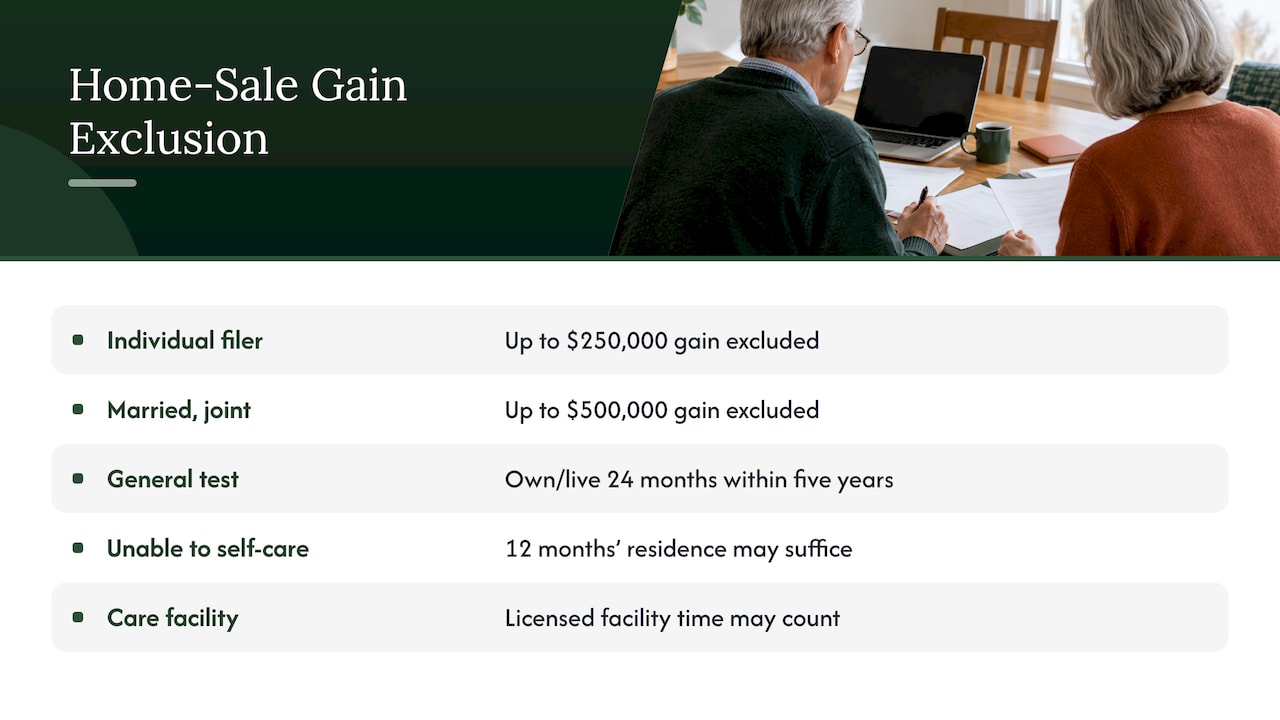
Per IRS Publication 523, if you meet certain conditions you may exclude up to $250,000 of gain from the sale of your main home, or up to $500,000 if you are married and file jointly. Generally you must have owned and lived in the home for at least 24 months during the five years before the sale. These months do not need to be consecutive.
Two points matter for seniors in particular. If you become physically or mentally unable to care for yourself, 12 months of residence may be enough, and time in a licensed care facility can count toward the residence requirement. This helps if you have already moved into assisted living before the house sells. Because the rules have conditions and your basis depends on improvements and purchase history, ask a CPA or tax preparer to run your numbers before you list.
If you are considering a reverse mortgage instead of selling, this explanation of federal tax on reverse mortgage draws can help you compare the two paths.
Maine transfer tax
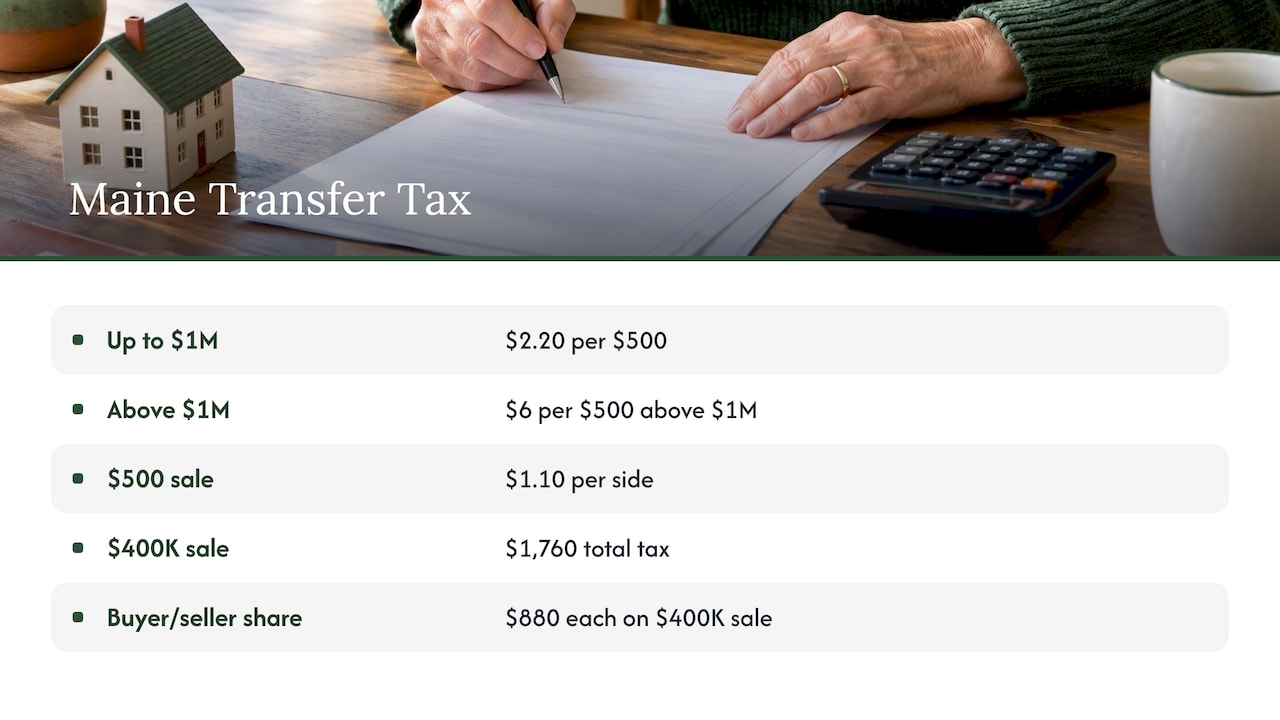
Maine charges a real estate transfer tax, split equally between buyer and seller unless an exemption applies. Since November 1, 2025, the rate is $2.20 per $500 of price for sales up to $1,000,000, and $6 per $500 on the portion above that. The Maine Revenue Service chart shows each half side by side: on a $500 sale, each side pays $1.10.
A quick example: on a $400,000 sale, that is 800 units of $500. The total tax is 800 × $2.20 = $1,760, so your half is $880. Recording fees at the county registry are separate and vary by county, so ask your closing attorney for the current figure.
Protect your MaineCare options
This is the part of senior home selling that deserves the most care. Legal Services for Maine Elders notes that selling your house for less than fair market value may affect MaineCare eligibility, even if the buyer is a family member. Their long-term care guidance explains that MaineCare looks back five years when you apply for nursing care help, and gifts of money or property in that window can create a period of ineligibility.
In practice:
- Selling at fair market value to an unrelated buyer is a normal sale, not a gift.
- If you plan to sell to a relative or give any of the proceeds away, speak to an attorney first.
- Maine residents 60 or older can call the Legal Services for Maine Elders Helpline at 1-800-750-5353 for free legal help.
A Realtor is not an attorney and should not give legal advice here. What we can do is document the market value with a CMA and coordinate with your attorney so the sale is clean.
Coordinating the sale with a move to senior living
The hardest part is rarely the paperwork. It is the overlap between two timelines. These steps help:
- Decide on the type of next home before listing. Single-level condo, 55+ community, independent living or assisted living each has different entrance timing.
- Ask for a flexible closing or a short rent-back. Many buyers will agree to a closing date that suits you, and a few extra days of occupancy can be negotiated in the purchase and sale agreement.
- Plan the cleanout. Sort in zones, schedule donation pickups, and book hauling help for what is left. For a move into care, a 12-week assisted living downsizing plan shows when to bring in help.
- Keep the house showable. Clear the surfaces and keep a short list of what must stay put during showings.
- Involve family early. Agree who will handle keys, utilities, mail forwarding and the final walk-through.
- Review condo or townhouse documents if you are moving into one. Budgets, fees and rules vary, and we review them with buyers before they commit.
Our perspective
We have spent 20 years helping Maine homeowners sell, and the seniors we work with are rarely in a hurry to leave the house. They are leaving behind decades of memories, and they want to do it once, correctly.
That is why we keep the process transparent and pressure-free. We start with data: a comparative market analysis built on recent local sales, so the price makes sense to you and to buyers. Then we plan the sale around your move, not the other way around.
We also stay reachable beyond standard hours, because questions about a closing date or an inspection request do not wait until Monday morning. Our work covers central and southern Maine, so we know how a lake town differs from a mill town when it comes to buyers and timing.
If a decision touches your taxes or MaineCare, we bring in your attorney or CPA early. Our job is to make the real estate part calm.
David
Talk to us about your sale
If you are thinking about selling a home in central or southern Maine, we can help with a pricing review, a plan for the timeline and a clear view of the paperwork. We handle listing, pricing strategy, negotiation and comparative market analyses for sellers, and we also help with the next purchase if you are staying in Maine.

See how we work on our Selling My Home page, or browse more plain answers in The Maine Real Estate Journal.
FAQ
How long does it take to sell a house in Maine?
Plan on listing time plus roughly 30 to 90 days from accepted offer to closing for a financed sale. Cash sales can be faster. Your own prep time, condition and price all affect how quickly an offer arrives.
Do I owe tax when I sell my Maine home as a senior?
Often not on the gain, if you qualify for the IRS exclusion of up to $250,000, or $500,000 for married couples filing jointly. You still pay your half of Maine’s transfer tax. A tax professional can confirm your situation.
Will selling my home affect MaineCare?
Selling at fair market value is not the concern. Selling below market value, or giving away money or property, can trigger a five-year lookback penalty. Call the Legal Services for Maine Elders Helpline at 1-800-750-5353 or an elder law attorney before you transfer anything to family.
What must I disclose when selling?
You must complete Maine’s property disclosure statement covering water, heating, waste disposal, hazardous materials, flood history, shoreland zoning proceedings and known defects. Deliver it no later than when the buyer makes an offer to avoid the 72-hour exit right.
Sources
- Maine Attorney General: Buying a Home
- 33 M.R.S. §174, Maine Legislature
- Maine Real Estate Commission Offers and Counteroffers Guidelines
- IRS Publication 523, Selling Your Home
- Maine Registry of Deeds Association fees
- Maine Revenue Service real estate transfer tax chart
- Legal Services for Maine Elders: Transferring Title to Your Home
- Legal Services for Maine Elders: Getting Help Paying for Long Term Care
- The County: Presque Isle taxpayer information
- iBuyer: Selling a House in Maine
- Propcash: Selling an Old Maine House As-Is