
A full-service Realtor handles your transaction from the first conversation to the closing table: pricing, marketing, showings, negotiation, paperwork and coordination with everyone else involved. You are not left to manage pieces yourself. In return, the agent is paid under a written agreement, and the amount is negotiable. Below is what the work includes, how it differs from limited-service options, and how to judge whether it fits your situation.
TL;DR
- Full service means the agent is responsible for the traditional brokerage tasks: marketing, MLS entry and upkeep, negotiation and managing the deal to closing.
- Limited-service and flat-fee options hand some of those jobs, such as showings or negotiation support, back to you.
- Agent compensation is negotiable and not set by law. Get the terms in writing before you sign.
- Buyers now sign a written representation agreement before touring homes, so ask what it covers.
- Choose on communication, local knowledge and availability as much as on price.
Table of Contents
- What “full service” actually means
- What a full-service Realtor does for sellers
- What a full-service Realtor does for buyers
- Full service versus limited service and flat fee
- How full-service agents get paid
- How to decide if full service fits you
- Our perspective
- Working with us
- FAQ
- Sources
What “full service” actually means
The term has a practical definition in the MLS world. connectMLS describes “Full Service” as the broker being responsible for providing the seller all traditional brokerage services, including marketing, MLS input and maintenance, and negotiations. That is the baseline. Everything else in this article is detail about what that looks like in a real sale or purchase.
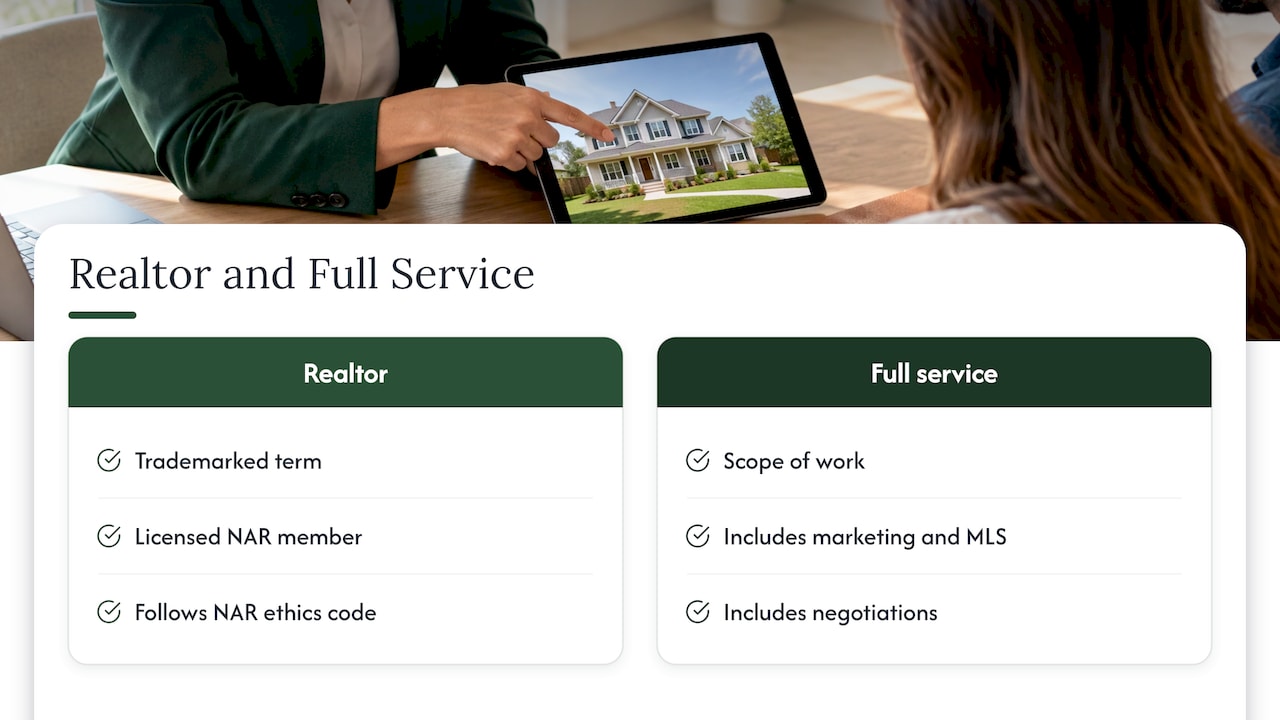
Two things are worth separating. “Realtor” is a trademarked term for a licensed agent who belongs to the National Association of REALTORS® and follows its code of ethics. “Full service” describes the scope of work, not the title. You can hire a Realtor on a limited-service basis, and you can hire a full-service agent who is not a member. When you search, you are really looking for an agent who will own the whole process and answer your calls while doing it.
For most people, the appeal is simple. A home sale or purchase is the largest financial transaction of their lives, involves dozens of deadlines and documents, and punishes small mistakes. Full service puts one licensed professional in charge of keeping all of it moving.
What a full-service Realtor does for sellers
For a seller, the work starts well before the sign goes in the yard and continues after you accept an offer.
Before the listing
- Pricing. The agent prepares a comparative market analysis, looking at recent sales, active competition and how fast similar homes are moving, then recommends a list price and explains the reasoning. Our guide to pricing a home in Maine shows why a single automated estimate is only a starting point.
- Preparation advice. A good agent tells you which repairs and presentation changes are worth the money and which are not. In Maine, simple fixes and staging that costs a few hundred dollars can change how a home shows.
- Marketing. Photography, the listing description, MLS entry, online exposure and open houses or private showings are the agent’s job to plan and carry out.
While the home is on the market
- Scheduling and hosting showings, and following up with buyers’ agents for feedback.
- Reviewing every offer with you, including price, contingencies, financing type, deposit and closing timeline.
- Negotiating counteroffers. In competitive markets this is where experience counts most, as we explain in our piece on multiple offers in Maine.
From accepted offer to closing
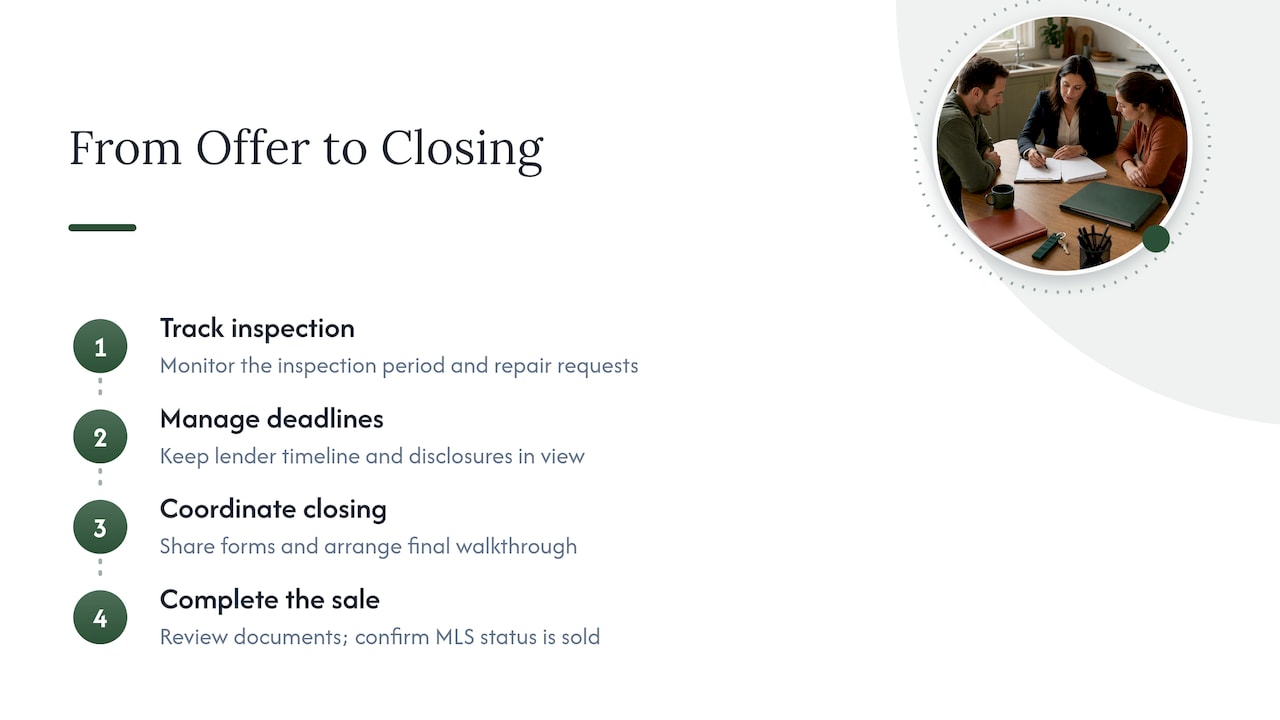
This stretch is where full service earns its keep, and it is the least visible part. The Newport Beach Association of REALTORS® lists seller-side closing duties such as coordinating closing with the buyer’s agent and lender, making sure all parties have the forms and information they need, coordinating the buyer’s final walkthrough, reviewing closing documents and confirming the MLS status changes to sold.
In practice that means tracking the inspection period, responding to repair requests, keeping the lender’s timeline in view and making sure disclosures are complete. In Maine, lead paint rules and the 10-day inspection window are a good example of a deadline a seller’s agent should have on the calendar from day one.
Some sales also raise legal questions that go beyond the agent’s role, such as title issues, estate matters or unusual contract terms. A full-service agent will tell you when it is time to bring in a lawyer, and real estate law guidance is the kind of support that can sit alongside the agent’s work on those files. If you are weighing a title company against an attorney for closing, our list of five questions to vet either one is a practical place to start.
What a full-service Realtor does for buyers
Buyer representation follows the same arc, pointed the other way.
- Planning and financing. Before touring, the agent helps you understand your budget and the loan types that may fit, such as FHA and conventional. You will want a lender conversation early.
- Search. The agent sets up alerts, screens listings against your needs, and tells you what the listing photos do not show.
- Showings. They schedule and attend tours with you, pointing out issues with the property, the street and the neighborhood.
- Offer strategy. The agent pulls comparable sales, advises on price, contingencies and escalation, and writes the offer.
- Due diligence. They coordinate inspections, negotiate repairs or credits, and track every deadline.
- Closing. They review settlement figures with you, check that the numbers match what was promised and attend to the final walkthrough.
For condos and townhouses, there is an extra layer. The association’s documents, budget and fees matter as much as the unit itself. Our guides to HOA fees in Maine and the condo resale certificate rule explain what to review and when. Closing costs are another place buyers want a guide, and the Maine closing costs breakdown walks through typical figures for both sides. One document buyers often misread is the closing disclosure, and the difference between owner’s and lender’s title insurance is a good example.
If this is your first purchase, the agent’s explanations matter as much as their actions. Our guide on choosing a first-time buyer Realtor covers what to look for.
Full service versus limited service and flat fee
The alternatives are real, and understanding them helps you see what full service includes.
The National Association of REALTORS® explains in its consumer guide to listing agreements that a limited-service agreement may provide a limited set of services, such as publicly marketing a home on an MLS, and may not include arranging showings, input on purchase offers or negotiation support. connectMLS gives a similar example: a seller handles showings while the agent takes part in negotiations for them.
| Task | Full service | Limited service or flat fee |
|---|---|---|
| Pricing advice | Included | Varies by agreement |
| MLS listing | Included | Usually included |
| Arranging showings | Agent handles | Often left to the seller |
| Reviewing and negotiating offers | Agent handles | May be limited or left out |
| Closing coordination | Agent handles | Depends on the agreement |
| Your time commitment | Lower | Higher |
What matters is the written scope. Whatever the agreement leaves out becomes your job. That can include preparing the house itself: clearing out a garage, basement or attic before photos is a common example, and a guide on junk removal for show-ready listings shows how much of that prep sellers can face when the agent’s role is narrow. With full service, your agent plans that preparation with you and lines up the right people.
The trade-off is simple. A limited arrangement asks you to take on more tasks and more risk. Full service asks you to rely on one professional to carry them. Which is right depends on your time, your experience and how complicated your sale or purchase is. For a home with an unusual feature, a tight timeline, a relocation from out of state or a competitive market, most people prefer having an agent responsible for everything.
How full-service agents get paid
Agents usually earn a commission when the transaction closes. The amount and who pays it are negotiable. The NAR consumer guide says a listing agreement lays out the services the agent will provide and what they will be paid, and that compensation is fully negotiable and not set by law. The North Carolina Real Estate Commission makes the same point in its consumer Q&A: there is no standard agent fee, and the buyer agency agreement should state the arrangement clearly.
What changed for buyers
For decades, the seller paid commissions for both agents. CNN Business reported that when the NAR settlement rules took effect in August 2024, sellers’ agents could no longer advertise commission offers to buyers’ agents on MLSs, and buyers had to sign a legally binding representation agreement before touring homes.
The practical result is that every buyer should read the agreement before the first showing. The NCREC document notes that buyer-agent compensation may be sought first from the seller or listing firm, and that the buyer could be responsible if that is refused. Rules differ by state and brokerage, so ask your agent to walk you through the exact terms.
What to check in the agreement
- Scope. Which services are included, from search to closing.
- Compensation. How much, how it is calculated and who pays it.
- Term. How long the agreement lasts.
- Ending it. What happens if the relationship is not working.
- What is left to you. Any task the agent does not cover.
Ask for plain answers. A transparent agent will explain each line without pressure.
How to decide if full service fits you
Full service tends to fit best when:
- You are a first-time buyer and want guidance through unfamiliar steps.
- You are relocating and cannot be at showings, inspections or meetings.
- You are selling a home that needs positioning, such as an older property or one with deferred maintenance.
- You are downsizing and want someone to coordinate timing between selling and moving.
- You are buying an investment or vacation property where local rules, seasonality and rental potential affect the numbers.
- The market is competitive and negotiation skill affects the outcome.
If you have done many transactions, have time and want to handle tasks yourself, a narrower arrangement may suit you. Be honest about your own bandwidth.
Questions to ask any agent you interview
- How many clients are you working with right now, and who covers when you are unavailable?
- How will we communicate, how often, and how fast do you reply to urgent questions?
- How many homes have you sold in my town or price range?
- How do you set a price, and what data do you use?
- What is included in your agreement, and what is left to me?
- Can I speak to recent clients?
Communication matters more than most people expect. Selling guides from national companies, such as this one on questions to ask before you sell, put frequency, preferred update method and response time on the list for good reason: the long gaps between offer and closing are when silence feels worst.
Our perspective
We have spent 20 years working Maine’s central and southern markets, and one thing has not changed: people do not want to be sold to, they want to be understood. Full service, to us, means being the one person who knows your whole picture.
That starts with a transparent process. We explain the numbers, show the data behind a price and tell you the options without pressure. Our goal is for you to make the decision, with the facts in front of you.
It also means being reachable. Real estate does not keep office hours. Offers arrive at night and lenders call on weekends, so we make ourselves available beyond standard hours to keep communication timely.
Local knowledge is the rest. Central Maine communities, coastal towns and southern Maine each behave differently, and a data-driven strategy only works when someone who knows the streets reads the data. That is how we approach pricing and negotiation for buyers, sellers, investors, seniors downsizing and families relocating.
David
Working with us
If you are buying or selling in central or southern Maine, we represent buyers and sellers from the first consultation through closing. That includes home search or listing, comparative market analysis, pricing strategy, negotiation and guidance on FHA and conventional financing. We also support first-time buyers, relocating families, investors, seniors and vacation property seekers, and we review documents for condos and townhouses.

Tell us what you are planning on RealtorMaine and we will talk through your timing, your goals and what full service would look like for your move.
FAQ
What is a full-service Realtor?
A full-service Realtor handles the whole transaction: pricing, marketing, showings, negotiation, paperwork and closing coordination. connectMLS defines full service as the broker providing all traditional brokerage services, including marketing, MLS maintenance and negotiations. You work with one professional from start to finish.
How much does a full-service agent charge?
There is no set fee. The NAR states that compensation is negotiable and not set by law, and the agreement should say what you pay and for which services. Ask for the figure and what it covers before you sign.
Do buyers need to sign an agreement with their agent?
Yes, in most cases. Since the rule changes in August 2024, buyers must sign a written representation agreement before touring homes with an agent. Read the scope, compensation and term first, and ask your agent to explain anything unclear.
What is left to me with a limited-service listing?
It depends on the agreement. The NAR notes that limited-service listings may leave out showings, offer input or negotiation support, so those tasks fall to you. A full-service agreement covers them.
Sources
- Types of Listing Service (List Type), connectMLS
- Why Use a REALTOR®, Newport Beach Association of Realtors
- Consumer Guide: Listing Agreements, National Association of REALTORS®
- Working with Real Estate Agents Q&A, North Carolina Real Estate Commission
- The NAR settlement comes into effect today, CNN Business
- 10 Critical Questions to Ask a Realtor Before You Sell, Opendoor
- Junk removal for realtors
- Real estate law