Most buyers finance a Maine vacation home with a conventional second home mortgage. Plan on at least 10% down, a rate a little above what a primary residence earns, and proof that you can carry two housing payments. The property must also be a place you will actually use, not a rental business. This guide covers the numbers, the rules, and the Maine-specific snags, from seasonal roads to private wells.
TL;DR
- A conventional second home loan generally starts at 10% down, or a 90% maximum loan-to-value, for a one-unit property.
- Expect a rate roughly 0.25% to 0.50% above a primary-home mortgage, plus closing costs of about 2% to 5% of the price.
- If you buy mainly for rental income, lenders treat it as an investment property with a larger down payment.
- Camps on seasonal roads, or without year-round heat, can fail the year-round-use test, so check access and utilities before you make an offer.
- Loans above $806,500 in 2026 are jumbo in every Maine county.
Table of Contents
- Second home or investment property: decide first
- Down payment, reserves and closing costs
- Rates and qualifying
- Renting your Maine vacation home
- Camps, seasonal roads and private wells
- Budgeting for the costs after closing
- A step-by-step path to a Maine second home mortgage
- Our perspective
- Work with a Realtor on your Maine vacation property
- FAQ
- Sources
Second home or investment property: decide first
Your intended use sets your loan. Before you tour a single cottage, decide whether the home is for your own family’s use or for rental income. Lenders sort these into different products with different terms.
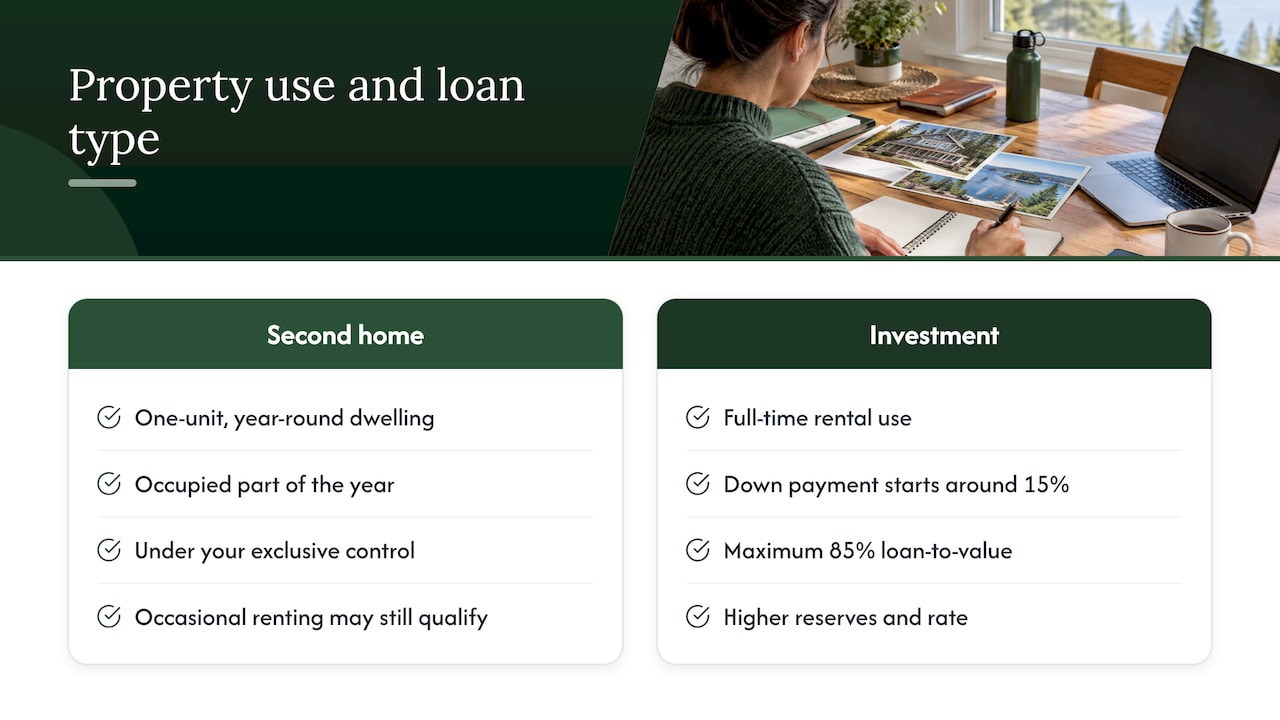
For a second home, Fannie Mae’s occupancy standards say the property must be a one-unit dwelling suitable for year-round occupancy, occupied by you for some part of the year, under your exclusive control, and not subject to an agreement that gives a management company control over occupancy.
An investment property is different. One Maine lender says that for a one-unit investment property, the typical minimum down payment starts around 15%, with a maximum 85% loan-to-value. It also expects higher reserves and a higher rate than a primary home.
If you plan to rent the place full-time, you are in investor territory. If you will use it yourself and rent only occasionally, you may still qualify as a second home, as covered below.
Down payment, reserves and closing costs
Down payment
For a personally used second home, the general program minimum is 10% down on a one-unit purchase. Eligibility still depends on the building, your credit, and your reserves. Lenders also say you should expect 10% down on a conventional loan and 20% on a jumbo.
Here is what that looks like on a few prices:
| Purchase price | 10% down | 20% down |
|---|---|---|
| $300,000 | $30,000 | $60,000 |
| $500,000 | $50,000 | $100,000 |
| $750,000 | $75,000 | $150,000 |
Maine’s coastal markets often push buyers toward the higher rows. Our guide to what a budget buys in each Maine region is a good way to calibrate before you pick a town.
Cash reserves
Fannie Mae generally wants at least two months of housing payments in reserve after closing on a second home loan run through its underwriting system. A $2,500 monthly payment means $5,000 set aside, on top of your down payment. Individual lenders can ask for more, especially on larger loans or thinner credit files.
Closing costs
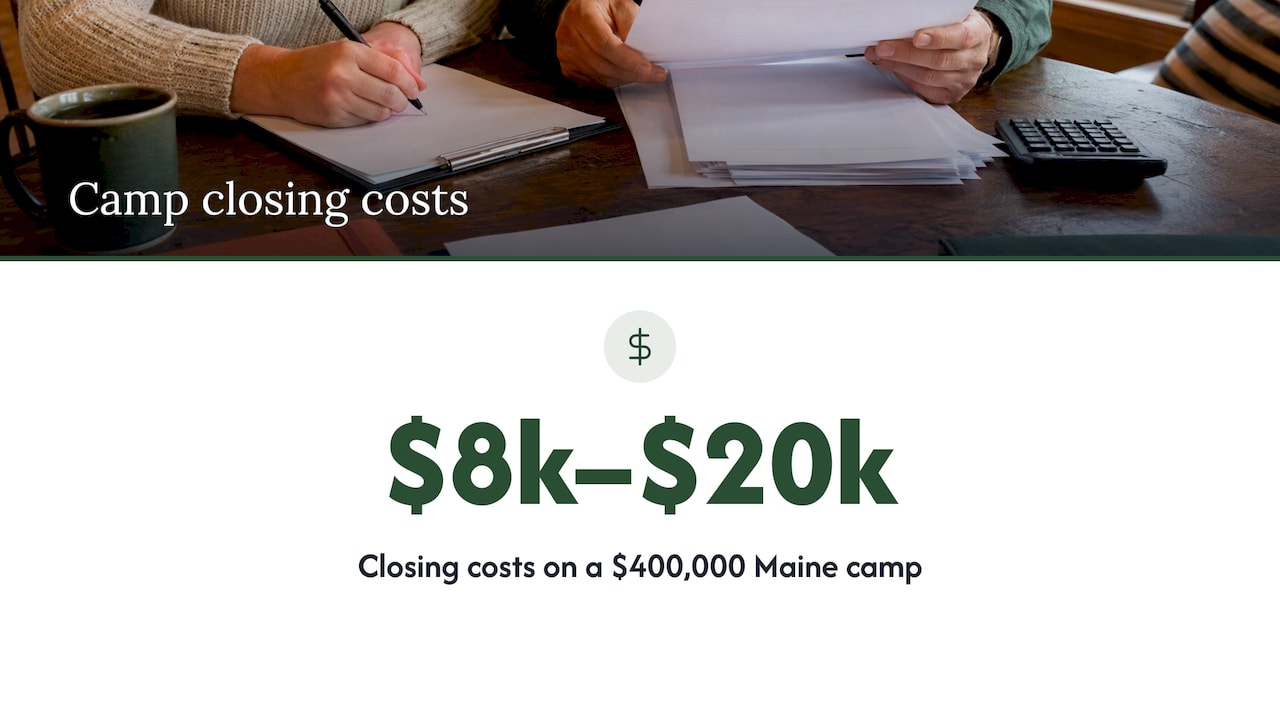
Closing costs on a purchase typically run 2% to 5% of the price. That covers lender fees, settlement and title fees, third-party fees, and taxes and government fees. On a $400,000 camp, that is a range of $8,000 to $20,000.
In Maine, a transfer tax is part of the picture. One Maine real estate law firm’s guide put it at $2.20 per $1,000 of the price, owed by both buyer and seller. That page dates from 2012, so confirm the current rate with your closing attorney. The same guide notes that title insurance is typically required when a lender is involved, with premiums based on the loan or purchase amount.
Rates and qualifying
Lenders see a home you do not live in as riskier. Experian’s Tim Maxwell explains that borrowers are more likely to stop paying on a home they don’t live in when money gets tight. That is why second home rates run about 0.25% to 0.50% higher and down payments are larger.
The gap shows up in the data. Homebuyer.com’s analysis of 2024 federal mortgage data found an average second home rate of 7.001%, against 6.545% for primary residences. The average second home loan was also larger, at $526,949 versus $371,008. Rates move weekly, so treat these as a snapshot of the gap, not a quote.
On qualifying, expect lenders to look harder at three things:
- Credit and debt-to-income. Second homes often come with more favorable credit and debt-to-income standards than a primary residence. Fannie Mae dropped its hard 620 minimum score for loans run through its underwriting system in November 2025, but most lenders still use 620 as a practical floor.
- Two payments. You need to show you can afford two mortgages plus property taxes and homeowner’s insurance.
- Stability. Lenders expect a stable employment history and, for example, investment income you are not already using, to show you can handle the added expense.
When the loan is jumbo
In 2026, any loan above $806,500 is jumbo in every Maine county, because the state has no high-balance conforming counties. Second home jumbos typically need 10% to 20% down, with rates around 0.25% above primary-residence jumbos. This matters on the southern coast, where many cottages and oceanfront homes clear that line.
Renting your Maine vacation home
Many buyers want the home to help pay for itself. The rule is simple to state and easy to trip over. A second home can’t be a rental property, and rent can’t be used to qualify under Fannie Mae’s occupancy rules. Limited rental activity may still be permitted while the home stays classified as a second home, but lender rules are specific, so tell your loan officer your rental plans before you apply.
Three practical points:
- Qualify on your own income. Do not count on rental income to get approved.
- Keep personal use real. The loan assumes you occupy the home for part of the year.
- Skip any arrangement that hands a management company control over when the home is occupied.
If rental income is the point of the purchase, financing it as an investment property is the cleaner path. Local rules matter too. Our write-up on Portland rental rules and due diligence shows how much the town can change the math. If the property comes with tenants, read how deposit liability transfers at closing.
Camps, seasonal roads and private wells
Maine has a property type that national lending guides barely mention: the camp. Financing seasonal or off-grid properties can be especially challenging. National banks and online brokers may not be able to meet the underwriting requirements. Local lenders who know the property type tend to be the better fit.
What to check before you fall in love with a lake camp:
- Year-round use. A camp reached by a seasonal road, or without year-round heat, may not meet the year-round use standard.
- Water and septic. Lenders and appraisers may want information on private wells and septic systems. Ask for the latest tests and service records early.
- Winter access. A place you love in summer may be inaccessible in winter, which limits how much you can use it.
- Condo and townhouse paperwork. If the vacation home is in an association, the documents matter as much as the unit. See what HOA fees in Maine cover and what to check.
Budgeting for the costs after closing
The mortgage is only one line. A second home carries property taxes, insurance, utilities, and upkeep while you are away. Maine’s tax rules, including the homestead exemption, usually apply to a primary residence, so read how Maine property taxes work before you assume your bill.
A home that sits empty for part of the year needs a plan. Security is one piece: if you are weighing cameras, alarms, or a safe, this overview of security systems in Maine covers the options. Plumbing and heating are another, since frozen pipes are a risk for any seasonal property. Setting up plumbing maintenance contracts is one way to keep a closed-up house in order.
A step-by-step path to a Maine second home mortgage
- Set your use plan. Personal use, occasional rental, or full-time rental decides which loan you need.
- Pick a price range from the cash side. Add the down payment, two months of reserves, and 2% to 5% for closing costs.
- Talk to a lender early. Ask how they treat camps, wells, septic, and seasonal roads, and get a pre-approval for a second home specifically.
- Choose the area by access and season. Coastal, lakes, and western mountains each carry different winter realities.
- Shop with a Realtor who knows the town. Pricing, condition, and access details often decide whether a loan closes.
- Review association documents for condos and townhouses before you commit.
Our perspective
Buyers often start with the question of rate. In our experience, the better first question is how the property will be used, because that answer shapes the loan, the down payment, and even which listings are worth a showing.
We have worked the Maine market for 20 years, across central and southern Maine, and we see the same pattern. The buyers who feel good a year after closing are the ones who priced the whole ownership picture before they made an offer: taxes, insurance, upkeep, and the access road in February.
Our approach is transparent and pressure-free. We use data-driven pricing and negotiation, we are available beyond standard hours when a listing moves fast, and we guide buyers through conventional financing questions so they walk into lender conversations prepared. For a vacation property, that means matching you with homes that fit your loan and your plans.
David
Work with a Realtor on your Maine vacation property
We help buyers find, price, and negotiate vacation and seasonal properties across central and southern Maine, and we guide you through the financing questions that shape your search. If you are ready to look at second homes with someone who knows these towns, start on our Buying a Home and Vacation / Seasonal Property page.

If you are a first-time buyer weighing a primary home before a second one, our guide to qualifying as a first-time homebuyer in Maine is a good starting point. More town guides and market notes are in The Maine Real Estate Journal.
FAQ
How much down payment do I need for a second home in Maine?
For a one-unit second home with a conventional loan, the general program minimum is 10% down, which is a 90% loan-to-value. Jumbo loans typically ask for more, in the range of 10% to 20%. Your credit, reserves, and the property itself can push the figure higher.
Can I rent my Maine vacation home and still use a second home mortgage?
Occasional rental may be allowed, but the home must stay a second home you actually use. Under Fannie Mae occupancy rules, rent can’t be used to qualify. If you buy mainly for rental income, expect investment property terms instead.
Are second home mortgage rates higher than primary home rates?
Usually, yes. One large lender gives an example of 0.25% to 0.50% above a primary-home mortgage, varying by lender and situation. Rates change often, so get a current quote from a lender.
Can I finance a camp on a seasonal road?
It can be harder. A camp on a seasonal road or without year-round heat may not meet the year-round use standard. Speak with a lender who handles camps before you make an offer, and ask about well and septic documentation.
What counts as a jumbo loan in Maine?
In 2026, any loan above $806,500 is jumbo in every Maine county. Second home jumbos typically require 10% to 20% down.
Sources
- Second home loans in Maine, from the camp to the coast
- Buying a second home: what to consider
- Mortgage loans for second homes
- How to get vacation home loans in Maine and New Hampshire
- How to buy a second home: mortgage requirements
- How you can prepare for the costs of homeownership
- Real estate transactions in Maine
- Compare current second home mortgage rates
- Mortgage market statistics
- Can you get a conventional loan with 10% down?
- Purchasing a vacation or second home
- Plan for a camp or vacation home purchase
- Maine jumbo loans 2026
- Security systems in Maine